
Southern Cross Acquisition I Corp. (NCO): Navigating Liquidity Constraints Amid Limited Transparency
Southern Cross Acquisition I Corp., a smaller reporting company with scant public operational details, faces significant liquidity challenges and net losses as of mid-2026. Without clear insights into its business model or strategic direction, the company’s path hinges on its ability to manage short-term obligations and secure capital support amidst opaque fundamentals.
Southern Cross Acquisition I Corp. reports constrained liquidity and ongoing net losses with minimal public disclosure on its business model or sector. The company’s financial snapshot reveals a stressed balance sheet, raising questions about operational viability. Its future depends critically on managing liquidity risks and clarifying its strategic footing, though current transparency limitations obscure the outlook.
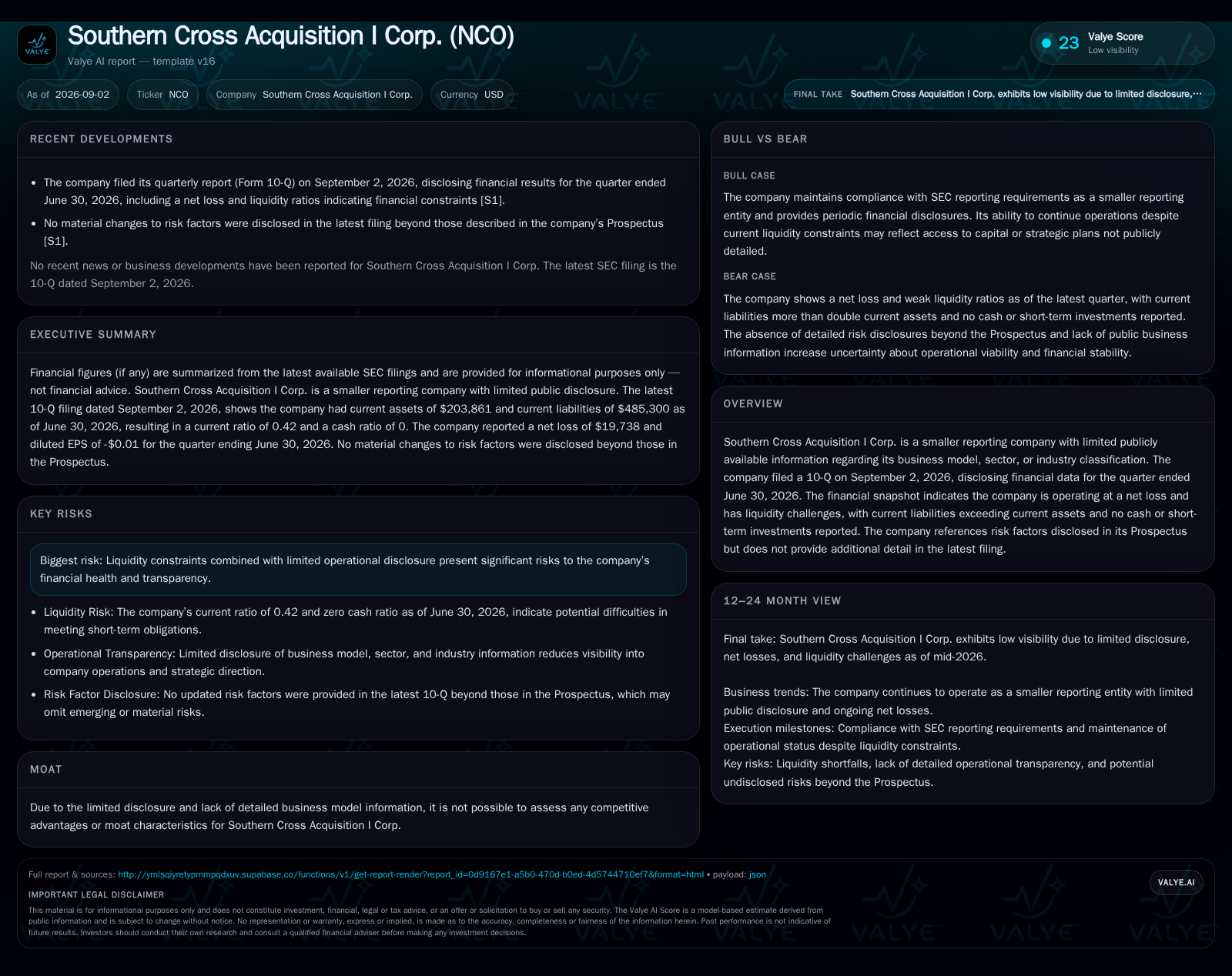
Southern Cross Acquisition I Corp. presents an opaque profile as a smaller reporting company with limited publicly available operational details. Its latest quarter reveals a financially strained position, with current liabilities exceeding current assets by more than twofold and no liquid cash reserves, underscoring liquidity pressures. Despite these financial headwinds, the company remains compliant with SEC reporting obligations but offers no new business insights or risk factor updates. This combination of constrained liquidity and limited transparency raises critical questions about the company’s capacity to sustain operations and the intrinsic fundamentals underlying its reported losses.
Latest Operating Snapshot
Southern Cross Acquisition I Corp. filed its most recent 10-Q on September 2, 2026, disclosing financial results for the quarter ended June 30, 2026. The filing reports current assets of $203,861 against current liabilities of $485,300, yielding a current ratio of 0.42 and a cash ratio of zero, indicating insufficient liquid assets to cover short-term obligations [S1]. This highlights acute liquidity constraints that may impair operational flexibility.
The company posted a net loss of $19,738 for the quarter with diluted earnings per share of -$0.01, signaling ongoing operational losses without any disclosed revenue or business segment details [S1]. No new risk factors were introduced beyond those in the company’s Prospectus, leaving investors with limited updated insights into emerging challenges or strategic shifts [S1]. The absence of detailed disclosures constrains meaningful evaluation of the company’s business dynamics.
Business Model and Unit Economics
Southern Cross Acquisition I Corp. provides minimal public information regarding its core business model, sector, or revenue streams, complicating direct analysis of how it generates or intends to generate economic value. Typically, smaller reporting companies may be vehicles for special purpose acquisitions or early-stage ventures, potentially incurring significant costs ahead of revenue realization. Without disclosed customer segments, pricing strategies, or product mix, the company’s unit economics remain entirely opaque.
Given the reported loss and liquidity profile, it is plausible the company faces a high fixed-cost base or is investing in an early development phase with negative operating leverage. The lack of cash reserves combined with a current ratio below 1 suggests capital intensity or working capital needs exceed immediate funding, necessitating external financing or operational restructuring. Operating leverage could emerge if fixed costs stabilize and revenue generation materializes, but absent clarity on capital deployment or revenue visibility, this remains speculative.
Moat, Competition and Counterforces
Southern Cross Acquisition I Corp.’s limited disclosures preclude identification of any sustainable competitive advantages or moat characteristics. Without clarity on its industry, products, or services, assessing differentiation strategies such as proprietary technology, network effects, regulatory barriers, or brand strength is not feasible. This opacity weakens investor confidence, as competitive positioning critically influences long-term value creation and resilience against rivals.
Potential counterforces include the company’s liquidity constraints which may limit investment in innovation or market expansion, and the absence of disclosed customer commitments or recurring revenue streams, reducing switching cost leverage. If the company is an acquisition vehicle or early-stage holding entity, competition may come from alternative capital providers or operators with clearer strategic focus and funding, intensifying pressure on operational viability.
Bull Case
In a favorable scenario, Southern Cross Acquisition I Corp. leverages its compliance with SEC reporting and small reporting status to secure additional capital through private placements or strategic partnerships, resolving liquidity issues. Access to capital could enable ramp-up of operations, realization of a nascent business plan, or execution of an acquisition strategy that unlocks value. Confirmation would come from filings indicating capital infusion, improved liquidity ratios, or disclosure of strategic initiatives.
Validating this scenario requires evidence of emerging revenue streams, cost structure improvements, or strategic transaction announcements. A falsification test would be continued liquidity depletion without capital raises, escalating losses, or regulatory non-compliance, all signaling failure to transition from a distressed or pre-operational state.
Base Case
The base case envisions Southern Cross Acquisition I Corp. maintaining minimal operational activity with ongoing losses and liquidity pressure but avoiding immediate insolvency through intermittent capital injections or deferral of liabilities. The company remains compliant with reporting requirements but refrains from substantive business disclosures, reflecting either a holding pattern or early-stage status with uncertain growth prospects.
Confirmation of this scenario involves stable but constrained liquidity metrics, modest net losses, and absence of material business updates in successive SEC filings. This steady state implies limited downside acceleration but also negligible near-term value creation absent strategic developments. Failure of the base case would be signaled by either a turnaround in financial health or deterioration into insolvency risks.
Bear Case
Under adverse conditions, Southern Cross Acquisition I Corp. fails to secure additional funding or generate cash flow, exacerbating liquidity shortfalls and forcing operational curtailments or insolvency proceedings. The current ratio well below 1 and zero cash reserves point to imminent risk in meeting obligations, especially if liabilities are pressing. The lack of transparency may mask deteriorating fundamentals or undisclosed contingencies that accelerate distress.
Evidence for this scenario includes further deterioration in liquidity ratios, increased net losses, missed filings, or disclosure of material adverse events. Falsification would require capital raises, improved cash positions, or operational milestones indicating recovery potential. Absent such developments, the bear case reflects a plausible path given current financial stress and informational opacity.
What Matters Next
Key metrics to monitor include liquidity indicators such as current ratio and cash ratio in subsequent filings, as these reflect the company’s ability to meet short-term obligations. Tracking net income or loss progression will reveal whether operational performance improves or worsens. Additionally, disclosures of capital raising events, debt refinancing, or strategic transactions would signal shifts in financial resilience or business direction.
Other important milestones are any updates to risk factors or business model disclosures that enhance transparency. Given the current opacity, announcements regarding sector focus, customer acquisition, or revenue recognition would materially affect assessment of unit economics and competitive positioning. Lastly, timely and compliant SEC filings remain a basic but critical signpost of operational viability.
Disclaimer: This is research-only, informational analysis and not investment advice. It may include AI-generated interpretation and general industry context. Always verify important details using primary sources.

Comments