
American Outdoor Brands Navigates Innovation-Driven Growth Amid Profitability Pressures
With deep product innovation and a diversified brand architecture, American Outdoor Brands leverages secular outdoor participation trends, yet faces key profitability and market sensitivity challenges that will shape its medium-term trajectory.
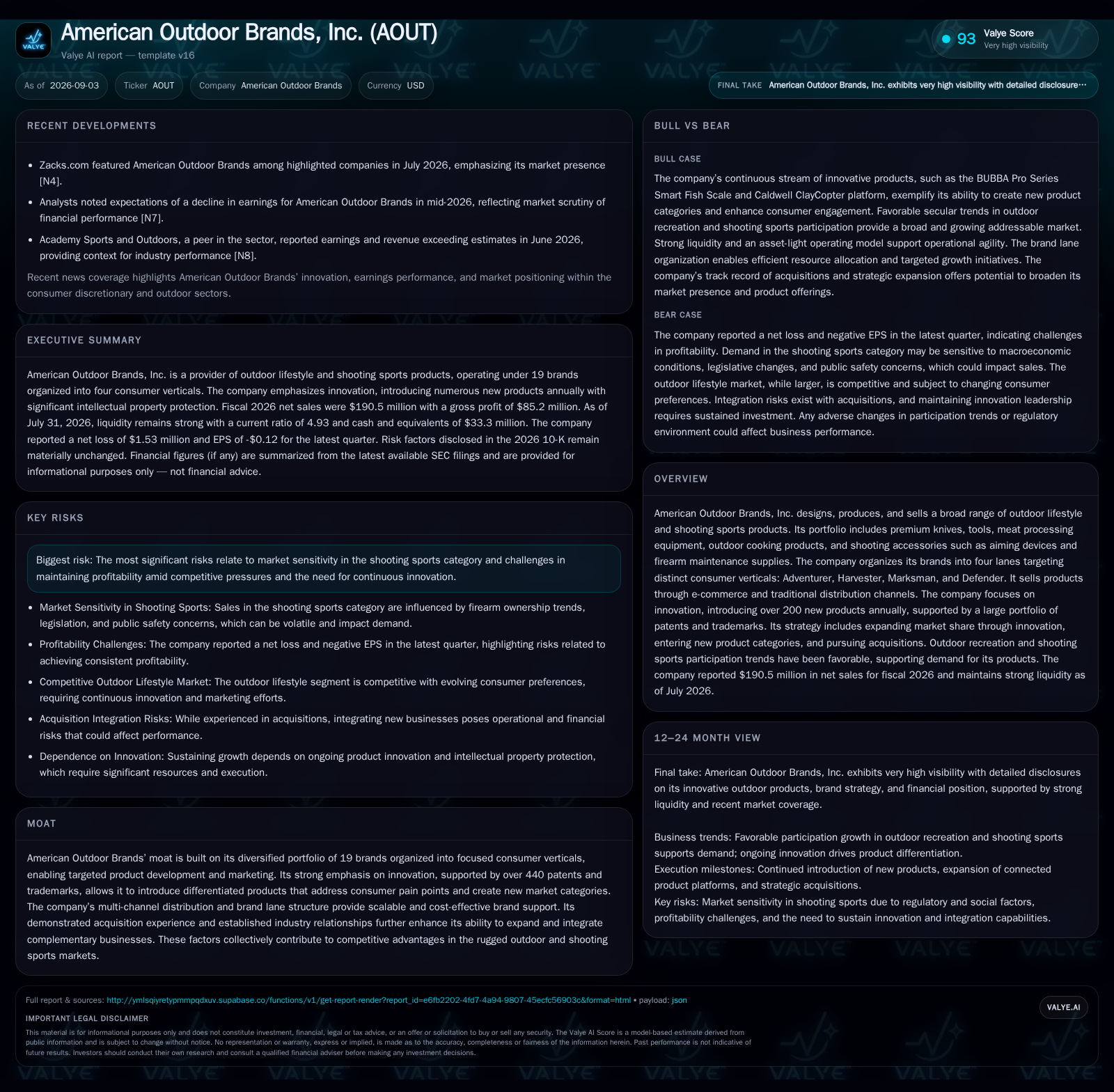
American Outdoor Brands combines a broad portfolio of rugged outdoor and shooting sports products with a steady cadence of innovation, driving strong product differentiation and healthy top-line growth. Despite reported liquidity position and strategic brand segmentation, recent quarterly losses reflect ongoing challenges in converting innovation and participation tailwinds into consistent profitability. The company’s future depends on its ability to sustain innovation leadership, navigate competitive pressures, and manage shooting sports market volatility.
American Outdoor Brands, Inc. stands at a strategic inflection point. It has established itself as an innovator in the outdoor lifestyle and shooting sports markets, leveraging a broad portfolio of 19 brands organized into four consumer-focused lanes. With over 200 new products annually and a substantial intellectual property base, the company has captured growth fueled by a surge in outdoor recreation and shooting participation. However, recent quarterly losses and the inherent volatility in shooting sports demand caution. The key question is whether American Outdoor Brands can translate its innovation and market momentum into sustainable profitability while managing competitive and regulatory risks.
Innovation Fuels Growth Amid Recent Profitability Challenges
American Outdoor Brands reported net sales of $190.5 million for fiscal 2026 with gross profit of $85.2 million, driven significantly by products introduced since fiscal 2020, which represent over 50% of sales and have grown at a 34% CAGR [S1]. This underscores the company’s reliance on continuous product innovation as a growth engine. Its portfolio spans 19 brands organized into four vertical lanes—Adventurer, Harvester, Marksman, and Defender—allowing targeted strategies for distinct consumer groups [S1].
Despite strong sales and innovation, the company reported a net loss of $1.53 million and negative EPS of -$0.12 in the quarter ended July 31, 2026 [S2]. Liquidity remains robust with $33.3 million in cash and equivalents and a current ratio near 5 [S2]. Favorable macro trends include a record 181.1 million U.S. participants in outdoor recreation and a 63.5 million adult shooting sports population, providing a broad addressable market [S1]. However, recent analyst commentary notes earnings pressure, reflecting operational challenges [N7].
Innovation-Driven Revenue Mix with Operating Leverage Constraints
American Outdoor Brands’ revenue model centers on designing, producing, or sourcing differentiated outdoor and shooting products, many protected by intellectual property—including over 440 patents and trademarks [S1]. Pricing power likely stems from product differentiation and brand segmentation, although the company’s diverse product mix across premium and mass-market verticals suggests a need to balance volume with premium pricing. Approximately 54% of fiscal 2026 sales derived from IP-protected products, indicating meaningful pricing differentiation potential [S1].
Fixed costs include R&D investments supporting new product introductions—over 200 annually—and multi-channel sales infrastructure including dedicated regional sales teams [S1]. Capital intensity appears moderate given a mix of in-house production and sourcing. Operating leverage could emerge if innovation drives higher premium product penetration and scale in distribution channels. However, recent net losses indicate fixed costs and competitive pressures currently offset volume gains, limiting margin expansion. Seasonal and category mix shifts, especially in shooting sports with regulatory sensitivity, could disrupt operating cadence.
Diversified Brands and Patents Support Differentiation but Face Market Volatility
American Outdoor Brands’ competitive moat rests on its 19-brand portfolio aligned into four vertical lanes, enabling focused product development and marketing tailored to consumer subsegments such as hunting (Harvester) and defense (Defender) [S1]. This segmentation facilitates efficient resource allocation and potentially higher customer loyalty through specialized offerings. Its large IP portfolio supports product differentiation and creates switching frictions by embedding technology into the user experience, e.g., Caldwell ClayCopter’s connected target shooting system [S1].
Nonetheless, the company operates in a highly competitive outdoor lifestyle market where consumer preferences evolve rapidly. Shooting sports products face additional volatility from regulatory changes and shifting public sentiment on firearms, which can dampen demand abruptly. Competitors include both general outdoor retailers and specialized shooting sports companies. The ability to integrate acquisitions effectively and maintain innovation leadership will be critical to sustaining advantage. Competitor peers like Academy Sports and Outdoors highlight the importance of scale and operational execution in this sector [N8].
Sustained Innovation Leadership Drives Market Share and Profit Expansion
In a favorable scenario, American Outdoor Brands successfully leverages its innovation pipeline to create new product categories and deepen consumer engagement, exemplified by connected products like the BUBBA Pro Series Smart Fish Scale and Caldwell ClayCopter platform [S1]. If new introductions continue to represent a growing share of sales and achieve premium pricing, the company could expand gross margins and operating leverage. Increasing participation in outdoor recreation and shooting sports would expand the addressable market, enabling volume growth across all brand lanes.
Confirmation of this scenario would come from sustained double-digit growth in new product revenues, margin improvement driven by a higher mix of IP-protected products, successful integration of accretive acquisitions, and stable or improving profitability metrics. Conversely, failure to maintain innovation cadence, erosion of pricing power, or shrinking shooting sports participation would undermine this upside case.
Moderate Revenue Growth Offset by Market and Competitive Dynamics
The most plausible path sees American Outdoor Brands maintaining moderate revenue growth fueled by ongoing product introductions and stable participation trends in outdoor recreation, but facing margin pressure from competitive pricing and fixed cost absorption challenges. Innovation continues to be a key differentiator, but incremental gains are offset by volatility in the shooting sports category due to regulatory scrutiny and shifting consumer sentiment [S1][S2].
Profitability remains subdued near breakeven as the company invests in R&D and sales expansion to defend market share while absorbing acquisition integration costs. Liquidity cushions operational flexibility, but margin expansion is gradual. Key validation would be consistent product innovation delivering steady sales growth, stable participation rates, and modest improvement in operating margins. Deterioration in any of these areas or increased competitive discounting would falsify this scenario.
Regulatory Headwinds and Profitability Struggles Undermine Growth
The downside risk centers on adverse legislative or social shifts constraining shooting sports participation, which accounts for a meaningful portion of American Outdoor Brands’ revenue [S1]. Heightened regulatory scrutiny or declining consumer interest could depress demand for shooting accessories and related products, exacerbating the company’s existing profitability challenges. Competitive pressures in the outdoor lifestyle segment could intensify, forcing price reductions and margin compression.
Confirmation of this downside would include sustained declines in shooting sports sales, worsening net losses, failure to launch successful new products, or impaired liquidity. Conversely, resilience in participation rates or successful diversification beyond shooting products would mitigate this risk.
Monitoring Innovation Impact and Market Sensitivities to Inform Future Trajectory
Investors should monitor the proportion of sales from products introduced in the last three to five years, as this reflects the effectiveness and market acceptance of the innovation pipeline. Incremental gross margin trends and operating margin progression will indicate whether scale and premium pricing are being realized. Tracking quarterly net income and EPS trends is critical given recent losses.
Participation data in outdoor recreation and shooting sports—though external—are vital leading indicators of addressable market size. Regulatory developments affecting shooting sports, such as firearm legislation or public safety policies, represent exogenous risks to demand. Additionally, the pace and success of acquisitions, integration outcomes, and the company’s ability to maintain R&D intensity relative to sales are useful operational metrics. Finally, evolving product mix shifts, especially toward connected or tech-enabled offerings, will signal strategic execution.
Disclaimer: This is research-only, informational analysis and not investment advice. It may include AI-generated interpretation and general industry context. Always verify important details using primary sources.

Comments