
ProtoKinetix Faces Viability Challenges Amid Liquidity Strains and Lack of Revenue
ProtoKinetix, Inc. faces critical liquidity shortages and a prolonged absence of revenue, underscoring deep operational risks. Without clear business model clarity or strategic milestones, its path to sustainable commercialization remains highly uncertain.
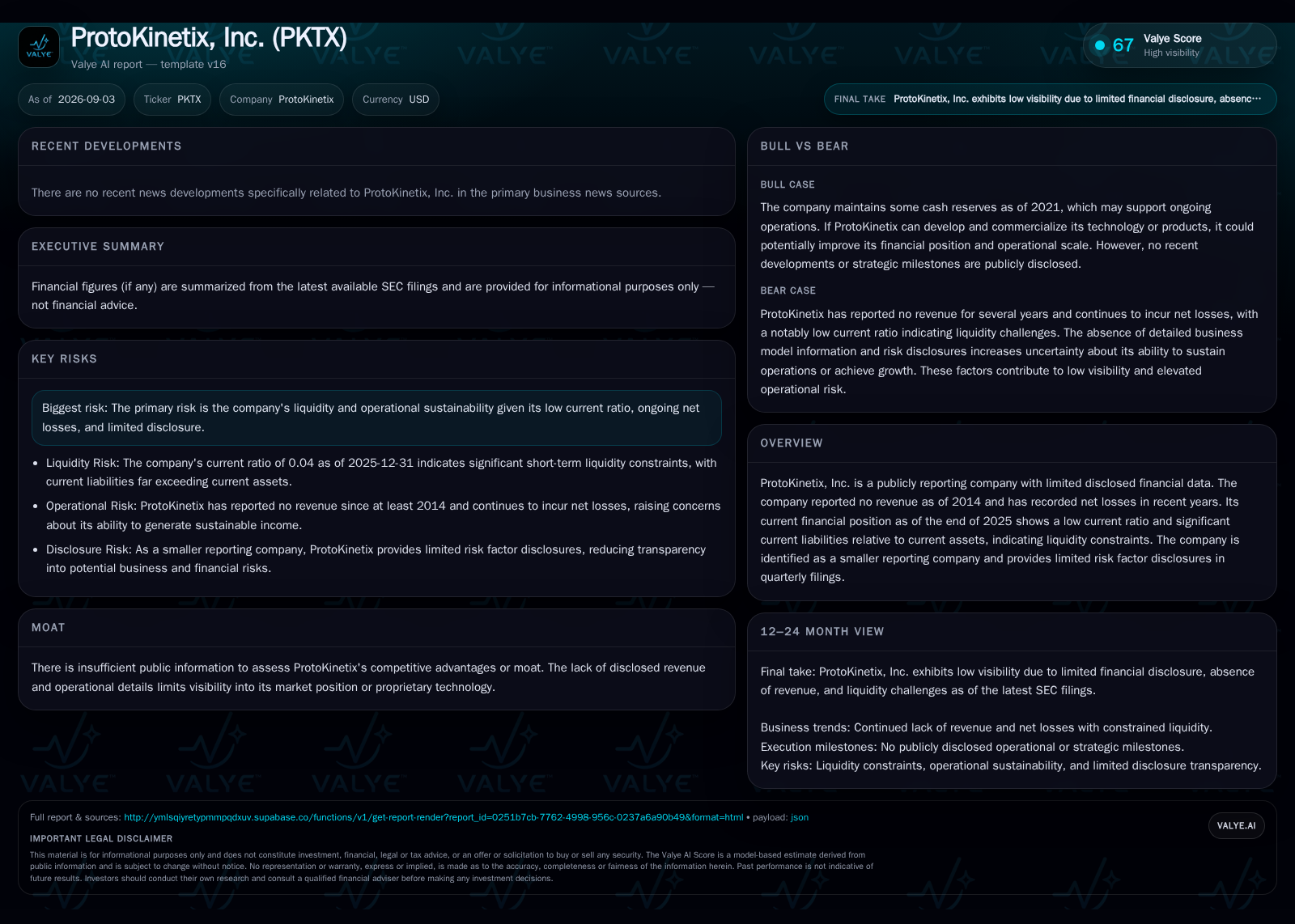
ProtoKinetix has no reported revenue since at least 2014 and continues to incur losses with a perilously low current ratio, signaling acute liquidity challenges. Its limited financial disclosures and lack of visible operational progress compound uncertainty about its ability to achieve commercial scale. The company’s financial and operational outlook hinges on whether it can translate any proprietary technology into marketable products, but absent transparency or recent developments, investors face elevated risk and low visibility.
ProtoKinetix, Inc. exemplifies a company struggling to transition from a development-stage entity into a commercial enterprise. Despite being publicly reporting, it has recorded no revenues since at least 2014 and continues to incur net losses, culminating in a troublingly low current ratio of 0.04 at the end of 2025. Its scarce liquidity and limited financial transparency raise profound questions about its operational sustainability. Without disclosed business model details or visible progress milestones, assessing its potential trajectory is challenging, exposing investors to significant uncertainty over its ability to achieve meaningful market presence or financial stability.
ProtoKinetix’s Financial Position Highlights Acute Liquidity and Revenue Gaps
ProtoKinetix reported zero revenue as of its fiscal year ended December 31, 2014, and this revenue absence has persisted through the latest available fiscal year, 2025 [S1]. The company recorded a net loss of $393,650 for 2025, with earnings per share reported as zero, underscoring its lack of profitability [S1].
Liquidity constraints are pronounced, reflected in a current ratio of 0.04 at the end of 2025—current liabilities of $185,434 vastly outstrip current assets of just $6,740 [S1]. While cash and equivalents were $57,568 at the end of 2021, the cash ratio had diminished by 2025, further signaling tight cash resources [S1]. The company’s classification as a smaller reporting entity means it provides limited risk disclosures, restricting insight into operational risks or strategic initiatives [S2].
ProtoKinetix’s Economic Model Remains Obscure Amid Development-Stage Financials
With no reported revenues since at least 2014, ProtoKinetix appears to remain a development-stage enterprise without a monetized product or service. This absence of revenue precludes analysis of pricing, volume, or product mix dynamics. The company likely incurs mostly fixed costs related to R&D and administrative functions, creating operating leverage risks if revenue fails to materialize.
Capital needs appear significant relative to its cash reserves and current liabilities, indicating ongoing cash burn. Without clear commercial outputs, the company’s path to scaling operations and achieving operating leverage is uncertain. The low current ratio and minimal liquid assets suggest limited runway absent new financing or a strategic inflection. The business model economics will depend heavily on successful R&D outcomes and subsequent commercialization, neither of which are evident from public disclosures.
Analyzing ProtoKinetix's financial model through the lens of unit economics reveals critical dependencies that currently remain opaque. The absence of revenue means there is no data on customer acquisition costs, lifetime value, or contribution margins, which are essential to assessing scalability and profitability. If the company’s fixed costs are high due to R&D intensity, the burden on future revenue to cover these costs and generate net profits becomes substantial. This creates a high operating leverage scenario where small revenue shortfalls could lead to disproportionate losses. Investors should scrutinize whether the company has a path to reduce fixed costs or convert R&D investments into recurring revenue streams to improve unit economics.
Opaque Competitive Position Amplifies Uncertainty About ProtoKinetix’s Market Potential
There is insufficient public information to assess ProtoKinetix’s competitive advantages, proprietary technologies, or barriers to entry. The lack of disclosed revenue and operational progress limits visibility into its market positioning or whether it has developed differentiated products that could command pricing power or customer loyalty.
Given the absence of strategic milestones or partnerships, it is unclear what competitor categories or peers are relevant. If the company operates in a highly competitive technology or biotech niche, the absence of revenue and ongoing losses raise risks that it may fail to establish defensible market share or a sustainable moat. Without transparency on its value proposition, customer traction, or product pipeline, the competitive landscape remains speculative.
From a competitive moat perspective, the lack of disclosed proprietary technology or intellectual property rights limits the company’s ability to establish barriers against competitors. In technology-driven sectors, sustainable moats often derive from patents, trade secrets, or network effects. Without clarity on these elements, ProtoKinetix risks commoditization or rapid obsolescence if competitors develop superior or more cost-effective solutions. Additionally, the absence of strategic partnerships or customer endorsements suggests limited market validation, which could hinder scaling efforts. Investors should watch for evidence of defensible technology or exclusive agreements that could underpin long-term competitive advantage.
Successful Commercialization of Proprietary Technology Could Reshape ProtoKinetix’s Outlook
A positive scenario would see ProtoKinetix leverage its R&D efforts into a commercially viable product or platform, generating initial revenues that could accelerate growth and improve liquidity. Confirming evidence would include announcements of product launches, customer contracts, or partnerships signaling market acceptance and revenue traction. Such developments would enable operational scaling and potential operating leverage as fixed costs are spread over increasing revenue.
Falsification of this optimistic scenario would occur if the company continues to report no revenue and fails to disclose meaningful operational updates, indicating persistent development hurdles or market irrelevance. Financial indicators such as worsening liquidity or increased net losses without offsetting progress would further contradict the emergence of a viable commercial model.
Ongoing Development-Stage Status with Continued Losses and Liquidity Pressures
The most plausible base scenario is that ProtoKinetix remains in a prolonged pre-commercial phase, incurring ongoing net losses and failing to generate revenue in the near term. The company’s fragile liquidity, reflected in a current ratio near zero, constrains its ability to fund operations without external capital or strategic transactions. This scenario suggests limited operational scale and absence of operating leverage.
Confirmation of this middling outlook would be continued absence of revenue and no disclosed material strategic milestones or partnerships. However, falsification could arise if the company accesses new financing, restructures liabilities, or announces credible development progress that could extend its runway or improve commercial prospects.
In an upside scenario, the timing and magnitude of commercialization milestones critically influence ProtoKinetix’s valuation trajectory. Early revenue inflection points could signal de-risking of the business model, attracting additional capital and enabling operational leverage. However, the pathway from R&D to market acceptance often involves regulatory hurdles, clinical validation, or customer adoption cycles that can delay revenue realization. Investors should therefore assess the plausibility of the company's timelines and the robustness of its go-to-market strategy. Failure to meet expected milestones could trigger valuation resets and capital access challenges, underscoring the importance of milestone-based monitoring.
Liquidity Crisis and Operational Failure Could Lead to Insolvency or Delisting
ProtoKinetix’s extremely low current ratio and ongoing losses expose it to the risk of insolvency or forced restructuring. Without new capital injections or a swift commercial breakthrough, the company may be unable to meet short-term obligations, leading to bankruptcy risks or stock delisting. The limited disclosure practices further increase uncertainty and investor risk.
Evidence confirming this downside would be missed debt payments, public warnings from auditors or regulators, or announcements of operational shutdowns. Conversely, if the company secures financing or reports operational improvements, this would mitigate the downside risk and contradict an imminent liquidity collapse.
Key Factors to Assess ProtoKinetix’s Progress Toward Commercial Viability
Key metrics to monitor include the company’s quarterly revenue disclosures, which currently stand at zero but would signal progress if initiated. Tracking cash burn rate and changes in cash balances would indicate financial runway and liquidity dynamics. Monitoring updates on product development milestones, regulatory approvals, or partnering announcements could provide insight into commercial advancement.
Additional useful data points are operating expense trends to assess cost control, any changes in current liabilities indicating refinancing or repayment activity, and disclosures about capital raises or debt issuance. Because the company offers limited risk factor detail, any expansion in disclosure scope or detail would improve transparency and reduce information asymmetry.
Monitoring ProtoKinetix’s evolving capital structure and liquidity metrics is essential to anticipate potential distress or recovery. Changes in debt covenants, refinancing terms, or equity dilution can materially affect shareholder value and operational flexibility. Furthermore, shifts in operating expense allocation—particularly R&D versus general and administrative spending—may indicate strategic prioritization or cost containment efforts. Investors should also consider external factors such as market conditions for biotech or technology startups, which influence capital availability. Enhanced disclosure on these financial and strategic dimensions would reduce information asymmetry and better inform investment decisions.
Disclaimer: This is research-only, informational analysis and not investment advice. It may include AI-generated interpretation and general industry context. Always verify important details using primary sources.

Comments