
Kohl’s Navigates Retail Headwinds with Margin Discipline and Digital Growth
Despite ongoing sales pressure, Kohl’s leverages inventory management, merchandise mix, and a growing digital channel to stabilize margins and generate cash flow, while strategic capital allocation and operational focus provide a foundation for navigating competitive and macroeconomic challenges.
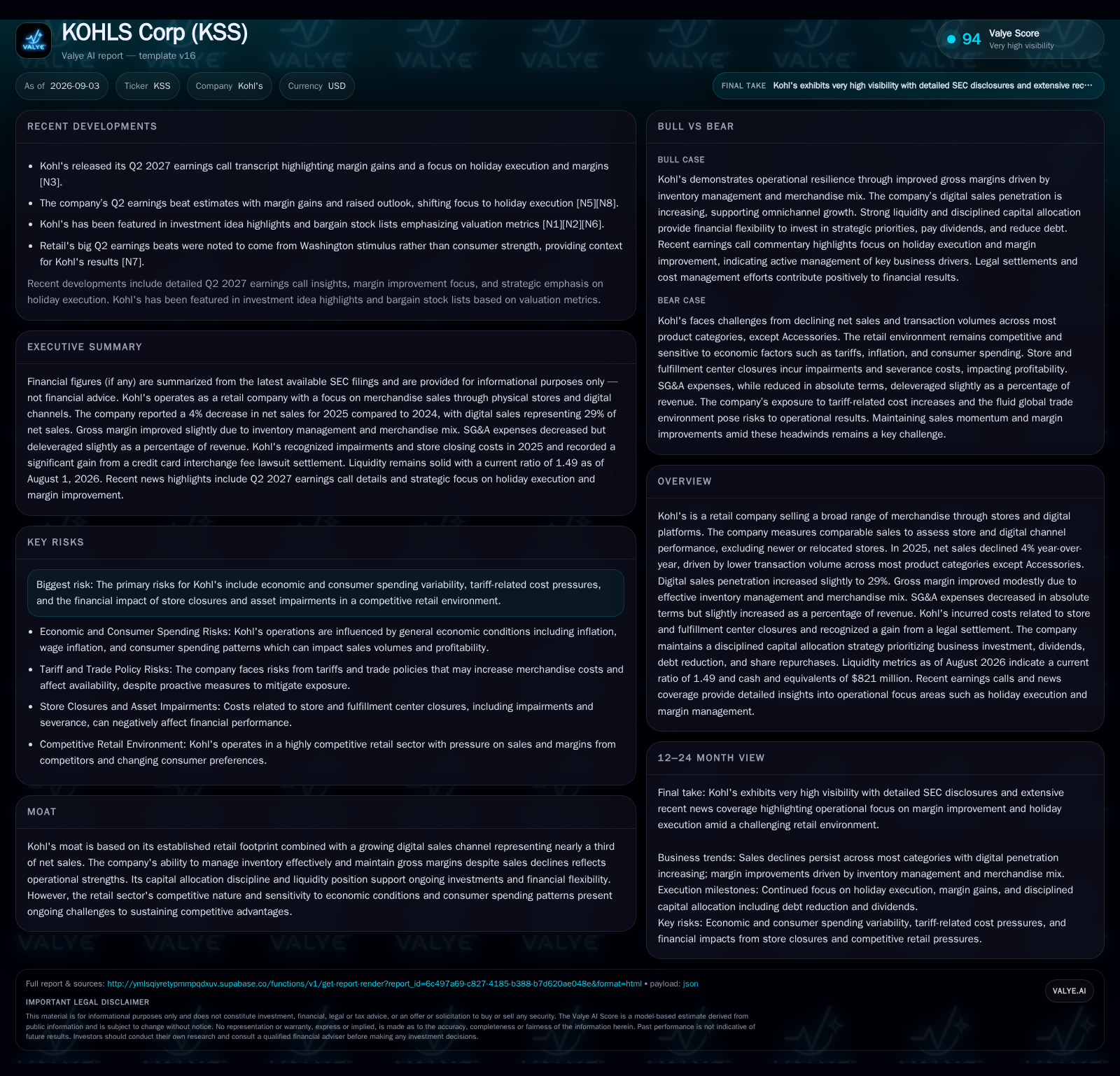
Kohl’s reported a 4% sales decline in 2025 driven by lower transaction volume across most categories except accessories, yet improved gross margins through better inventory and merchandise mix. Digital sales penetration rose modestly to 29%, supporting omnichannel momentum. Operational efficiencies and a legal settlement bolstered cash flow, enabling disciplined capital deployment including debt reduction and dividends. The company faces risks from competitive pressures, tariff exposure, and store closure costs but recent earnings commentary highlights margin improvements and holiday execution focus. Key uncertainties include sustaining sales momentum and managing cost pressures amid a challenging retail environment.
Kohl’s Corp continues to operate in a challenging retail environment characterized by declining transaction volumes and intense competition. In 2025, the company’s net sales decreased by 4%, impacted broadly across categories except for a small rise in accessories. However, Kohl’s demonstrated operational resilience by modestly expanding gross margins through disciplined inventory management and an improved merchandise mix. Digital sales, now accounting for nearly a third of net sales, provide a growing channel that supports the broader omnichannel strategy. Coupled with solid cash flow generation and a $129 million settlement gain, Kohl’s maintains potential financial flexibility to prioritize investments, dividends, debt repayment, and share buybacks. The key question remains whether Kohl’s can sustain margin improvements and stabilize sales as it navigates tariff exposures, store closures, and evolving consumer preferences amid a competitive retail landscape.
Sales Decline and Margin Improvement Mark Kohl’s Latest Financials
Kohl’s reported a 4% decline in net sales for 2025, driven by a corresponding 4% decrease in transaction volume across most merchandise categories except for accessories, which grew approximately 2% [S2]. Digital sales penetration increased slightly from 28% to 29%, reflecting a modest shift toward online channels. Gross margin expanded by 34 basis points to 37.5% of net sales, primarily due to effective inventory management and a favorable merchandise mix [S2].
Operating expenses decreased by 4.1% to $5.1 billion, but SG&A expenses deleveraged modestly relative to revenue, indicating limited operating leverage in the face of sales pressure. Costs related to store and fulfillment center closures, including impairments and severance, amounted to $15 million, impacting profitability. Additionally, Kohl’s recognized a $129 million gain from a credit card interchange fee lawsuit settlement, which bolstered reported net income [S2]. These factors combine to portray a company managing near-term profitability challenges while leveraging operational improvements and one-time gains.
Margin Resilience Hinges on Inventory and Merchandise Mix Amid Volume Headwinds
Kohl’s business model centers on generating revenue through merchandise sales in physical stores and digital platforms, with omnichannel integration becoming increasingly important. Pricing power is limited in a competitive retail environment; therefore, volume and merchandise mix are primary drivers of revenue. The 4% decrease in transaction volume highlights vulnerability to consumer spending shifts. However, a slight improvement in gross margin suggests Kohl’s can partially offset volume declines through better inventory management and product assortment, which can increase unit margins.
The company’s cost structure features moderate fixed costs related to store operations and fulfillment centers, with variable costs aligned to sales volume. The 4.1% absolute decline in SG&A expenses indicates some expense control, but the slight deleveraging as a percentage of revenue suggests fixed costs limit operating leverage when sales fall. Capital expenditures and investments are likely focused on digital capabilities and store optimization, which require steady outlays but could improve long-term efficiency. Operating cash flow doubled year-over-year to $1.38 billion, driven by higher net income and inventory reductions, indicating effective working capital management that supports liquidity and flexible capital deployment [S2].
Omnichannel Presence and Inventory Control Support Kohl’s Amid Retail Pressures
Kohl’s competitive position relies on a broad physical store footprint complemented by a growing digital sales channel now accounting for nearly 30% of net sales. This omnichannel approach provides customer convenience and diversified revenue streams, which can serve as a partial moat against pure-play e-commerce competitors and traditional brick-and-mortar retailers. Effective inventory management underpins margin expansion despite declining sales, highlighting operational competencies that competitors may find difficult to replicate quickly.
Nevertheless, the retail sector remains intensely competitive, with peers ranging from discount chains to specialty retailers and online platforms. Consumer preferences continue evolving rapidly, and pricing pressures remain intense. Store and fulfillment center closures with associated impairments reflect structural challenges in the physical footprint, potentially weakening the scale advantage. Tariff exposure on merchandise costs adds another layer of risk given the fluid global trade environment. Maintaining differentiation through merchandise mix, customer experience, and cost control will be critical to sustaining Kohl’s competitive position.
Margin Expansion and Digital Growth Drive Kohl’s Return to Sales Growth
In a favorable scenario, Kohl’s leverages its inventory management expertise and merchandise mix optimization to expand gross margins further, offsetting continued pressure on transaction volumes. Digital sales penetration accelerates beyond 30%, supported by investments in e-commerce infrastructure and omnichannel shopping experiences, attracting new customers and increasing wallet share among existing shoppers. Enhanced operational efficiencies and cost discipline improve SG&A leverage, converting incremental sales into outsized earnings growth.
Confirmation of this scenario would include sustained sequential improvement in comparable sales, particularly in digital and accessories categories, plus margin expansion exceeding current trends. Further reductions in store and fulfillment center costs without impairing service levels would also support improved profitability. Falsification would occur if digital sales plateau or decline, margins compress due to rising costs or inventory issues, or if sales declines deepen across key product categories despite promotional support.
Modest Sales Stabilization with Incremental Margin Gains Amid Retail Headwinds
The most plausible scenario sees Kohl’s maintaining its current trajectory of modest sales declines or stabilization, with digital sales growth partially offsetting weakness in physical store volumes. Gross margins improve incrementally through continued inventory control and merchandise mix shifts but face limits from competitive pricing and cost pressures. SG&A expenses remain relatively stable in absolute terms, with some deleveraging as revenue growth remains subdued. Store and fulfillment center closures continue to weigh on earnings but are managed prudently to balance cost savings against customer experience.
Evidence supporting this path includes flat to slightly negative comparable sales in upcoming quarters, stable or slightly improved gross margins, and consistent cash flow generation enabling ongoing capital allocation to dividends, debt reduction, and selective share repurchases. Deviation from this scenario would be signaled by sharper sales declines or margin compression due to cost inflation or execution issues, or alternatively by a more pronounced rebound in consumer spending driving stronger top-line growth.
Accelerating Sales Declines and Cost Pressures Erode Kohl’s Profitability
In a downside scenario, Kohl’s encounters accelerating declines in transaction volume across most categories, including accessories, driven by intensifying competition, weaker consumer spending, and ineffective promotional strategies. Digital sales growth stalls or reverses as competitors capture online market share. Increasing tariff-related merchandise costs and wage inflation squeeze gross margins, while store and fulfillment center closure costs rise due to operational disruptions or suboptimal execution.
SG&A expenses remain sticky or increase as the company invests to defend market share, causing deleveraging on a revenue base that continues to contract. These pressures culminate in margin compression and weaker earnings, undermining cash flow generation and constraining capital allocation flexibility. Confirmation would be visible in deteriorating comparable sales metrics, margin declines, and negative cash flow trends despite cost-cutting efforts. Falsification would occur if sales stabilize or margins improve despite these headwinds.
Monitoring Sales Mix, Digital Penetration, and Cost Efficiency to Gauge Outlook
Key performance indicators to watch include comparable sales growth, both overall and segmented by digital versus physical channels, to assess momentum and omnichannel integration success. Tracking transaction volume changes and product category performance (especially accessories) will illuminate demand dynamics. Gross margin trends and inventory turnover ratios will provide insight into merchandise mix optimization and inventory management efficacy.
Operating expense ratios, particularly SG&A as a percentage of sales, will indicate cost control effectiveness and operating leverage potential. Capital allocation metrics such as free cash flow, debt levels, dividend payout ratios, and share repurchase activity will reveal potential financial flexibility and management priorities. Additionally, monitoring tariff exposure impacts and the pace and cost of store or fulfillment center closures will be critical to understanding structural cost challenges. Disclosure of digital customer acquisition costs and retention rates would be useful metrics for evaluating omnichannel growth sustainability.
Disclaimer: This is research-only, informational analysis and not investment advice. It may include AI-generated interpretation and general industry context. Always verify important details using primary sources.

Comments