
LSI Industries Faces Margin Pressure Amid Strategic Expansion in Display Solutions
Recent acquisition growth supplements LSI’s core lighting and display businesses, but profit softness and competitive dynamics raise questions on operating leverage and integration success.
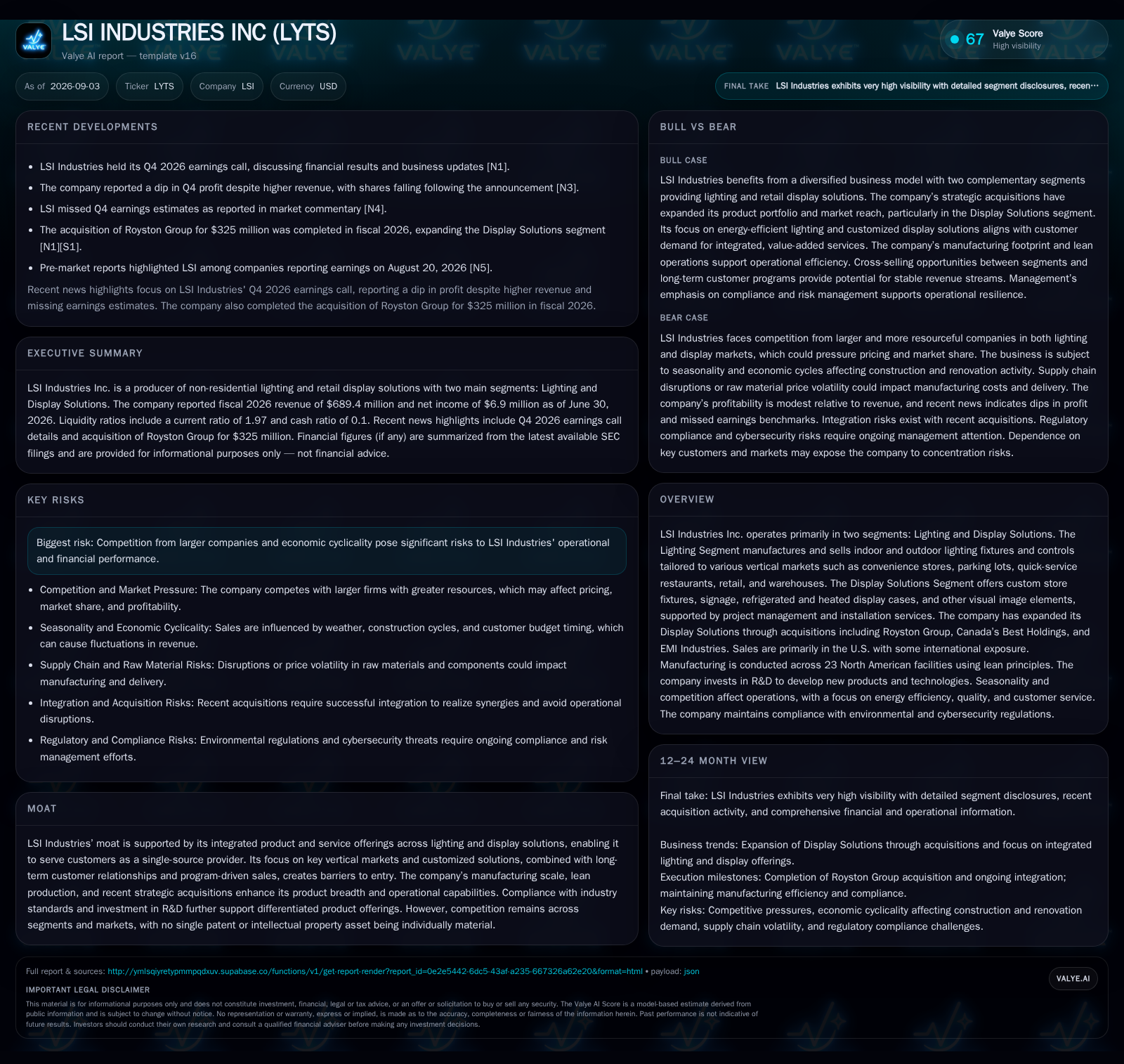
LSI Industries expanded its Display Solutions segment via a $325 million Royston Group acquisition during fiscal 2026, enhancing product breadth and market access. Despite revenue growth, Q4 2026 profit declined and earnings estimates were missed, signaling margin and execution challenges. The company’s business model balances manufacturing scale and lean operations against competitive pressures and economic cyclicality. Future outcomes hinge on successful integration, cost control amid raw material volatility, and the ability to leverage cross-segment sales to stabilize earnings amid seasonality and pricing pressures.
LSI Industries Inc., a provider of non-residential lighting and retail display solutions, reported fiscal 2026 revenue growth driven partly by its $325 million acquisition of Royston Group, which expanded its Display Solutions segment. However, the company’s Q4 earnings revealed declining profits and missed estimates despite higher sales, underscoring margin pressures amid competitive and operational challenges. This juxtaposition raises questions about LSI’s ability to convert recent investments into sustainable profit growth, manage supply chain and integration risks, and navigate a market environment shaped by seasonal demand and economic cycles. The firm’s trajectory will depend heavily on leveraging its manufacturing scale, cross-selling capabilities, and product innovation to defend against resourceful competitors.
Revenue Gains from Royston Acquisition Contrasted by Q4 Profit Decline
LSI Industries completed the acquisition of Royston Group for $325 million during fiscal 2026, significantly expanding its Display Solutions segment that provides custom store fixtures and signage [N1][S1]. This strategic move aims to broaden product offerings and increase market penetration, particularly in retail verticals where integrated lighting and display solutions are increasingly demanded.
Despite this top-line growth, LSI’s Q4 2026 financial results showed a dip in profit and missed earnings estimates, causing shares to fall [N3][N4]. The company reported $689.4 million in fiscal 2026 revenue but only $6.9 million in net income as of June 30, 2026 [S1]. These results highlight emerging margin pressures potentially driven by higher costs, integration expenses, or competitive pricing pressures. The mixed signals from revenue versus profitability set the stage for challenging operational execution ahead.
Balancing Manufacturing Scale and Variable Costs Amid Margin Headwinds
LSI’s revenues primarily stem from two segments: Lighting and Display Solutions. The Lighting segment manufactures indoor and outdoor fixtures tailored to verticals like convenience stores and warehouses, while Display Solutions offers custom fixtures and visual merchandising support. Both segments rely on a North American manufacturing footprint of 23 facilities employing lean principles, suggesting a focus on cost efficiency and operational discipline [S1].
Financially, the company’s capital intensity is moderate due to manufacturing investments and acquisition costs, like the Royston purchase. The business model mixes fixed manufacturing overhead with variable raw material and labor costs, making operating leverage contingent on volume growth and cost containment. However, recent profit declines despite revenue increases imply that cost pressures—such as raw material volatility or integration costs—may be compressing margins. The ability to leverage scale and cross-segment sales will be critical for improving profitability.
From a unit economics perspective, the mix of fixed and variable costs in LSI’s manufacturing operations creates a nuanced operating leverage profile. While fixed overheads such as facility maintenance and salaried labor provide a baseline cost structure, significant exposure to raw material prices and direct labor costs injects variability that can erode margins during periods of input cost inflation. This dynamic means that volume growth alone may not translate proportionally into profit expansion unless accompanied by disciplined cost management and supply chain optimization. Furthermore, the integration of acquisitions typically introduces short-term cost disruptions, including duplicated functions and system harmonization expenses, which can temporarily depress operating margins before synergy benefits materialize.
Another critical factor in LSI’s business economics is the potential for cross-segment synergies to enhance asset utilization and sales efficiency. By leveraging the combined product portfolio of Lighting and Display Solutions, the company could increase average transaction size and reduce customer acquisition costs through bundled offerings. However, the realization of such synergies depends on effective sales force alignment, integrated product development, and streamlined order fulfillment processes. Failure to synchronize these elements may lead to missed revenue opportunities and sustained margin pressure, underscoring the importance of cohesive operational integration beyond mere product expansion.
Facing Larger Competitors and Market Cyclicality in Lighting and Retail Fixtures
LSI operates in a competitive environment characterized by larger, resource-rich companies in both the lighting and retail display markets. These competitors may exert pricing pressure and challenge LSI’s market share, especially given the modest net income relative to revenue and the absence of a singularly dominant intellectual property moat [S1]. The company’s integrated product and service offerings across lighting and display create some differentiation by serving as a single-source provider, but switching costs and customer lock-in factors are limited by the commoditized nature of many fixtures and signage products.
Economic cyclicality and seasonality heavily influence demand, with construction cycles and renovation budgets affecting order timing. Supply chain disruptions and raw material cost volatility also pose recurring risks to manufacturing efficiency and delivery schedules. LSI’s recent acquisitions, while expanding product breadth, introduce integration risks that could weaken competitive positioning if not managed effectively. Overall, competitive resilience depends on innovation, customer relationship depth, and operational agility.
Competitive pressures in the lighting and retail display markets also impose constraints on pricing power and margin sustainability. Larger competitors with broader product lines and deeper capital resources can engage in aggressive pricing strategies or invest in innovation to capture market share, potentially forcing LSI to accept lower margins to retain customers. Additionally, the commoditized nature of many fixture products limits differentiation, making customer loyalty fragile and switching costs low. To counter these risks, LSI must continuously invest in product customization, energy-efficient solutions, and customer service excellence to build intangible moats that justify premium pricing and foster repeat business.
Economic cyclicality further complicates LSI’s competitive positioning by introducing demand volatility tied to construction and retail spending cycles. During downturns, customers may defer capital expenditures or prioritize cost-cutting, reducing order volumes and pressuring pricing. Conversely, upturns can strain supply chains and capacity, increasing costs and delivery lead times. This cyclical demand pattern requires LSI to maintain operational flexibility and prudent inventory management to avoid margin erosion from underutilized capacity or expedited procurement costs. Investors should monitor the company’s ability to smooth earnings through diversified vertical exposure and flexible cost structures as a key resilience indicator.
Successful Acquisition Integration Drives Synergies and Margin Expansion
In a favorable scenario, LSI effectively integrates Royston Group and other acquisitions, unlocking cross-selling opportunities between Lighting and Display Solutions segments. This synergy could increase average order size and customer retention by providing bundled, customized offerings tailored to key verticals like convenience stores and retail chains. Enhanced scale and product breadth might enable better pricing power and operational efficiencies, gradually improving margins beyond historical levels.
Evidence supporting this would include accelerating revenue growth outpacing operating costs, improving segment margins, and positive customer feedback on integrated solutions. Conversely, failure to realize these benefits would manifest as flat or declining margins despite revenue gains, operational disruptions, or customer attrition, which would falsify this optimistic outlook.
Ongoing Revenue Growth with Persistent Margin Pressure from Costs and Competition
The most plausible outcome involves moderate top-line growth fueled by ongoing demand in lighting and retail display markets, supported by recent acquisitions but offset by persistent margin compression. Supply chain volatility and raw material price increases may continue to pressure costs, while competitive pricing limits the company’s ability to fully pass through inflation. Integration of acquisitions proceeds but without dramatic synergy realization, leading to incremental improvements in product offerings but not transformative profit gains.
Supporting evidence for this scenario would be steady revenue growth coupled with stable or slightly declining operating margins, reflecting a tradeoff between scale benefits and cost challenges. If margins improve significantly or deteriorate sharply, it would challenge this balanced view.
Integration Failures and Intensifying Competition Weaken Profitability
A downside scenario emerges if LSI faces significant difficulties integrating acquisitions such as Royston Group, leading to operational inefficiencies, customer dissatisfaction, and elevated costs. These could exacerbate margin pressures already affected by aggressive pricing from larger competitors and unfavorable economic conditions reducing construction and renovation activity. Supply chain disruptions or raw material cost spikes could further squeeze profitability and delay deliveries, damaging customer trust and future sales.
Confirmation of this scenario would appear in continued profit declines, missed earnings estimates, and negative cash flow trends. Conversely, signs of improving integration metrics, cost control, and stable market share would weaken this negative outlook.
Assessing Integration Milestones, Margin Recovery, and Demand Visibility
Key indicators to watch include segment-level revenue growth rates and operating margins to assess whether acquisition synergies materialize and margin pressures ease. Monitoring gross margin trends can reveal raw material and labor cost impacts. Customer retention rates and the mix of new versus repeat business will inform on competitive positioning and product acceptance.
Additional metrics include order pipeline visibility to gauge demand cyclicality, supply chain lead times indicating operational risk, and capital expenditure trends reflecting manufacturing capacity investments. Disclosure of integration milestones or qualitative management commentary on acquisition progress would also be valuable to assess execution risks.
Disclaimer: This is research-only, informational analysis and not investment advice. It may include AI-generated interpretation and general industry context. Always verify important details using primary sources.

Comments