
Medtronic’s Strategic Expansion Amid Complex Risks Highlights a Delicate Growth-Leverage Balance
As Medtronic capitalizes on acquisition-driven portfolio expansion and growth in robotics and hypertension therapies, it confronts multifaceted pressures from regulatory compliance, geopolitical tensions, and cost inflation that test its operating leverage and competitive durability.
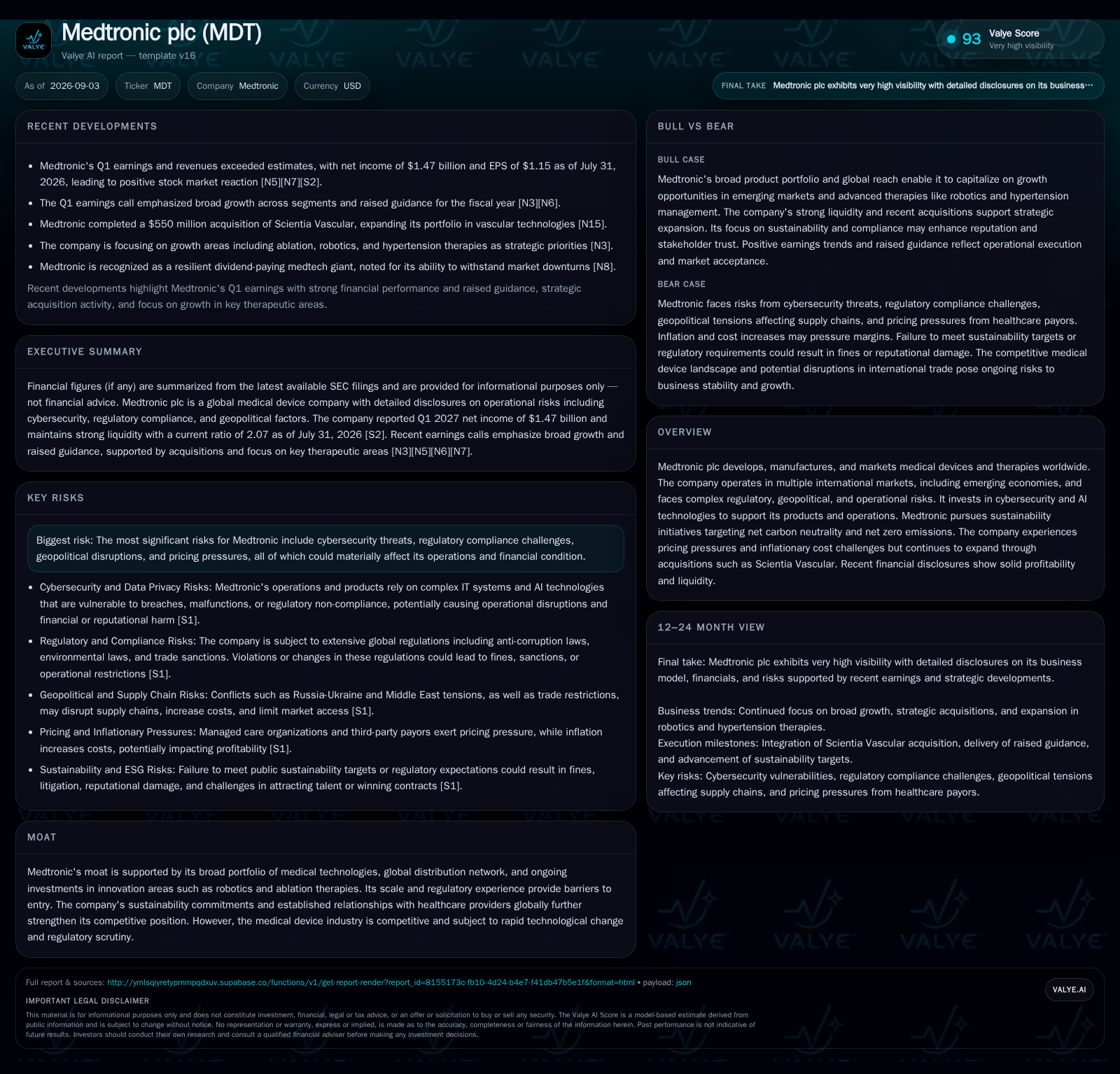
Medtronic’s Q1 2027 results surpassing expectations reflect successful execution of strategic priorities including the $550 million Scientia Vascular acquisition and focus on growth areas like ablation, robotics, and hypertension treatments. The company’s broad global footprint and innovation investments underpin a defensible competitive position, though persistent pricing pressures, inflation, and geopolitical-supply risks present ongoing margin challenges. Medtronic’s operating model balances capital-intensive innovation and fixed-cost commitments against variable-volume growth, making operating leverage contingent on sustained demand and cost control. Upside hinges on accelerating adoption of next-gen therapies and smooth integration of acquisitions, while downside risks include regulatory setbacks and supply constraints. Key metrics on product uptake, margin trends, and geopolitical risk management will be critical to monitor.
Medtronic plc’s latest quarterly performance reaffirms its strategic momentum in medical device innovation and portfolio expansion, punctuated by a significant acquisition and focus on high-growth therapeutic areas such as robotics and hypertension. However, the company navigates a complex environment marked by regulatory scrutiny, pricing headwinds, supply chain vulnerabilities, and ambitious sustainability targets. Understanding how Medtronic’s business economics interplay with these external risks is essential to assessing whether its competitive advantages and operating leverage can sustain profitable growth over the medium term.
Strong Q1 Earnings and Strategic Acquisition Drive Momentum Amid Complex Risks
Medtronic reported Q1 2027 net income of $1.47 billion and basic EPS of $1.15, exceeding estimates and triggering positive market reactions alongside raised full-year guidance. This robust financial performance underscores operational execution across its diversified segments and validates recent investment decisions [S2][N5][N7].
The company completed a $550 million acquisition of Scientia Vascular in mid-2026, enhancing its portfolio in vascular technologies, which aligns with its strategic emphasis on expanding offerings in robotics, ablation, and hypertension therapies. These growth areas represent both innovation-driven revenue streams and responses to evolving clinical needs [N3].
Concurrently, Medtronic faces multifaceted risks including cybersecurity vulnerabilities, stringent regulatory compliance demands, geopolitical tensions affecting supply chains—particularly related to Russia-Ukraine and Middle East conflicts—and inflationary pressures that challenge margin sustainability [S1].
The company also pursues ambitious sustainability targets aiming for net carbon neutrality in operations by 2030 and net zero emissions by 2045, which have operational cost implications but may improve long-term corporate reputation and stakeholder alignment [S1].
Balancing Capital-Intensive Innovation with Variable Demand and Margin Pressures
Medtronic generates revenue primarily through the design, manufacture, and sale of advanced medical devices and therapies globally. Pricing is influenced by product mix, volume growth, and reimbursement dynamics, with payor entities exerting downward pressure on prices. Volume growth benefits from expanding clinical adoption of novel therapies like robotics and ablation, yet the company must continuously invest in R&D and capital expenditures to innovate and maintain product relevance.
The company’s operating model features a mix of fixed costs—such as manufacturing facilities, regulatory compliance infrastructure, and R&D investments—and variable costs tied to production volume. Operating leverage therefore depends on scaling revenue faster than fixed costs. Inflation and supply chain disruptions can increase variable costs, compressing margins if price increases lag. Capital intensity is elevated by the need for regulatory approvals and clinical trials that delay time to revenue and require upfront investment.
Recent acquisitions, including Scientia Vascular, add complexity by integrating new product lines and potentially increasing fixed overhead before revenue synergies materialize. Sustainability initiatives, while strategically beneficial, introduce additional operational costs that may dampen near-term margin expansion unless offset by efficiency gains or price realization.
Global Scale and Innovation Pipeline Support Differentiation Amid Intense Industry Rivalry
Medtronic’s competitive advantage derives from its extensive product portfolio spanning multiple therapeutic areas, a broad global distribution network, and a steady pipeline of innovations—particularly in robotics, ablation, and hypertension management. The company’s scale facilitates regulatory navigation and supply chain management, creating barriers to entry for smaller players.
Investment in AI and cybersecurity technologies for product safety and operational efficiency may enhance differentiation if these capabilities translate into improved clinical outcomes and customer trust. Furthermore, established relationships with healthcare providers worldwide and sustainability commitments strengthen Medtronic’s brand and stakeholder alignment.
However, competition in medical devices is intense and rapidly evolving, with peers and new entrants vying for market share through technological breakthroughs and pricing strategies. Regulatory scrutiny and reimbursement environments vary by region, complicating market access. Pricing pressures from payors and managed care organizations challenge Medtronic’s ability to maintain premium pricing, while geopolitical risks and trade restrictions could disrupt supply chains and increase costs, eroding competitive positioning.
Accelerated Adoption of Next-Gen Therapies and Smooth Acquisition Integration Boost Growth
A favorable scenario envisions Medtronic successfully integrating Scientia Vascular’s assets, rapidly commercializing expanded vascular technologies, and achieving strong market uptake of its robotics, ablation, and hypertension therapies. This would drive volume growth and enable improved pricing power amid evolving clinical preferences, enhancing operating leverage as fixed costs are absorbed over higher sales.
Confirming evidence would include sustained revenue growth exceeding guidance, margin expansion despite inflationary pressures, successful regulatory approvals for new products, and positive clinical data driving adoption. In addition, effective management of supply chain risks and cybersecurity resilience would reinforce operational stability.
This scenario could be falsified by slower-than-expected clinical adoption, delays or failures in product approvals, adverse regulatory actions, or integration challenges that raise costs disproportionately. Worsening geopolitical tensions that disrupt supply chains or exacerbate inflation beyond Medtronic’s pricing power would also undermine this upside case.
Moderate Growth with Margin Pressure Balanced by Portfolio Diversification and Cost Controls
The most plausible baseline outlook sees Medtronic achieving steady revenue growth driven by incremental adoption of new therapies and geographic expansion, offsetting moderate pricing erosion and inflation-driven cost increases. The company’s diversified product mix and global footprint provide resilience, but operating leverage gains are modest as fixed and variable cost pressures limit margin expansion.
Evidence supporting this scenario includes revenue growth tracking guidance with stable but pressured margins, ongoing investments in innovation and sustainability without significant disruptions, and manageable geopolitical and regulatory risks. Acquisition integration enhances product breadth without materially diluting profitability.
Falsification of this base case would occur if either upside or downside factors dominate—for instance, if pricing pressures intensify and margins deteriorate sharply or if breakthrough product success triggers higher-than-expected growth and profitability improvements.
Regulatory Setbacks, Supply Chain Disruptions, and Margin Compression Weigh on Profitability
In a downside scenario, Medtronic encounters significant regulatory compliance challenges, including fines or restrictions related to cybersecurity incidents or environmental regulations. Concurrently, escalating geopolitical conflicts disrupt supply chains, leading to shortages, production delays, and higher costs.
These factors, combined with persistent pricing pressures from managed care organizations and inflation exceeding the ability to pass through costs, compress margins substantially. Acquisition-related expenses and operational inefficiencies amplify financial strain, while sustainability initiatives become a cost burden rather than a reputational asset.
Confirming evidence would be visible in deteriorating margin trends, revision of guidance downward, negative regulatory findings, and publicized supply chain challenges. Conversely, rapid resolution of these issues or effective cost mitigation would falsify this scenario.
Monitoring Product Adoption, Margin Trajectory, and Risk Management Execution
Key performance indicators to watch include quarterly revenue growth by therapeutic area—especially robotics, ablation, and hypertension therapies—to gauge adoption momentum and volume expansion. Tracking operating margin trends will reveal how effectively Medtronic manages pricing pressures and inflationary costs.
Progress on integration milestones for the Scientia Vascular acquisition, including synergies realized and R&D pipeline advancements, will be critical to assess strategic execution. Regulatory compliance metrics and cybersecurity incident reports, if disclosed, are important to monitor given their potential operational impact.
External factors such as geopolitical developments affecting supply chains and global trade policies should be evaluated regularly, as these can materially influence cost structures and market access. Finally, updates on sustainability initiatives and related capital expenditures will indicate how environmental targets influence operational efficiency and stakeholder perception.
Disclaimer: This is research-only, informational analysis and not investment advice. It may include AI-generated interpretation and general industry context. Always verify important details using primary sources.

Comments