
DOMO’s Integrated AI Data Platform Faces Critical Liquidity Inflection Amid Asset Sale Uncertainty
DOMO, INC. offers a composable cloud-based AI and data platform with broad connectivity and operationalized analytics but confronts pressing financial covenant breaches and a pivotal asset sale that will determine its viability.
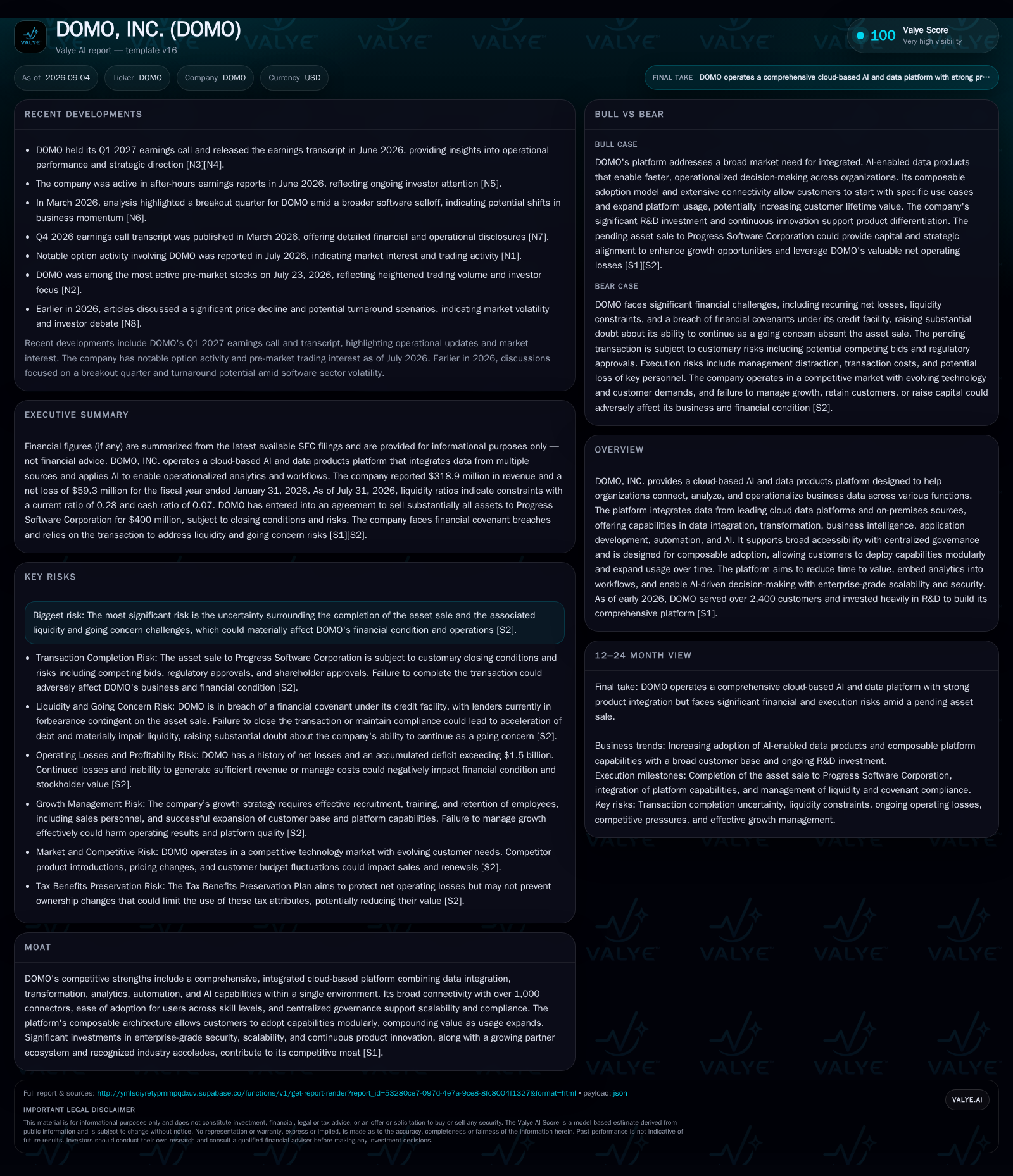
DOMO’s platform integrates data and AI across enterprise functions with a modular adoption approach, serving over 2,400 customers. Despite substantial R&D investment and product breadth, DOMO’s ongoing losses and liquidity constraints have led to an asset sale agreement with Progress Software. Completion risks and competitive dynamics create substantial execution uncertainty, making the near-term outlook contingent on transaction success and operational stabilization.
DOMO, INC. operates a comprehensive cloud-based platform designed to unify data integration, AI-powered analytics, and workflow automation across enterprise functions. Its modular, composable architecture enables customers to start with select capabilities and expand usage over time, fostering deeper operational adoption. However, despite serving over 2,400 customers and investing heavily in R&D to build a robust ecosystem, DOMO faces significant financial distress. Its liquidity constraints and breach of credit covenants have compelled the company to enter an asset purchase agreement with Progress Software Corporation, a transaction fraught with execution risks. The outcome of this sale will be a critical determinant for DOMO’s future viability and ability to capitalize on the growing AI-driven data platform market.
Liquidity Pressures and Pending Asset Sale Define DOMO’s Near-Term Landscape
As of July 31, 2026, DOMO reported cash and cash equivalents of just $25.1 million against current liabilities of $353.6 million, yielding a current ratio of 0.28 and a cash ratio of 0.07, signaling acute liquidity constraints [S2]. The company is in breach of a minimum annual recurring revenue covenant under its credit facility, with lenders granting forbearance contingent on the completion of an asset sale.
DOMO has entered into an Asset Purchase Agreement with Progress Software Corporation to sell substantially all of its assets for approximately $400 million in cash, subject to customary closing conditions including regulatory and shareholder approvals [S2]. The sale is supported by a Voting and Support Agreement with a majority of stockholders but carries risks such as competing bids and transaction failure. This asset sale is currently the primary mechanism to alleviate liquidity stress and address going concern doubts.
Composable Platform Model Offers Revenue Expansion but Struggles with Profitability
DOMO’s revenue is primarily driven by subscriptions to its integrated cloud platform, which offers data integration, transformation, analytics, AI, and workflow automation capabilities. Its composable adoption model allows customers to selectively deploy modules based on maturity and needs, creating opportunities for land-and-expand growth through increased usage and cross-selling within existing accounts [S1].
Despite $318.9 million in annual revenue as of January 31, 2026, the company sustained a net loss of $59.3 million, reflecting high operating expenses, particularly in R&D and sales, and limited operating leverage [S1]. Capital intensity is moderate, focused on platform development and cloud infrastructure, while fixed costs related to R&D and customer support limit scalability benefits. The platform’s broad connectivity and governance features could enhance customer retention and pricing power if usage deepens, but current financials show limited margin improvement.
The composable platform model, while offering flexibility and tailored adoption paths for customers, inherently faces unit economics challenges that can slow profitability gains. Each incremental module sold may have diminishing marginal returns if the cost to acquire and support these modules remains high relative to incremental revenue. Additionally, because DOMO’s platform targets diverse enterprise functions, sales cycles can be elongated and complex, increasing customer acquisition costs and delaying revenue recognition. The platform’s reliance on ongoing R&D investment to maintain competitive parity also means fixed costs remain elevated, constraining operating leverage. Investors should watch for improvements in customer lifetime value relative to acquisition costs and evidence that cross-sell motions are becoming more efficient to validate the model’s scalability.
Integrated AI and Data Connectivity Provide Differentiation Amid Fierce Cloud Analytics Competition
DOMO’s competitive strengths lie in its comprehensive platform that unites multiple data functions—ingestion, preparation, analytics, AI, and operational workflows—within a single environment. Its extensive library of over 1,000 connectors enables broad data source integration, spanning major cloud data warehouses and on-premises systems, catering to diverse enterprise needs [S1].
However, the market for AI-enabled analytics platforms is highly competitive, featuring incumbents such as Tableau (Salesforce), Microsoft Power BI, and specialized AI analytics startups. These rivals often have deeper pockets or stronger ecosystems. DOMO’s moat hinges on its composable architecture and ease of operationalizing analytics across business functions, but competitive pressure on pricing, innovation cycles, and customer retention remain persistent threats.
DOMO’s competitive moat, while supported by broad connectivity and integrated AI capabilities, is vulnerable to erosion from both incumbent cloud analytics providers and agile AI-focused startups. Incumbents benefit from extensive ecosystems and bundling opportunities that can pressure DOMO’s pricing and customer retention. Meanwhile, startups may innovate faster on niche AI analytics features or user experience, appealing to specific verticals or use cases. The composable architecture, though a differentiation, requires continuous innovation to prevent commoditization. A potential counterforce to moat erosion is the platform’s governance and security capabilities, which can be critical in regulated industries. Investors should monitor the company’s pace of innovation, customer churn, and pricing trends as leading indicators of moat durability.
Strategic Asset Sale Enables Capital Infusion and Integration to Accelerate Growth
If DOMO completes the asset sale to Progress Software Corporation successfully, it could gain a substantial cash infusion to stabilize liquidity and reduce financial distress [S2]. Under new ownership, the platform could benefit from enhanced go-to-market resources, integration into a broader product suite, and operational synergies that reduce costs and improve margins.
In this scenario, DOMO’s composable platform gains traction as AI adoption accelerates across enterprises, driving upsell and cross-sell opportunities that increase net retention beyond the current 94%. Confirmation would include transaction closure on terms, improved liquidity ratios, renewed R&D investment, and accelerating revenue growth. Failure to realize these outcomes within 12-18 months would call the upside scenario into question.
Platform Adoption Grows Moderately Amid Financial Restructuring and Market Competition
The most plausible path sees DOMO completing the asset sale with some delay or concessions, allowing a partial easing of liquidity constraints but continuing margin pressures. Platform adoption expands gradually as customers deploy additional modules, maintaining ARR net retention near current levels. However, competitive dynamics and evolving AI analytics demands limit pricing power and growth acceleration.
Operational execution focuses on maintaining core customer relationships and controlling costs, with moderate improvements in operating leverage over 12-24 months. Key evidence includes completion of the asset sale without material dilution, steady revenue progression, and manageable operating losses. Conversely, failure to improve net retention or continued cash burn beyond forecasts would challenge this scenario.
In the base scenario, the interplay between financial restructuring and competitive market pressures creates a delicate balance. Even with asset sale completion, DOMO must manage integration risks and avoid customer disruption that could impair net retention. Market competition may limit pricing flexibility, necessitating operational efficiency improvements to protect margins. The platform’s ability to demonstrate clear ROI through operationalized AI use cases will be critical to justify expansion within existing accounts and attract new customers. A failure to achieve these operational milestones could result in prolonged losses and further covenant stress, potentially triggering additional restructuring. Therefore, tracking customer satisfaction metrics and usage depth alongside financial results is essential to assess progress in this scenario.
Asset Sale Failure Triggers Liquidity Crisis and Accelerated Financial Distress
If the asset sale to Progress Software falls through due to competing bids, regulatory hurdles, or shareholder opposition, DOMO would face immediate liquidity and covenant default risks [S2]. The credit facility could accelerate, triggering debt repayment demands that the company cannot meet given limited cash reserves and ongoing losses.
This scenario could force restructuring, asset fire sales below fair value, or bankruptcy proceedings, severely disrupting platform operations and customer relationships. Confirmation would include public statements of covenant default, lender actions, or inability to meet payroll and operational expenses. Recovery from this scenario would require a significant capital raise or turnaround under heavily constrained conditions.
The downside scenario underscores the systemic risks that liquidity crises impose on SaaS platforms like DOMO. Beyond immediate financial distress, such crises can damage customer confidence and accelerate churn, as enterprises seek more stable vendors for mission-critical analytics. The loss of key talent during financial turmoil can also impair product development and support, further weakening competitive positioning. In this context, the company’s ability to secure bridge financing or strategic partnerships becomes a critical falsification test of survival prospects. Investors should watch for signs of operational degradation, such as slowing sales cycles or increased customer cancellations, which often precede formal restructuring events. Recovery from such distress would likely require substantial dilution or asset divestitures, impacting long-term value creation.
Transaction Completion, Customer Expansion, and Liquidity Metrics Will Determine Outlook
Key milestones include the closing of the asset sale with Progress Software Corporation, which would relieve immediate liquidity pressures and provide strategic clarity. Monitoring shareholder and regulatory approvals, competing bids, and announced closing dates is critical.
Operational KPIs such as annual recurring revenue growth, net retention rate, and customer count trends will reveal whether the platform’s composable adoption model drives deeper account penetration amid competitive pressures. Cost management and operating margin trends will indicate potential for scaling profitability.
Financial metrics remain vital: current ratio, cash runway, and credit covenant compliance will reflect ongoing liquidity health. Additionally, tracking R&D investment levels can signal commitment to innovation and platform competitiveness post-transaction.
Disclaimer: This is research-only, informational analysis and not investment advice. It may include AI-generated interpretation and general industry context. Always verify important details using primary sources.

Comments