
Smith & Wesson Navigates Regulatory Complexities Amid Fluctuating Firearms Demand
The firearms maker’s current liquidity and shipment growth contrast with persistent regulatory, litigation, and cost pressures that shape its operational and financial outlook over the next 1-2 years.
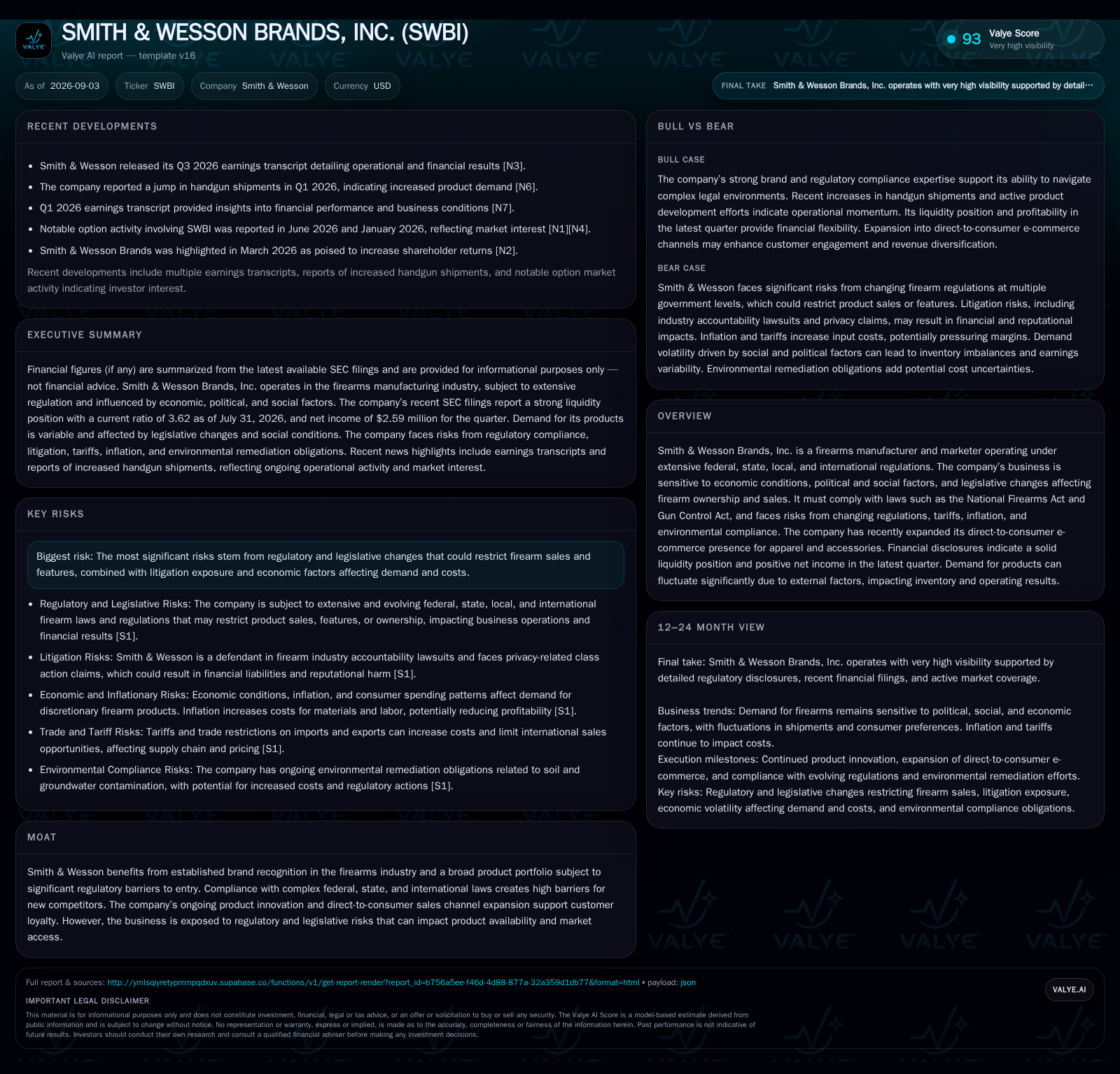
Smith & Wesson benefits from a strong brand and recent shipment increases but faces significant risks from evolving firearm regulations, litigation, inflation-driven cost pressures, and environmental remediation obligations. Its direct-to-consumer e-commerce expansion may diversify revenue but the variable demand tied to political and social factors injects ongoing volatility. The key question is whether regulatory headwinds and litigation can be balanced by operational agility and product innovation to sustain steady profitability.
Smith & Wesson Brands, Inc. stands at a crossroads defined by the volatile nexus of regulatory scrutiny, social-political influences, and shifting consumer demand in the firearms industry. As of mid-2026, the company reports improved handgun shipments and modest profitability amid inflationary cost pressures and ongoing environmental remediation responsibilities. Its strategic steps into direct-to-consumer sales signal attempts to diversify revenue streams and deepen customer relationships. Yet, the company’s financial and operational trajectories remain sensitive to legislative changes and litigation risks that could materially alter its business landscape. Understanding how Smith & Wesson balances these forces is critical for assessing its medium-term prospects.
Recent Operational Momentum and Regulatory Environment Tightly Intertwined
Smith & Wesson’s Q3 2026 financial disclosures reveal a net income of $2.59 million and a robust current ratio of 3.62, underscoring a solid liquidity cushion to support near-term operational needs [S2]. Notably, handgun shipments increased significantly in Q1 2026, indicating a pickup in demand that could sustain revenue growth if maintained [N6]. This shipment jump is a key operational signal amidst fluctuating market interest in firearms products.
However, the company remains deeply embedded in a complex regulatory framework encompassing federal, state, and international laws such as the National Firearms Act and Gun Control Act [S1]. These laws continuously evolve, creating material uncertainty around product sales, permissible features, and ownership criteria. Regulatory changes could restrict product offerings or access to key markets, directly impacting revenue and inventory dynamics. The interplay between demand surges and regulatory constraints remains a defining feature of Smith & Wesson’s current business context.
Balancing Pricing Pressure and Demand Volatility Under Capital-Light Manufacturing
Smith & Wesson generates revenue primarily through the manufacture and sale of firearms and related parts, with expanding contribution from apparel and firearm accessories sold via its direct-to-consumer e-commerce platform launched in 2025 [S1]. Pricing power is constrained by regulatory limits and competitive pressures, with volume swings driven by political, social, and legislative factors that influence consumer firearm purchases. Inflationary pressures on raw materials and labor increase unit costs, squeezing margins unless offset by pricing adjustments or operational efficiencies.
The business model involves fixed manufacturing capacity with variable cost inputs such as materials and labor. This structure offers some operating leverage when volume rises, as fixed overheads dilute over larger output. However, demand fluctuations driven by external factors mean inventory and production planning are challenging, potentially limiting the benefit of operating leverage. Capital intensity remains moderate, with capital expenditures mainly devoted to compliance, remediation, and incremental facility improvements rather than large-scale expansion. Overall, margin expansion depends on stable or growing demand and effective cost management amid inflation.
Brand Strength and Regulatory Expertise Contrast With Volatile Industry Dynamics
Smith & Wesson’s legacy brand recognition and broad product portfolio provide a foundational competitive advantage in the firearms market. The company’s proven ability to comply with complex and evolving federal, state, and international regulations erects high barriers to entry for new competitors, protecting its market position. Innovation in product design and incremental feature improvements further support customer retention and brand loyalty in a market sensitive to quality and reliability.
Nonetheless, the firearms industry is exposed to abrupt shifts in regulatory regimes, social sentiment, and political debates over gun control that disrupt demand patterns and can narrow the addressable market. Competitors range from other established firearm manufacturers to emerging players focused on niche or tactical products. Smith & Wesson must continuously navigate litigation risks and environmental liabilities, which can erode competitive differentiation if reputational damage or cost burdens intensify. The expansion into direct-to-consumer e-commerce channels may improve customer engagement but requires sustained execution to build a defensible retail presence against broader consumer goods competitors.
Sustained Demand Growth and Regulatory Stability Enable Margin and Revenue Expansion
In a favorable scenario, Smith & Wesson leverages its strong brand and regulatory compliance expertise to maintain and grow handgun shipments beyond the recent Q1 2026 increase [N6]. Stable or moderately easing firearm regulations at federal and state levels reduce uncertainty and enable consistent product availability, supporting steady volume growth. Inflationary pressures moderate or are passed through to consumers effectively, preserving margins. The direct-to-consumer e-commerce channel gains traction, contributing incremental revenue and enhancing brand loyalty.
Confirming evidence for this scenario includes sustained or growing shipment volumes, manageable regulatory changes, improving margin trends, and positive consumer adoption metrics for the e-commerce platform. Conversely, this scenario would be falsified by rapid regulatory tightening, sustained demand contraction, or failure to scale the retail channel profitably.
Demand Volatility and Regulatory Headwinds Lead to Earnings Variability
The most plausible middle-path outlook envisions Smith & Wesson experiencing continued fluctuations in firearm demand driven by social and political forces, with episodic regulatory tightening that intermittently constrains product features or sales in key markets [S1]. Inflation and tariffs maintain cost pressures that partially offset pricing gains. Profitability remains positive but volatile, reflecting inventory adjustments and uneven operating leverage realization. The direct-to-consumer e-commerce initiative grows slowly, providing a modest but not transformative offset to core product volatility.
Evidence supporting this base case includes moderate shipment volatility, incremental regulatory restrictions that curb but do not decimate sales, and steady but modest margin compression from cost inflation. The scenario would be contradicted by either a structural demand recovery driving consistent volume growth or by severe regulatory or litigation developments causing material financial distress.
Regulatory Crackdowns and Litigation Risks Undermine Market Access and Profitability
A downside scenario materializes if significant new firearm regulations at federal, state, or local levels severely restrict Smith & Wesson’s product sales or mandate costly design changes that reduce market appeal. This could include bans on popular handgun features, increased age restrictions, or limits on magazine capacity [S1]. Concurrently, litigation outcomes in firearm industry accountability lawsuits or privacy class actions result in substantial financial liabilities and reputational harm. Inflationary cost pressures persist or worsen, compressing margins further.
Confirming this downside would be evidenced by sharp declines in shipments, negative regulatory rulings, large litigation settlements or judgments, and deteriorating profitability metrics. A reversal of these adverse trends or legislative relief would act as falsifiers, signaling a more resilient business environment.
Monitoring Shipment Trends, Regulatory Developments, and E-Commerce Adoption
Key performance indicators to watch include quarterly handgun shipment volumes, which provide direct insight into demand trends and inventory cycles. Changes in federal, state, or local firearm regulations affecting sales or product features should be closely tracked to assess potential impact on market access and product mix. Inflation metrics and input cost trends are also critical to gauge margin pressures.
Additional important milestones are the growth trajectory and customer adoption rates of Smith & Wesson’s direct-to-consumer e-commerce platform, which could diversify revenue and improve customer engagement if scaled effectively. Litigation developments, including the progress and outcomes of firearm industry accountability lawsuits and privacy class actions, remain material risk factors to monitor. Finally, updates on environmental remediation efforts and associated costs may affect capital allocation and profitability.
Disclaimer: This is research-only, informational analysis and not investment advice. It may include AI-generated interpretation and general industry context. Always verify important details using primary sources.

Comments