
Mama's Creations Navigates Growth and Integration in the Fresh Prepared Foods Market
Mama's Creations, Inc. leverages authentic recipes and a broad all-natural product portfolio to expand national distribution while integrating recent acquisitions, balancing operational scale with regulatory and competitive pressures.
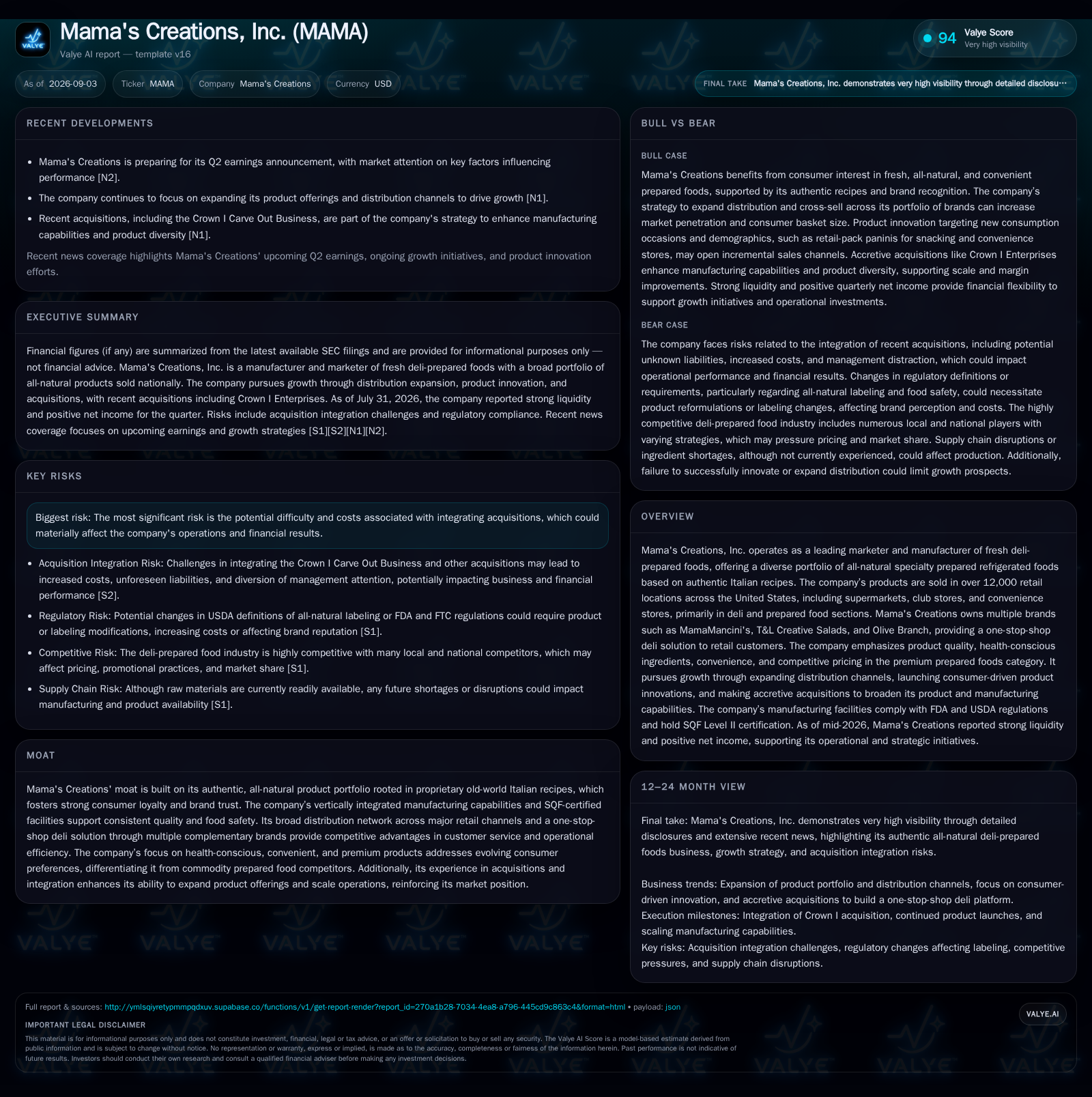
Mama's Creations, Inc. markets and manufactures all-natural deli-prepared foods sold in over 12,000 U.S. retail locations through multiple brands. Its growth strategy combines organic expansion, product innovation, and accretive acquisitions like Crown I Enterprises to enhance scale and capabilities. reported liquidity position and positive recent earnings underpin its financial health. However, the company faces integration risks, regulatory uncertainty on all-natural claims, and competitive challenges in a fragmented market. The path to a $1 billion sales platform depends on successful execution of acquisitions, sustained innovation, and navigating evolving consumer demands and regulatory frameworks.
Mama's Creations, Inc. has carved a niche in the fresh deli-prepared foods market through its authentic, all-natural Italian-inspired product line marketed under multiple complementary brands. Sold in over 12,000 retail outlets nationwide, the company aims to become a comprehensive deli platform valued at $1 billion in sales by blending organic growth with strategic acquisitions. Their internally controlled manufacturing and reported liquidity position position them well, yet the company must carefully manage integration complexities from recent acquisitions and adapt to evolving regulatory standards on all-natural labeling. The balance of expanding distribution and product innovation against competitive and regulatory headwinds will be pivotal to sustaining and scaling their market position.
Expanding Distribution and Acquisition Integration Drive Recent Growth
Mama's Creations currently sells its all-natural deli-prepared foods in over 12,000 grocery, mass, club, and convenience stores nationwide, leveraging multiple brands including MamaMancini's, T&L Creative Salads, and Olive Branch for a diversified product offering [S1]. Its product portfolio emphasizes authentic, old-world Italian recipes using natural ingredients without preservatives, approved by USDA and FSIS for all-natural labeling [S1].
Recent corporate developments include the 2025 acquisition of Crown I Enterprises’ assets, expanding manufacturing capabilities and product breadth, integral to Mama's Creations’ strategy of building a one-stop-shop deli platform targeting $1 billion in sales [S1]. The company reported reported liquidity position with $138.6 million in cash and equivalents and positive net income of $2.565 million in Q2 2026, underscoring operational stability amid integration efforts [S2].
Premium Pricing and Internal Manufacturing Underscore Operational Leverage Potential
Mama's Creations generates revenue by selling specialty refrigerated foods priced between $7.99 and $9.99 per pound, positioning itself in the premium segment where quality and brand authenticity justify higher retail prices [S1]. The company’s vertical integration, with primarily internal manufacturing supplemented by third parties and reliance on domestically sourced raw materials, supports quality control and supply chain reliability [S1]. Fixed costs include maintaining SQF Level II certified manufacturing facilities and compliance with FDA and USDA regulations, creating operating leverage as volume scales.
Variable costs largely stem from raw materials and labor, with 581 full-time employees providing a stable workforce without union constraints [S1]. The recent expansion through acquisitions adds capital intensity but may improve capacity utilization and margin expansion if integration succeeds. Operating leverage could emerge if distribution expansion and product innovation increase volume without proportional rises in fixed overhead, though risks include cost inflation and integration expense overruns [S2].
From a unit economics perspective, Mama's Creations' premium pricing strategy hinges critically on sustained consumer perception of superior quality and authenticity. Should competitive entrants replicate similar all-natural claims or introduce disruptive price points, the company may face margin compression unless it can deepen brand loyalty or innovate faster. The vertical integration model offers cost control benefits but also concentrates operational risk; any supply chain disruption or regulatory compliance failure could disproportionately impact margins. A key investor watchpoint is the company's ability to maintain stable or improving contribution margins as volumes scale, signaling effective absorption of fixed costs and favorable input cost management.
Moreover, the capital intensity introduced by acquisitions demands careful scrutiny of return on invested capital (ROIC). If integration leads to underutilized capacity or duplicated overhead, the anticipated operating leverage may not materialize, eroding shareholder value. Conversely, successful capacity optimization and process harmonization could enhance incremental margins and free cash flow. Monitoring capital expenditure trends relative to incremental revenue and margin expansion will provide early signals of integration efficiency or cost overruns. The balance between organic innovation-driven growth and acquisition-fueled scale will shape the company's medium-term profitability trajectory.
Authenticity and Multi-Brand Platform Offer Differentiation Amid Intense Competition
Mama's Creations’ moat lies in its authentic Italian family recipes and all-natural ingredient positioning, fostering consumer loyalty and brand trust [S1]. Its multi-brand portfolio enables cross-selling and provides retail customers with a one-stop-shop deli solution, enhancing customer retention and operational efficiency. Vertical integration and SQF-certified facilities support consistent quality and regulatory compliance, which are critical in the prepared foods segment.
Nevertheless, the deli-prepared foods industry is highly fragmented, with numerous local and national competitors exerting pricing and promotional pressure [S1]. While Mama's Creations targets premium pricing, competitive risks include encroachment from commodity prepared foods and private-label brands. The company’s ability to maintain differentiation depends on continuous product innovation, brand marketing effectiveness, and expansion into new retail and consumption occasions.
While authenticity and multi-brand presence create differentiation, these moats are vulnerable to erosion if competitors innovate faster or if consumer preferences shift away from traditional Italian recipes toward emerging health or convenience trends. The company’s multi-brand strategy can mitigate risk by catering to diverse consumer segments but also risks diluting brand focus and increasing marketing complexity. Investors should assess whether Mama’s Creations can sustain differentiated product pipelines and effective brand positioning without overextending resources. Additionally, the company’s ability to leverage cross-brand synergies in distribution and marketing will be crucial to defend pricing power amid intensifying competition.
The fragmented nature of the deli-prepared foods sector means that local players with deep community ties or nimble innovation cycles may capture niche market share, challenging Mama's Creations' national scale advantage. Private-label expansion by large retailers could undercut pricing and shelf space, testing the company’s brand equity. A falsification test for the moat would be a sustained loss of shelf presence or a need for increased promotional spending to maintain sales volumes. Conversely, consistent premium shelf placement and consumer willingness to pay a price premium would validate the durability of the company’s competitive positioning.
Successful Integration and Innovation Propel Mama’s to a Leading Deli Platform
In a favorable scenario, Mama's Creations seamlessly integrates the Crown I assets, enhancing manufacturing scale and product diversity, which drives cost efficiencies and margin expansion. This integration enables the company to accelerate distribution growth beyond 12,000 locations and successfully launch innovative products targeting emerging consumer trends, such as snackable retail-pack paninis and health-conscious prepared meals for convenience stores [S1].
Confirming evidence would include consistent quarterly revenue growth outpacing industry averages, improving gross margins reflecting operational leverage, and rising brand awareness metrics from marketing campaigns. A falsification test would be persistent cost overruns from integration, stagnant or declining sales in key distribution channels, or failure to innovate consumer-preferred products, which would signal structural challenges to scaling.
Steady Expansion Balances Incremental Growth Against Integration and Competitive Headwinds
The most plausible outcome is moderate organic growth complemented by gradual acquisition integration. Mama’s Creations expands distribution and product offerings, but integration challenges slow scale benefits and increase expenses temporarily [S2]. Pricing power remains stable within the premium segment but competitive pressures cap margin gains. Product innovation delivers incremental revenue but is insufficient to materially accelerate growth rates.
Confirming evidence includes steady but unspectacular quarterly revenue increases, stable gross margins with some volatility from acquisition-related costs, and incremental but not transformative product launches. Falsification would be either rapid margin improvement and accelerated distribution growth (better scenario) or sustained integration expenses and market share erosion (worse scenario).
Integration Disruptions and Regulatory Shifts Undermine Growth and Profitability
A downside emerges if Mama's Creations faces significant acquisition integration difficulties, including unknown liabilities and elevated expenses from the Crown I carve-out, distracting management and straining operational execution [S2]. Simultaneously, regulatory changes narrowing the USDA’s definition of all-natural labeling could force product reformulations or costly relabeling, damaging brand equity and increasing costs [S1].
Competitive dynamics could intensify, pressuring prices and inducing higher marketing spend to defend share. Supply chain disruptions or raw material cost inflation, though not currently evident, could further compress margins. Evidence confirming this path would be increased SG&A and integration costs outpacing revenue growth, negative margin trends, and regulatory compliance costs. Conversely, timely resolution of integration issues and regulatory clarity would falsify this scenario.
Monitoring Integration Progress, Innovation Impact, and Regulatory Developments
Key metrics to watch include the pace of integration expense reduction and synergy realization from the Crown I acquisition, which will indicate management’s execution capability. Tracking quarterly revenue growth by distribution channel and product line will reveal whether organic and acquisition-driven expansion gains traction. Gross margin trends will elucidate operating leverage and pricing power amid competitive pressures.
Additional watchpoints include new product launch success measured by incremental sales and market penetration, changes in all-natural labeling regulations or enforcement that may require product or marketing adjustments, and supply chain stability indicators such as raw material cost trends and manufacturing capacity utilization rates. Brand awareness and consumer trial metrics, if disclosed, would also provide early signals of demand shifts.
Disclaimer: This is research-only, informational analysis and not investment advice. It may include AI-generated interpretation and general industry context. Always verify important details using primary sources.

Comments