
Asana Advances AI-Powered Workflow Platform Amid Profitability Challenges
Leveraging a proprietary Work Graph® and AI integration, Asana aims to deepen organizational workflow orchestration while navigating competitive, financial, and adoption challenges that shape its growth trajectory.
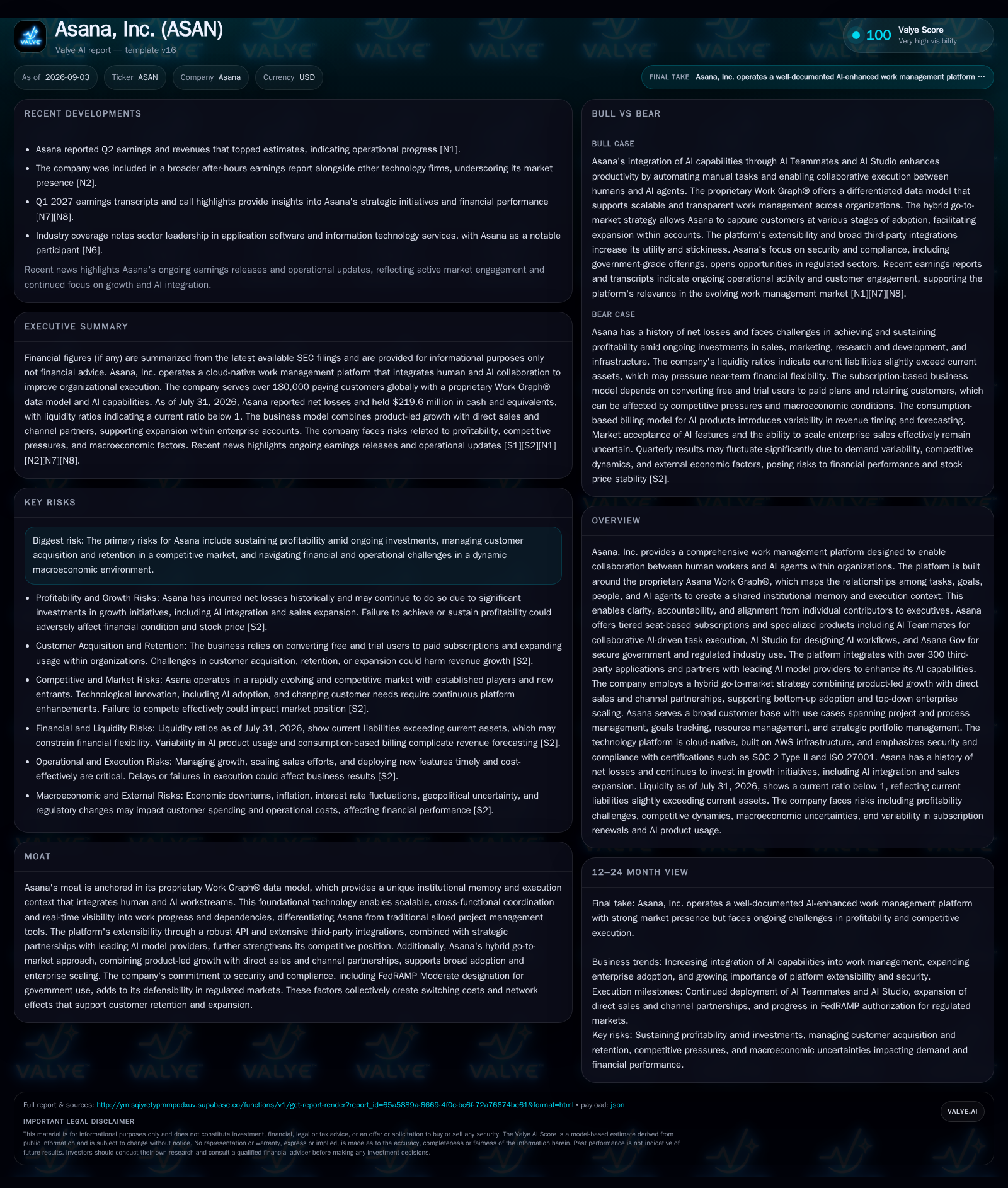
Asana, Inc. operates a cloud-native work management platform that combines human and AI collaboration to enhance clarity and execution within enterprises. Its proprietary Work Graph® underpins differentiated institutional memory and real-time dependency mapping, while AI Teammates and AI Studio introduce automation and workflow design capabilities. Serving over 180,000 paying customers globally, Asana employs a hybrid sales approach supporting bottom-up and top-down adoption. Despite operational progress and strong strategic positioning, the company faces ongoing net losses, liquidity constraints, variable AI product revenue, and competitive risks that could impact its ability to scale profitably and sustain growth.
Asana, Inc. has positioned itself at the intersection of human collaboration and artificial intelligence within work management, leveraging its proprietary Work Graph® to create a shared institutional memory and real-time workflow orchestration across organizations. By integrating AI Teammates and AI Studio, Asana aims to automate routine tasks and manage dependencies dynamically, enhancing productivity for a diverse user base of over 180,000 paying customers worldwide. However, the company’s path to sustained profitability remains challenging amid persistent net losses, investment-heavy growth initiatives, and competitive pressures in a rapidly evolving software landscape. Understanding how Asana’s business economics and competitive positioning interplay with its AI-driven platform adoption is critical for assessing its medium-term outlook.
Asana Advances AI-Enhanced Workflow Management Amid Financial and Market Headwinds
Asana’s platform, underpinned by the proprietary Work Graph®, integrates tasks, goals, individuals, and AI agents to create a system of action that supports clear accountability and execution context across enterprise workflows [S1]. The addition of AI Teammates and AI Studio enables automation of manual work and structured AI workflow design, reflecting a strategic emphasis on embedding AI to accelerate outcomes [S1].
Serving more than 180,000 paying customers globally, Asana operates on a hybrid go-to-market model that mixes product-led growth with direct sales and channel partnerships, facilitating bottom-up adoption and enterprise scaling [S1]. Despite operational progress, the company reported a net loss of $39.2 million over six months ending July 31, 2026, with liquidity ratios indicating current liabilities slightly exceed current assets, posing near-term potential financial flexibility challenges [S2]. Revenue from AI products follows a consumption-based billing model, introducing variability in revenue timing and forecasting [S2].
Monetizing Collaborative AI Workflows Through Hybrid Sales and Consumption-Based Models
Asana generates revenue primarily through seat-based subscriptions tiered by user count and organizational size, complemented by consumption-based fees for AI-driven features like AI Teammates and AI Studio [S1][S2]. This hybrid pricing approach combines predictable recurring revenue from subscriptions with variable income tied to AI usage, creating complexity in revenue forecasting but offering upside potential if AI adoption scales.
The company’s platform economics feature significant upfront fixed costs in R&D, infrastructure, and sales expansion, particularly investments in AI integration and enterprise sales capabilities [S2]. Operating leverage could materialize as incremental revenue from large enterprise accounts spreads fixed costs, but this depends on effective upselling and retention. Given persistent net losses and a cash ratio below 0.5, near-term profitability is constrained, and capital intensity remains elevated to sustain product innovation and market penetration.
The hybrid revenue model combining subscription and consumption-based fees introduces a nuanced dynamic in Asana's unit economics. While subscription fees provide a baseline of recurring revenue, the consumption-based AI fees create variable revenue streams that can amplify growth in high-usage scenarios but also increase forecasting uncertainty. This variability necessitates sophisticated demand modeling and customer usage analytics to optimize pricing tiers and anticipate revenue fluctuations. Moreover, the balance between encouraging AI feature adoption and preventing revenue cannibalization from existing subscription tiers is delicate, requiring continuous calibration of product packaging and customer segmentation strategies.
From a cost structure perspective, Asana's significant upfront investments in AI research and development, cloud infrastructure, and salesforce expansion reflect a capital-intensive growth phase typical of SaaS companies pursuing platform differentiation. The scalability of the Work Graph® and AI modules could yield substantial operating leverage if the company successfully expands its enterprise customer base, as fixed costs are amortized over a growing user population. However, this leverage is conditional on maintaining low churn rates and achieving efficient customer acquisition, as high churn or sales inefficiency would dilute margin gains and prolong the path to profitability.
Proprietary Work Graph and AI Integration Support Differentiation Amid Intense Software Competition
Asana’s competitive moat centers on its proprietary Work Graph®, which uniquely maps complex relationships among work elements and AI agents, enabling institutional memory and transparent execution context that traditional project management tools lack [S1]. This data model, combined with broad third-party integrations exceeding 300 applications, enhances platform extensibility and user stickiness.
However, the market features entrenched incumbents (e.g., Atlassian, Microsoft, Smartsheet) and emerging AI-centric workflow platforms competing on capabilities and pricing. Success hinges on continuous innovation, seamless AI-human collaboration, and effective enterprise sales execution. The hybrid model supports multiple adoption pathways but also requires strong customer success efforts to convert and expand within accounts, mitigating churn risks and competitive poaching.
While the proprietary Work Graph® offers a defensible data moat by encoding complex organizational workflows and dependencies, this advantage could be challenged by competitors leveraging open ecosystems or AI models trained on broader datasets. The extensibility of Asana’s platform via third-party integrations is a double-edged sword: it enhances customer lock-in but also exposes the company to risks if key integrations become commoditized or if partners develop competing native workflow solutions. Therefore, sustained innovation in AI-human collaboration and user experience is critical to reinforcing the platform’s stickiness and preventing erosion of its competitive moat.
AI-Driven Workflow Automation Spurs Enterprise Expansion and Margin Improvement
In a favorable scenario, Asana’s AI Teammates and AI Studio gain widespread adoption within existing accounts and attract new enterprise customers seeking productivity gains from AI-human collaboration. The proprietary Work Graph® scales effectively, enabling complex mission-critical workflows across departments, increasing switching costs and reducing fragmentation risks.
Confirming evidence would include accelerating dollar-based net retention rates above current ~97% for core customers, strong consumption growth in AI features leading to higher revenue per user, and expanding direct sales and channel partner productivity. Margin improvement would arise from operating leverage as fixed costs are absorbed by increasing subscription and AI consumption revenue. A falsification test would be persistent stagnation or decline in AI feature adoption, rising churn, or competitor disruption eroding price realizations.
Platform Adoption Progresses with Increasing AI Revenue Despite Margin Pressures
The most plausible trajectory sees Asana maintaining steady growth in paid seat subscriptions and moderate AI feature adoption that incrementally enhances revenue but does not dramatically accelerate overall growth. The hybrid go-to-market model continues to enable account expansion, but competitive pressures and market saturation limit rapid scaling.
Operating leverage materializes slowly as investments in AI and sales infrastructure sustain elevated costs, resulting in ongoing net losses or marginal profitability. Revenue variability from consumption-based AI billing remains a forecasting challenge. Confirmation includes stable or modestly improving retention rates, consistent incremental AI revenue growth, and manageable sales efficiency. Falsification would be sudden AI adoption spikes or sharp margin expansion, or conversely, accelerating churn and contraction in enterprise deals.
Profitability Challenges and Competitive Erosion Limit Growth and potential financial flexibility
In a downside outcome, Asana fails to convert enough free and trial users into paying customers at scale, and AI features see slow uptake due to customer reluctance or competing platforms offering superior integration or pricing. This, combined with increasing operational costs and constrained liquidity, pressures the company’s financial position.
Revenue growth slows or declines, exacerbated by the variability in AI consumption revenue, complicating cash flow management. Competitive dynamics lead to pricing pressure and customer churn. Confirmation includes deteriorating net retention rates below 95%, prolonged net losses widening the accumulated deficit, and liquidity ratios declining further below 1. Falsifying evidence would be unexpected strategic partnerships or product breakthroughs reversing these trends.
Financial and operational watchpoints extend beyond headline revenue and loss figures to include granular metrics such as usage frequency of AI features, customer segmentation shifts, and sales cycle length for enterprise deals. For instance, an increase in average AI consumption per user without corresponding subscription growth could indicate deepening engagement but also potential pricing pressure. Conversely, a rise in sales cycle duration or customer acquisition cost might signal market saturation or competitive headwinds. Monitoring these indicators in conjunction with macroeconomic factors and technology adoption trends will provide a more comprehensive view of Asana’s strategic momentum and resilience.
Customer Conversion, AI Usage Growth, and Financial Metrics Will Signal Strategic Momentum
Key metrics to monitor include dollar-based net retention rates for both core and enterprise customers, which indicate success in account expansion and pricing power. Tracking the growth rate and average revenue per user of AI Teammates and AI Studio consumption-based products will reveal the traction of AI integration within workflows.
Financially, trends in net loss magnitude, cash burn rate, and liquidity ratios such as current and cash ratios will clarify the company’s runway and ability to invest in growth. Sales and marketing efficiency, measured by customer acquisition cost relative to lifetime value, will show scalability of the hybrid go-to-market approach. Lastly, progress in FedRAMP certification adoption and government sector penetration will provide insight into regulated market opportunities.
Disclaimer: This is research-only, informational analysis and not investment advice. It may include AI-generated interpretation and general industry context. Always verify important details using primary sources.

Comments