
U S Global Investors Returns to Profitability Amid Asset Growth and Competitive Pressures
The company’s niche expertise and expanding ETF offerings support recent financial improvement, yet regulatory risks and a material control weakness temper confidence in sustained execution.
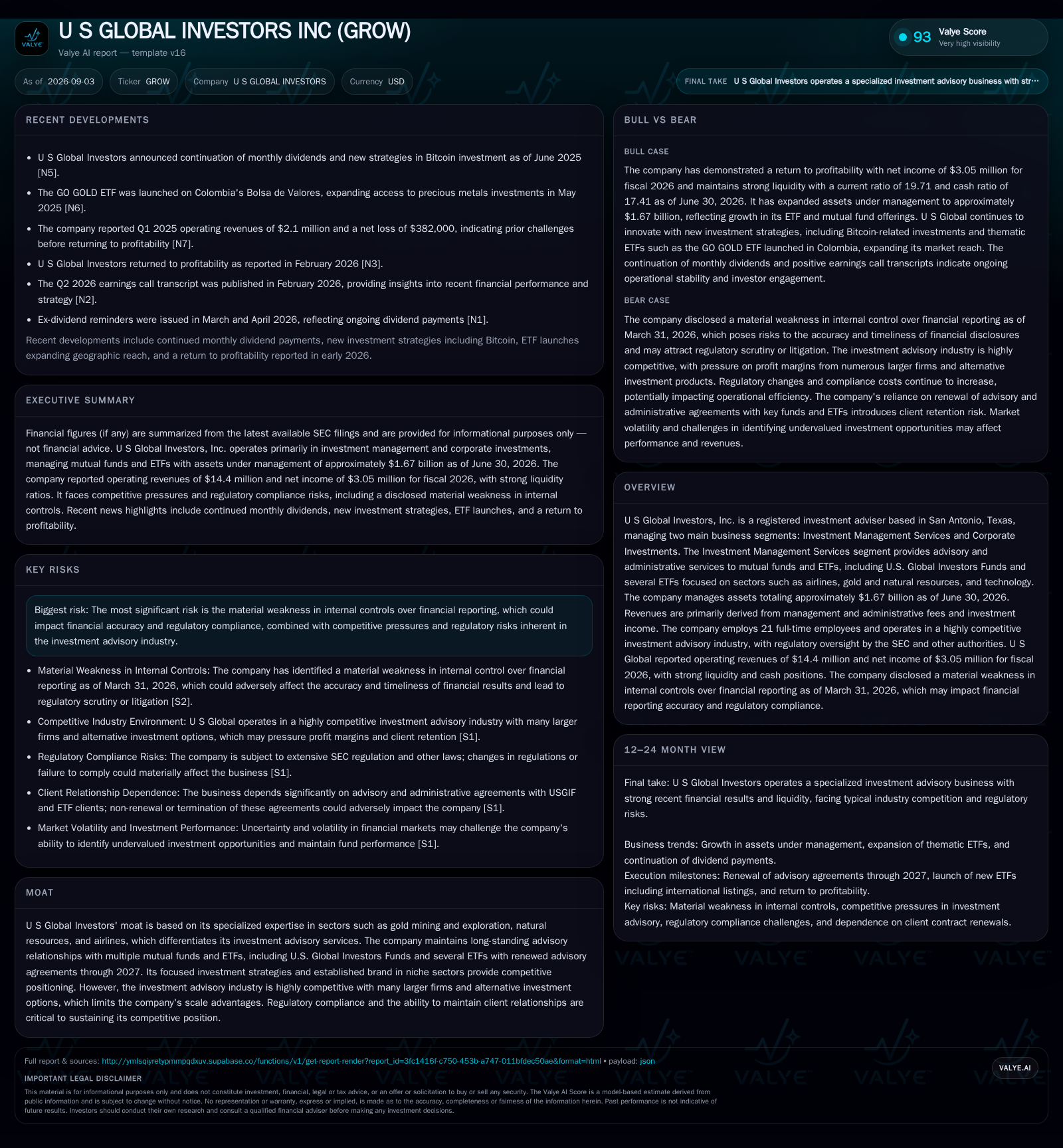
U S Global Investors has increased its assets under management to $1.67 billion and returned to profitability in fiscal 2026, driven by growth in thematic ETFs and continued dividend payments. However, a disclosed material weakness in internal controls and stiff competition from larger asset managers introduce execution and regulatory risks. The firm’s specialized sector focus and renewed advisory agreements provide a competitive foundation, but sustaining margins and client retention amid market volatility remain key challenges.
U S Global Investors, a Texas-based registered investment adviser, has navigated a competitive and regulated environment to return to profitability in fiscal 2026, supported by an increase in assets under management to $1.67 billion. The firm’s focused investment themes in airlines, natural resources, and precious metals, along with new ETF launches and Bitcoin strategies, have contributed to asset growth and revenue stability. However, a disclosed material weakness in internal financial controls and ongoing competition from larger asset managers pose material risks to sustained execution and financial reporting reliability.
Profitability Recovery and Asset Growth Amid Product Expansion
U S Global Investors reported fiscal year 2026 operating revenues of $14.4 million and net income of $3.05 million, marking a clear return to profitability following a net loss reported in early 2025 [S1][N3]. This financial turnaround coincides with assets under management rising to approximately $1.67 billion as of June 30, 2026, up from $1.32 billion a year earlier. The growth largely stems from key funds including airline, travel and cargo ETFs, which compose the majority of AUM at $998 million, alongside gold and natural resources funds at $164 million [S1].
The company has actively expanded its product offerings with thematic ETFs such as the GO GOLD ETF launched on Colombia’s Bolsa de Valores and has incorporated new investment strategies including Bitcoin-related products [N5][N6]. Additionally, the firm has maintained consistent monthly dividend payments through mid-2026, signaling operational confidence and shareholder return focus [N1][N4]. However, U S Global disclosed a material weakness in internal control over financial reporting as of March 31, 2026, which raises questions regarding the accuracy and timeliness of financial disclosures and potential regulatory scrutiny [S2].
Fee-Driven Revenue Model with Scale and Operational Risks
U S Global Investors generates revenue predominantly through advisory and administrative fees on its mutual funds and ETFs, alongside investment income from corporate investments [S1]. The economics are sensitive to assets under management (AUM); fee income scales with AUM growth, but is exposed to market volatility, which can erode asset values and reduce fee base. Fee rates depend on negotiated agreements with fund sponsors and may be pressured by competition and investor demand for low-cost products, limiting pricing power.
Operating leverage appears moderate given the firm’s relatively small headcount of 21 employees and fixed-cost base, but the disclosed material weakness in internal controls suggests potential inefficiencies that could constrain cost management and margin expansion [S1][S2]. Capital intensity is low compared to traditional asset-heavy businesses, but compliance and administrative costs are nontrivial given SEC oversight. The renewal of advisory agreements through 2027 provides some visibility on fee continuity, yet the firm’s ability to grow AUM, maintain client retention, and manage operational risks will ultimately determine scalability and profitability.
Niche Sector Expertise Offers Differentiation but Faces Intense Industry Rivalry
U S Global Investors’ competitive advantage derives primarily from its specialization in sectors such as gold mining, natural resources, and airlines, where its focused expertise and established reputation can attract a dedicated investor base seeking thematic exposure [S1]. The company’s portfolio of mutual funds and ETFs, including U.S.-based and European-listed products, reflects this sector concentration, which can differentiate it from broader asset managers.
However, the investment advisory industry is intensely competitive, featuring large diversified asset managers with scale advantages, extensive distribution networks, and broader product suites. This competitive landscape exerts margin pressure and challenges client retention. The firm’s relatively small scale limits economies of scale and bargaining power. Regulatory compliance adds complexity and cost. The renewal of advisory agreements through 2027 mitigates near-term contract risk, but sustained competitive advantage depends on maintaining differentiated strategies, delivering performance, and managing operational integrity.
Growing AUM and Thematic Innovation Drive Sustainable Profit Expansion
In a favorable scenario, U S Global Investors continues to grow assets under management by expanding its thematic ETF offerings, such as GO GOLD in emerging markets and Bitcoin-related investment strategies, attracting new investors seeking niche exposures [N5][N6]. Successful product launches and marketing could increase AUM beyond current levels, scaling fee income while fixed costs remain stable, generating operating leverage and margin improvement.
Further, the company could remediate its internal control weakness effectively, restoring investor and regulator confidence and reducing compliance risk [S2]. Renewal of advisory agreements and potential new client mandates would enhance revenue visibility. Confirmation of this scenario would be sustained AUM growth, rising net income margins, and clean audit opinions on internal controls. Failure to fix internal controls or stagnant AUM growth would falsify this scenario.
Stable AUM with Margin Pressure Amid Regulatory and Competitive Challenges
The most plausible base case involves moderate AUM growth driven by retention of core funds and modest inflows to thematic ETFs, offset by ongoing competition from larger firms offering lower fees or broader product suites [S1]. Fee rates may face pressure, limiting revenue per dollar of AUM. Operating margins remain stable but constrained by compliance costs related to regulatory oversight and internal control remediation efforts [S2].
In this scenario, the company maintains profitability and dividend payments but struggles to accelerate growth meaningfully. Confirming indicators would include flat or modestly increasing AUM, stable but tight margins, and incremental progress on internal control improvements without full resolution. A sharp decline in AUM or renewed losses would challenge this scenario.
Control Failures and Competitive Losses Undermine Financial Performance
A downside pathway involves failure to remediate the material weakness in internal controls, leading to inaccurate or delayed financial reporting that triggers regulatory sanctions, investor distrust, or litigation [S2]. This could materially impair the company’s reputation and limit its ability to attract or retain clients, resulting in AUM declines and fee revenue contraction.
Concurrently, intensified competitive pressure could accelerate client losses to larger, lower-cost asset managers, reducing scale and further pressuring margins. Market volatility might exacerbate asset outflows, and failure to innovate product offerings could limit new investor interest. Evidence confirming this downside would be deteriorating financial reporting quality, regulatory investigations, client contract non-renewals, and declining AUM. Conversely, timely remediation and stable fund performance would falsify this scenario.
Client Retention, Internal Control Remediation, and AUM Trends Will Define Future Trajectory
Key metrics include growth or decline in assets under management by fund and ETF category, which directly impacts fee revenue and profitability. Monitoring renewal status and terms of advisory agreements beyond 2027 will be critical to assess client retention risk. Progress on remediation of the material weakness in internal controls is essential to ensure financial reporting integrity and avoid regulatory penalties.
Additional watchpoints are operating margin trends to detect margin pressure or operational leverage, net inflows versus outflows to thematic ETFs reflecting investor appetite, and developments in regulatory environment impacting compliance costs. Disclosure of performance metrics for key funds and ETFs, such as relative returns versus benchmarks, would be useful in gauging competitive positioning but is not currently detailed. Dividend consistency and changes may also signal management’s confidence in cash flow sustainability.
Disclaimer: This is research-only, informational analysis and not investment advice. It may include AI-generated interpretation and general industry context. Always verify important details using primary sources.

Comments