
Matrix Service Advances Energy Infrastructure Growth Amid Execution and Liquidity Pressures
Focused on LNG, power, and mining markets, Matrix Service aims to leverage its integrated EPC capabilities and operational reforms to boost profitability, while navigating backlog volatility and tight liquidity constraints.
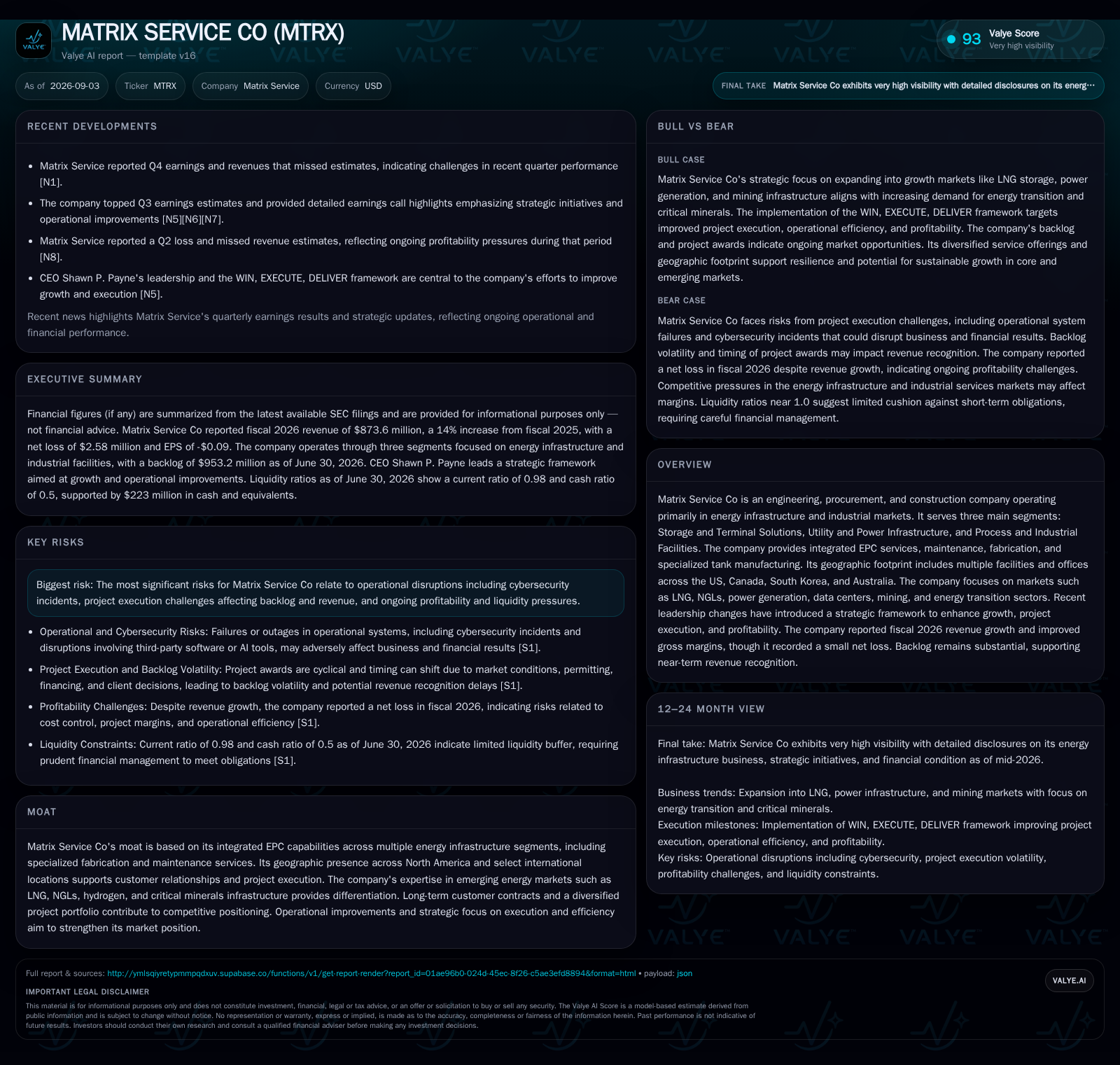
Matrix Service Co reported 14% revenue growth in fiscal 2026 driven by expansion in energy infrastructure segments but posted a small net loss amid ongoing profitability challenges. Its strategic WIN, EXECUTE, DELIVER framework targets improved project execution and operational efficiency. The company’s substantial but declining backlog and near-neutral liquidity ratios highlight revenue visibility and potential financial flexibility concerns. Competitive pressures and operational risks including cybersecurity remain key threats. The company’s ability to convert backlog into profitable projects and maintain liquidity will critically influence its trajectory in energy transition-related markets.
Matrix Service Co, an integrated engineering, procurement, and construction firm focusing on energy infrastructure and industrial markets, reported solid revenue growth in fiscal 2026 driven by expansion in LNG storage, power generation infrastructure, and mining-related projects. However, a persistent net loss and a declining backlog underscore operational and market challenges. New leadership under CEO Shawn P. Payne seeks to improve project execution and profitability through a strategic WIN, EXECUTE, DELIVER framework. While the company’s broad service portfolio and geographic footprint support diverse market exposure, tight liquidity and operational risks temper near-term financial stability. The interplay between backlog conversion, margin control, and capital management will shape Matrix’s ability to capitalize on the energy transition demand surge.
Revenue Growth and Strategic Shift Under New Leadership Spotlight Execution Gaps
Matrix Service Co reported fiscal 2026 revenue of $873.6 million, marking a 14% increase over the prior year, supported by improved gross margins rising to 7.3% from 5.2%. Despite top-line growth, the company recorded a net loss of $2.58 million and a negative EPS of $0.09, highlighting persistent profitability challenges [S1]. This performance illustrates that revenue growth alone has not yet translated into sustainable bottom-line improvement.
Backlog as of June 30, 2026, stood at $953.2 million, down significantly from $1.38 billion a year earlier, with a book-to-bill ratio of 0.7x for the year, pointing to delays or reductions in new project awards. The transition in leadership to CEO Shawn P. Payne on July 1, 2026, brought the WIN, EXECUTE, DELIVER strategic framework focusing on disciplined growth, project execution, and operational efficiency [N5]. This framework addresses root causes behind margin pressures and backlog volatility by emphasizing project controls and quality management.
A critical aspect for investors to consider is the interplay between revenue growth and profitability in project-based EPC businesses like Matrix Service. While top-line expansion reflects market demand and contract wins, the conversion of revenue into profit hinges on effective project execution and cost management. EPC firms often face margin compression due to fixed-price contracts and cost overruns, making operational discipline paramount. The new leadership’s strategic framework attempts to address these execution gaps, but the lag between implementation and financial impact can create interim volatility. Monitoring the timeline and consistency of margin improvements relative to revenue growth will be essential to assess whether the company can sustainably close the gap between volume expansion and profitability.
Integrated EPC Model Balances Volume Growth with Execution-Dependent Margins
Matrix Service operates through three segments providing integrated engineering, procurement, and construction (EPC) services, maintenance, and fabrication for energy infrastructure, including LNG storage, power generation, and industrial facilities. Revenue generation relies on winning project contracts (volume) and maintaining execution efficiency to protect thin operating margins, historically around 5-7%. Pricing is largely project-based, subject to competitive bidding, with limited ability to pass through cost increases, which constrains margin expansion.
Capital intensity is moderate, centered on fabrication facilities and project equipment distributed across North America and select international sites. Operating leverage can emerge if fixed overheads are absorbed by higher project volumes and successful execution reduces rework and cost overruns. Conversely, project delays or quality issues can quickly erode margins. The company’s improved project controls and safety culture under its strategic framework could unlock operating leverage, but the declining backlog and sub-1 book-to-bill ratio limit visibility on sustained volume growth.
The integrated EPC model’s reliance on project volume and execution quality creates a double-edged dynamic for Matrix Service. On one hand, higher project volumes can leverage fixed overhead costs and improve operating leverage, but only if projects are executed efficiently without significant rework or delay. On the other hand, the inherent complexity and scale of energy infrastructure projects amplify execution risks, where delays or quality issues can rapidly erode margins and cash flow. This structural sensitivity underscores the importance of robust project controls, risk management, and supply chain coordination. Investors should also consider the company’s capital allocation strategy, as investments in fabrication capabilities and equipment must be balanced against backlog visibility to avoid overcapacity or underutilization.
Diverse Energy Infrastructure Exposure Supports Resilience Amid Execution Risks
Matrix Service’s integrated EPC capabilities across Storage and Terminal Solutions, Utility and Power Infrastructure, and Process and Industrial Facilities segments position it to serve complex projects spanning LNG, NGLs, hydrogen, power generation, data center infrastructure, mining, and renewables. This diversity provides some insulation against downturns in single markets and aligns with growth trends in energy transition and critical minerals.
Competitive advantages stem from specialized fabrication expertise, geographic reach, and long-standing customer relationships. However, these sectors are highly competitive with peers ranging from large EPC firms to specialized contractors. The company faces threats from competitors with greater scale, better capital flexibility, or superior execution track records. Execution risks, including cybersecurity vulnerabilities and operational system failures, also threaten its ability to build durable advantage. Maintaining disciplined project delivery and cost control is critical to defend its position.
Enhanced Project Execution Drives Margin Expansion and Backlog Recovery
In a positive scenario, CEO Payne’s WIN, EXECUTE, DELIVER framework successfully addresses historical project execution inefficiencies, leading to improved quality, schedule adherence, and cost control. This would boost gross margins beyond the recent 7.3% level and reduce SG&A expenses through organizational efficiencies. Enhanced execution credibility could increase win rates and accelerate backlog replenishment, reversing the decline from $1.38 billion.
Confirming evidence would include sequential margin improvement, rising book-to-bill ratios above 1.0, and renewed contract awards in LNG, power infrastructure, and mining sectors. Conversely, failure to meet targets on project controls or safety culture would falsify this scenario. Progress in operational metrics disclosed in quarterly reports and sustained positive cash flow generation would further validate the favorable outlook.
From a competitive standpoint, Matrix Service’s diversified exposure across multiple energy infrastructure segments can be both a strength and a challenge. While diversification mitigates revenue concentration risk and aligns with broader energy transition trends, it requires maintaining expertise and operational excellence across disparate project types and geographies. This can strain management focus and dilute resource allocation. Additionally, the competitive landscape includes larger EPC firms with deeper capital resources and specialized contractors with niche capabilities, increasing pressure on pricing and execution. The company’s ability to sustain its competitive moat will depend on continuous innovation in project delivery, maintaining strong customer relationships, and effectively managing emerging risks such as cybersecurity threats, which could disrupt operations or damage reputation.
Sustained Demand Supports Revenue Growth Amid Execution and Liquidity Challenges
The most plausible outcome involves moderate revenue growth sustained by ongoing demand in energy transition markets but accompanied by continued challenges in fully stabilizing project execution and profitability. Backlog may stabilize near current levels but not grow substantially due to competitive pressures and cyclical project award timing. Gross margins might improve modestly but remain under pressure from cost inflation and pricing constraints.
Liquidity ratios close to 1.0 and a cash ratio of 0.5 suggest limited buffer, requiring prudent working capital management. The company’s ability to navigate operational and cybersecurity risks will be tested, and while strategic initiatives provide a framework for improvement, execution risks will cap upside. Evidence supporting this includes stable but not expanding backlog, mixed quarterly margin trends, and limited improvement in cash flow metrics.
Execution Failures and Backlog Erosion Amplify Profitability and Liquidity Risks
In a downside case, operational failures, including project overruns, quality issues, or cybersecurity incidents, further degrade profitability and damage customer confidence. Backlog could decline sharply as clients delay or cancel projects, reducing revenue visibility and depressing utilization of fixed assets. Margin erosion would intensify losses, potentially forcing cost-cutting measures that impair long-term competitiveness.
Liquidity pressures would rise as working capital needs grow or receivables collections slow, exacerbating balance sheet strain given the current ratio below 1.0. Confirming signs include consecutive quarterly losses, further backlog reductions, negative cash flows, and missed execution milestones. Stabilization or reversal of these trends would be needed to falsify the downside scenario.
Backlog Trends, Margin Progress, and Liquidity Stability Will Determine Near-Term Outcomes
Key indicators to monitor include the backlog level and book-to-bill ratio, which signal new contract momentum and revenue visibility. Improvement above 1.0 would indicate growing demand and execution capacity. Quarterly gross margin trends and SG&A expense ratios will reveal progress on operational efficiency and cost control under the new strategic framework.
Liquidity metrics such as the current ratio and cash ratio remain critical given limited cushion; trends in cash flow from operations and working capital management will also be telling. Operational KPIs around project schedules, safety incident rates, and cybersecurity event disclosures would provide insight into execution risk management. Finally, any changes in geographic or market segment revenue mix could indicate strategic shifts toward higher-growth or higher-margin areas.
For investors, ongoing assessment of liquidity and working capital management is critical given the company’s near-neutral ratios and the capital-intensive nature of EPC projects. Project delays or payment timing shifts can quickly strain cash flows, necessitating vigilant cash conversion cycle management. Furthermore, the company’s capacity to access external financing or optimize capital structure under stress scenarios will influence its financial resilience. Monitoring operational KPIs such as project milestone adherence, safety performance, and cybersecurity incident frequency provides early warning signals of execution risk escalation. Lastly, shifts in revenue mix toward higher-margin or faster-growing segments, if sustained, may offer a pathway to improved profitability and valuation multiple expansion over time.
Disclaimer: This is research-only, informational analysis and not investment advice. It may include AI-generated interpretation and general industry context. Always verify important details using primary sources.

Comments