
Oxford Industries Balances Margin Discipline Against Revenue Headwinds to Maintain Profitability
After a Q2 sales decline and cautious annual outlook revision, Oxford Industries demonstrates operational resilience through margin management, raising critical questions about sustaining growth amid liquidity constraints and market volatility.
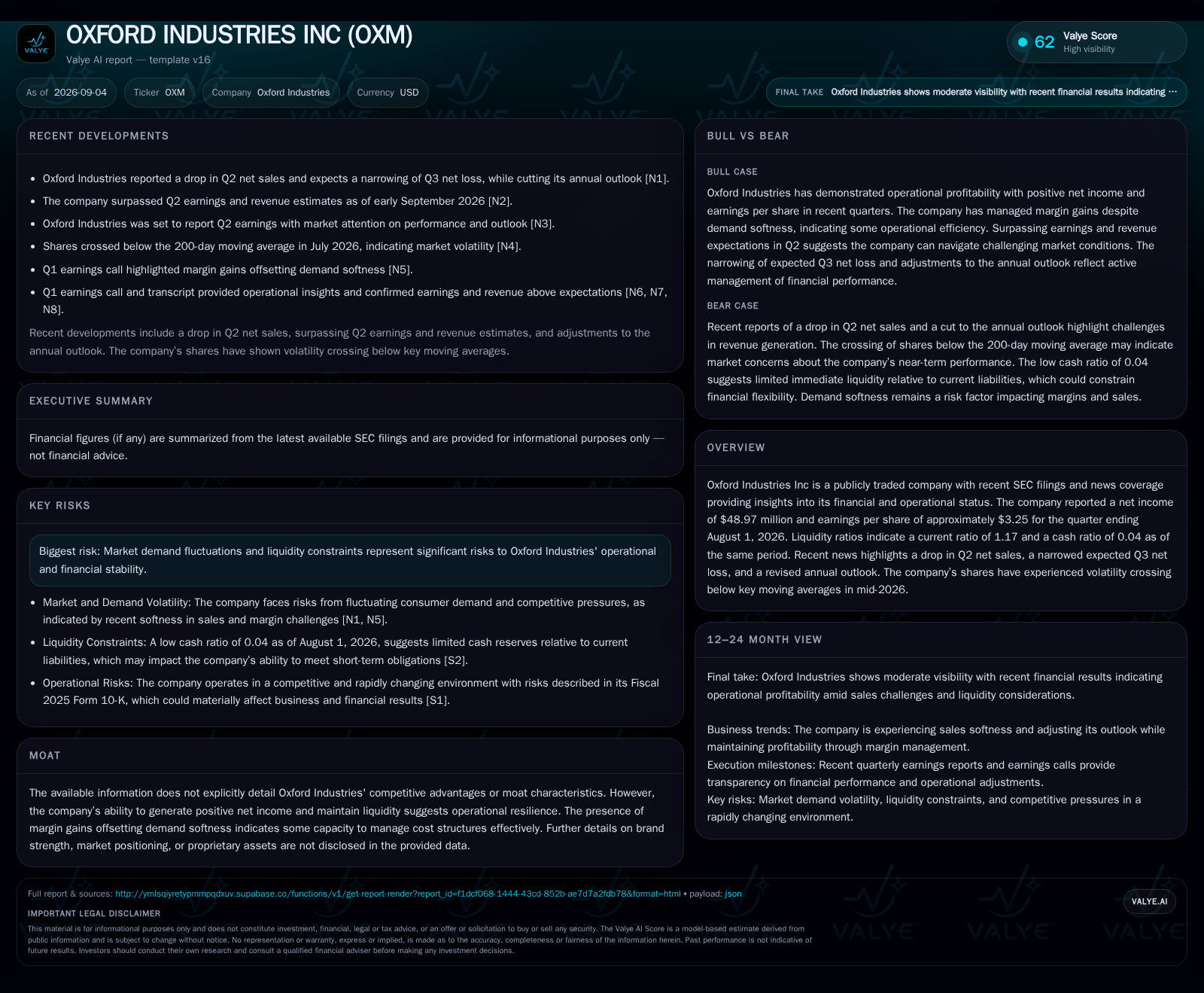
Oxford Industries reported a net income of nearly $49 million in Q2 2026 despite falling net sales and a lowered annual outlook. The company’s ability to achieve margin gains amid demand softness underpins recent earnings beats but is challenged by limited cash reserves and share price volatility. The key to Oxford’s near-term trajectory lies in balancing pricing power, cost control, and inventory management while navigating competitive pressures and macroeconomic uncertainties.
Oxford Industries Inc reported a mixed set of results in Q2 2026, with a notable decline in net sales alongside strong profitability metrics that beat market expectations. The company’s strategic focus on margin gains has partially insulated it from revenue pressures, yet liquidity limitations and a cautious annual outlook temper the optimism. Market volatility evident in the stock’s technical breakdown underscores investor uncertainty about Oxford’s ability to sustain growth. This analysis explores the company’s economics, competitive stance, and plausible financial pathways amid evolving consumer demand and operational challenges.
Recent Financial Dynamics Highlight Revenue Challenges and Profit Resilience
Oxford Industries experienced a drop in Q2 net sales, leading to a downward revision of its annual guidance and a forecast for a narrower net loss in Q3 2026 [N1]. This sales decline suggests increased difficulty in top-line growth, potentially reflecting softer consumer demand or competitive pressures.
Despite this revenue softness, Oxford exceeded Q2 earnings and revenue estimates, with net income of approximately $49 million and EPS around $3.25, underscoring effective margin management [N2][S2]. However, liquidity metrics show a current ratio of 1.17 but a low cash ratio of 0.04, indicating limited cash buffers relative to current liabilities, which could constrain operational flexibility [S2]. The share price falling below the 200-day moving average in July signals market caution about future growth [N4].
Margin Management Drives Profit Amid Revenue Volatility and Capital Constraints
Oxford’s business model relies on generating profitable sales through a mix of volume growth, pricing, and cost controls. The recent margin gains that offset demand softness suggest a focus on pricing discipline and expense management rather than volume expansion [N5]. This indicates a variable cost structure that can be somewhat flexibly managed, but also signals vulnerability if volume erosion continues.
Capital intensity appears moderate given the liquidity profile; the low cash ratio coupled with a current ratio just above 1 implies working capital is tightly managed, and cash generation depends heavily on operational efficiency. Operating leverage may emerge if fixed costs remain stable while sales recover, but margin gains alone may not sustain earnings if volume declines deepen. The balance of pricing power versus competitive substitution will be critical to the profitability trajectory.
A deeper examination of Oxford's margin management reveals critical unit economics dynamics that investors should consider. The company's ability to maintain or improve gross margins amid declining volumes suggests some pricing power or cost pass-through capability, but this is likely bounded by competitive pricing pressures and consumer price sensitivity. If the company relies heavily on discounting to sustain sales, margin gains may be illusory and unsustainable. Conversely, if cost reductions stem from operational efficiencies or supply chain optimization, these may provide more durable margin support. Monitoring the mix of fixed versus variable costs is essential, as a high fixed cost base could amplify earnings volatility in the face of volume swings. Additionally, working capital efficiency, especially inventory management, plays a pivotal role in cash generation and margin preservation, particularly when sales soften.
Competitive Pressures and Market Sensitivity Challenge Oxford's Growth Stability
Oxford operates in a competitive environment where consumer discretionary spending and brand preference heavily influence sales. The reported softness in sales and market reaction to technical stock signals suggest that competitive pressures and demand volatility could erode pricing power and volume. Without clear indications of proprietary advantages or loyal customer segments, sustaining margins may require ongoing cost discipline.
Peers and category competitors likely include other apparel and lifestyle brands facing similar market headwinds, making differentiation and brand strength essential for durable advantage. Oxford's ability to manage inventory and respond to shifting consumer trends will affect its competitive stance. The absence of explicit moat attributes means that competitive position hinges on execution quality and adaptability.
Competitive dynamics in the apparel sector often erode pricing power, especially when brand differentiation is limited or consumer preferences shift rapidly. Oxford's reported sales softness may reflect broader market saturation or changing fashion trends that undermine traditional brand appeal. Without a strong moat such as proprietary designs, exclusive partnerships, or a highly loyal customer base, Oxford faces the risk of commoditization, which pressures margins and volume alike. The company's ability to innovate product offerings or enhance customer engagement through digital channels could be decisive in maintaining relevance. Moreover, supply chain agility and responsiveness to inventory obsolescence risks are critical competitive levers. Failure to adapt could accelerate inventory markdowns and margin compression, while successful adaptation could bolster both top-line growth and profitability.
Improved Consumer Demand and Enhanced Pricing Power Drive Earnings Expansion
In a favorable scenario, Oxford could capitalize on recovering consumer demand, translating into volume growth that complements its demonstrated margin discipline. If pricing power strengthens through brand differentiation or product innovation, revenue growth could accelerate, leveraging fixed cost absorption and expanding operating margins.
Confirming evidence would include sequential sales growth in upcoming quarters, expanding gross margins beyond current gains, and positive inventory turnover improvements. A falsification of this scenario would be continued sales declines, margin compression due to discounting or cost inflation, or deteriorating cash flow that restricts reinvestment.
Margin Discipline Counters Sales Pressure to Sustain Profitability
The most plausible scenario sees Oxford maintaining its margin gains to partially offset ongoing sales softness, resulting in stable but modest profitability without significant top-line growth. This would reflect cautious consumer spending patterns and competitive pricing pressures balanced by operational efficiency improvements.
Evidence supporting this includes continued earnings beats driven by cost management, stable current ratios indicating controlled working capital, and incremental improvement in demand signals. Conversely, failure to sustain margins or a sharper sales decline would challenge this outlook, while a stronger-than-expected sales recovery would push toward the upside case.
In the upside scenario, the interplay between recovering consumer confidence and Oxford’s pricing strategy will be crucial. If consumers become more willing to pay premium prices or accept less discounting, Oxford can leverage fixed cost absorption to magnify operating leverage effects. However, this scenario depends on the company’s capacity to avoid inventory overhang and to execute timely product launches that resonate with target demographics. Additionally, external factors such as raw material cost trends and logistics expenses will influence margin expansion potential. Investors should watch for consistent improvements in same-store sales or comparable channel performance as leading indicators. A falsification of this scenario would be persistent discounting or promotional activity that erodes margins despite volume improvements, signaling weaker pricing power than anticipated.
Prolonged Demand Weakness and Liquidity Strains Pressure Financial Stability
A downside path involves persistent sales declines eroding margins despite cost controls, exacerbated by limited cash reserves constraining operational flexibility. This could lead to inventory build-up, higher discounting, and potential margin degradation, undermining profitability and increasing financial risk.
Confirmation would come from widening net losses beyond Q3 expectations, negative cash flow trends, deteriorating liquidity ratios, and further technical weakness in the stock price. If Oxford can improve working capital efficiency or secure additional liquidity, these risks could be mitigated, representing a falsification of the downside scenario.
Indicators Highlight Oxford’s Capacity to Rebound and Manage Financial Risks
Important metrics to monitor include sequential quarterly net sales growth, gross margin trends, and operating margin stability to assess demand recovery and cost control effectiveness. Inventory turnover rates would provide insight into product demand and supply-chain management.
Liquidity-related indicators such as cash flow from operations, changes in working capital, and cash ratio movements will reveal potential financial flexibility. Share price behavior relative to moving averages can reflect investor sentiment shifts. Disclosure of capital expenditure plans or strategic initiatives would also be useful to gauge management’s response to market conditions.
Disclaimer: This is research-only, informational analysis and not investment advice. It may include AI-generated interpretation and general industry context. Always verify important details using primary sources.

Comments