
Victoria's Secret & Co. Leverages Brand Differentiation and Digital Innovation Amid Tariff and Market Pressures
The company balances strategic brand repositioning and operational efficiency with external challenges including tariffs and security risks, aiming to deepen customer loyalty in intimate apparel and beauty segments.
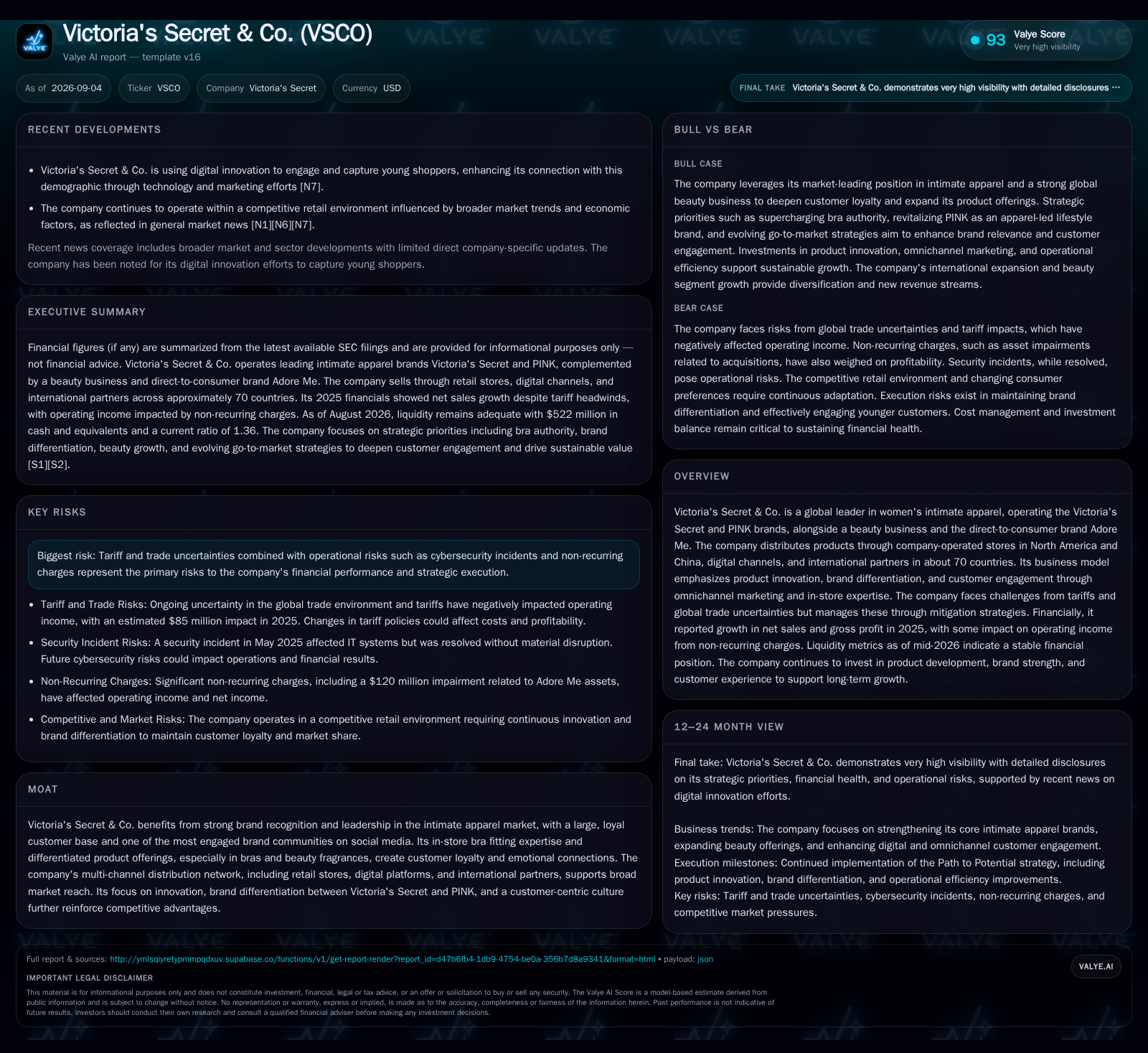
Victoria's Secret & Co. operates two leading intimate apparel brands, Victoria's Secret and PINK, alongside a growing beauty business and direct-to-consumer offerings. Recent financials show modest sales growth despite tariff headwinds and non-recurring charges. The company’s business economics rely on product innovation, brand differentiation, and a diversified omnichannel distribution approach. Competitive pressures and global trade risks pose challenges, but digital innovation and targeted brand strategies offer pathways to deepen engagement and expand margins. Key uncertainties revolve around tariff impacts, the success of brand repositioning, and execution of operational improvements.
Victoria's Secret & Co. continues to navigate a complex retail and global trade environment by emphasizing brand differentiation, product innovation, and digital customer engagement. Its twin pillars, Victoria's Secret as a luxury intimate apparel brand and PINK as a bold lifestyle apparel brand, underpin strategic priorities to deepen customer loyalty and expand market share. Despite challenges from tariffs and non-recurring charges, the company maintains solid liquidity and a focus on operational excellence. The growing beauty segment, particularly fragrance, and direct-to-consumer channels complement its core apparel business, offering diversified growth avenues. How effectively Victoria's Secret executes on brand strategies and manages external risks will shape its financial trajectory and competitive positioning in the near term.
Sales Growth Amid Tariff Headwinds and Operational Challenges
Victoria's Secret & Co. reported a 5% increase in net sales to $6.553 billion in 2025, reflecting successful product innovation and brand differentiation efforts despite significant tariff pressures that reduced operating income by an estimated $85 million [S1]. The company manages a complex global footprint, selling through company-operated stores in North America and China, digital channels, and international partners across approximately 70 countries [S1].
Operating income declined by $39 million to $271 million, impacted notably by a $120 million non-recurring impairment related to Adore Me assets, underscoring risks tied to acquisitions and integration [S1]. Despite this, reported liquidity metrics include $522 million in cash and equivalents and a current ratio of 1.36 as of August 2026, supporting ongoing investments in brand and product development [S2]. Concurrently, the company resolved a May 2025 IT security incident without material disruption, maintaining operational stability [S1].
Revenue Driven by Brand-Led Product Innovation and Omnichannel Reach
Victoria's Secret & Co. generates revenue primarily through intimate apparel sales under Victoria's Secret and PINK brands, complemented by beauty products and direct-to-consumer offerings like Adore Me and DailyLook. Pricing power stems from brand positioning—Victoria's Secret as a premium, sexy brand and PINK as a bold, playful lifestyle brand—allowing differentiation in a competitive apparel market [S1]. Volume growth is supported by omnichannel distribution, combining physical retail, company-owned digital channels, and partner-operated international outlets across about 70 countries, which also facilitates geographic diversification [S1].
Fixed costs include retail store operations and brand marketing, while variable costs relate to product manufacturing and distribution. Tariff impacts elevate cost of goods sold, pressuring gross margins, but ongoing mitigation efforts aim to contain these effects [S1]. Capital intensity arises from store operations and investment in digital platforms, though the company’s operating cash flow of $499 million in 2025 indicates some degree of operating leverage. Product innovation and brand marketing investments serve as key drivers to sustain volume and pricing mix, with risks if consumer preferences shift or tariff costs escalate.
A deeper examination of the unit economics reveals that Victoria's Secret & Co.'s ability to sustain pricing power hinges critically on maintaining strong brand equity amidst evolving consumer preferences. The premium positioning of Victoria's Secret allows for higher gross margins compared to mass-market competitors, but this advantage is vulnerable if competitors successfully emulate or undercut the brand's value proposition. Additionally, the company's omnichannel approach, while providing diversified revenue streams, introduces complexity in inventory management and channel conflict risks. For example, balancing inventory allocation between physical stores and direct-to-consumer digital platforms requires precise demand forecasting to avoid markdowns that erode margins. Digital investments, though capital intensive, can yield scalable customer acquisition and retention benefits if conversion rates and lifetime value metrics improve consistently.
From a cost structure perspective, the fixed costs associated with retail stores and brand marketing create operating leverage that can amplify profitability during periods of volume growth. However, in a scenario of stagnant or declining sales, these fixed costs may pressure operating margins. The tariff-induced cost inflation adds a layer of uncertainty that complicates margin management, particularly if the company cannot fully pass increased costs to consumers without dampening demand. Supply chain diversification and nearshoring initiatives could serve as mitigating strategies but may require upfront investments and operational adjustments. Monitoring the elasticity of demand relative to price changes amid tariff fluctuations will be critical to anticipate margin trajectory and inform pricing strategies.
Brand Differentiation and Customer Engagement as Defensive Assets
Victoria's Secret & Co. holds competitive advantages through strong brand recognition in intimate apparel, a loyal and engaged customer base, and differentiated product offerings especially in bras and beauty fragrances. In-store bra fitting expertise and a multi-channel retail network enhance customer experience and foster switching frictions. The dual-brand strategy—elevating Victoria's Secret as a luxury brand and repositioning PINK as an apparel-led lifestyle brand—helps target distinct customer segments and reduce intra-company brand cannibalization [S1].
However, the company faces pressure from global apparel competitors, fast-fashion retailers, and digital disruptors who may erode market share through pricing, innovation speed, or channel agility. Tariff risks and global trade uncertainties add cost volatility, while cybersecurity events pose operational risks. Maintaining brand relevance among younger consumers is a critical battleground, making successful digital innovation and cultural engagement vital to defending its market position [N7].
Successful Brand Repositioning Fuels Margin Expansion and Global Beauty Growth
In a favorable scenario, Victoria's Secret & Co. leverages its strategic priorities to supercharge bra authority, successfully modernize PINK into an apparel-led lifestyle brand, and deepen customer loyalty through omnichannel marketing and digital innovation. Enhanced product mix and pricing power drive margin expansion, offsetting tariff headwinds. The beauty segment, particularly fragrance, accelerates internationally, benefiting from dedicated beauty-only stores and travel retail distribution, adding high-margin revenue streams [S1].
Confirming evidence would include sustained net sales growth above 5% annually, expanding gross margins despite tariff costs, improving operating income excluding non-recurring charges, and strong digital engagement metrics demonstrating traction with younger demographics. Failure to see these trends or recurring impairments related to acquisitions would falsify this scenario.
The dual-brand strategy introduces both opportunities and risks in competitive positioning. While targeting distinct customer segments reduces internal cannibalization, it necessitates differentiated marketing and product development efforts, which can increase overhead costs. The success of this approach depends on clear brand narratives and consistent consumer experiences across channels. Moreover, the rise of fast-fashion and digitally native brands intensifies pressure on innovation cycles and speed to market, challenging Victoria's Secret & Co. to accelerate product development without compromising quality or brand integrity. Cybersecurity risks, if realized, could disrupt customer trust and operational continuity, underscoring the importance of robust IT governance as part of the competitive moat.
Brand Differentiation Balances Tariff Pressure and Competitive Dynamics
The most plausible middle-path assumes continued modest sales growth driven by brand differentiation and product innovation, with tariff-related cost pressures persisting but largely mitigated through supply chain and sourcing strategies. Operating income growth may remain constrained by non-recurring items and competitive investments in marketing and digital capabilities. The company maintains stable liquidity and operational discipline, supporting steady but unspectacular margin improvement.
Supporting evidence would be consistent sales growth near 5%, stable gross margins with moderate tariff impact, operating income fluctuating with non-recurring charges, and gradual progress in digital engagement and brand repositioning. Conversely, a sharp deterioration in margins or loss of brand relevance would challenge this view.
Escalating Tariffs and Competitive Erosion Pressure Profitability and Growth
A downside case entails worsening tariff and global trade conditions driving higher input costs without sufficient price pass-through, compressing margins. Execution risk in brand repositioning or failure to engage younger consumers could lead to market share losses to faster-moving or lower-cost competitors. Additional non-recurring charges, cybersecurity disruptions, or integration failures related to acquisitions like Adore Me could depress operating income and impair investor confidence.
Key confirming indicators would include declining sales or flat revenue growth, shrinking gross margins, repeated asset impairments, increased cybersecurity incidents, and deteriorating liquidity ratios. Recovery in these metrics or successful cost mitigation would mitigate downside risks.
Evaluating Impact of Tariffs, Brand Engagement, and Operational Efficiency
Critical metrics include net sales growth by brand and geography, gross margin trends adjusted for tariff and cost inflation, and operating income excluding non-recurring items to assess core profitability. Monitoring digital engagement metrics, such as active users and conversion rates on company-owned platforms, will reveal success in attracting younger consumers [N7].
Other key indicators are the trajectory of the beauty segment's revenue, particularly fragrance growth internationally, and the effectiveness of marketing initiatives in driving same-store sales and in-store bra fitting conversions. Liquidity measures like cash and equivalents and current ratio track potential financial flexibility amid trade uncertainties. Lastly, tracking any future security incidents or impairment charges will provide early warning on operational risks.
Investor watchpoints should also include the company's capital allocation decisions, particularly concerning reinvestment in digital capabilities versus physical retail footprint optimization. Given the shifting retail landscape, a strategic recalibration towards high-return digital initiatives could enhance customer lifetime value and operational efficiency. Conversely, overinvestment in underperforming store locations could dilute returns. Additionally, the company's approach to managing tariff-related cost pressures—whether through pricing, sourcing, or product mix adjustments—will be a key determinant of margin resilience. Tracking changes in customer acquisition costs and retention rates will provide early signals about the effectiveness of brand repositioning efforts and digital engagement strategies in sustaining long-term growth.
Disclaimer: This is research-only, informational analysis and not investment advice. It may include AI-generated interpretation and general industry context. Always verify important details using primary sources.

Comments