
Netskope Inc (NTSK) Equity Analysis: Navigating AI-Driven Cloud Security Growth Amid Profitability Challenges
Netskope’s rapid growth in cloud-native security solutions, anchored by AI integration and a robust partner ecosystem, offers a compelling expansion narrative tempered by persistent net losses, long sales cycles, and evolving competitive dynamics.
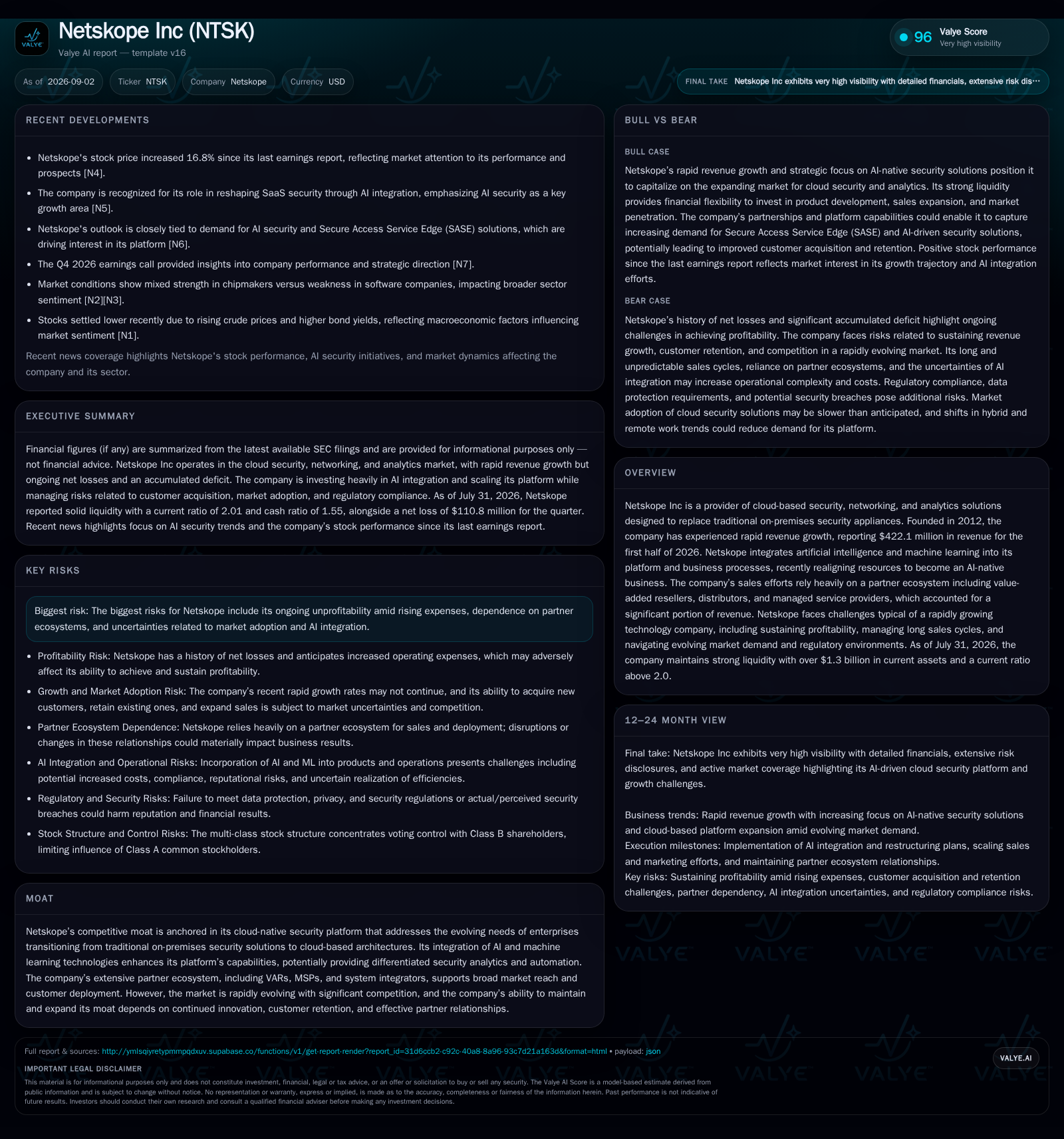
Netskope has emerged as a significant player in cloud security by leveraging AI and machine learning to enhance its platform, driving strong revenue growth and solid liquidity. However, sustaining profitability remains elusive due to rising operating costs, long and unpredictable sales cycles, and dependency on partners. Its competitive moat hinges on technological innovation and ecosystem depth, but regulatory risks, market adoption uncertainties, and execution on AI transformation will shape its trajectory. Investors should monitor customer metrics, AI product integration success, and sales efficiency to gauge future performance.
Netskope Inc stands at the intersection of cloud security evolution and AI-driven innovation, rapidly scaling a platform designed to replace legacy on-premises appliances with cloud-native solutions. Reporting $422.1 million in revenue for the first half of 2026 alongside substantial net losses, the company illustrates the classic rapid-growth cloud security profile: strong top-line momentum paired with ongoing investment-heavy operating models. Its strategic pivot to become an AI-native business reflects recognition of AI's transformative potential in cybersecurity, particularly in the context of emerging Secure Access Service Edge (SASE) demand. While solid liquidity provides a runway for continued expansion, long sales cycles, partner dependency, and evolving regulatory landscapes complicate the path to profitability and sustained competitive advantage.
Latest Operating Snapshot
For the six months ended July 31, 2026, Netskope reported revenue of $422.1 million, a significant increase from $328.5 million in the same period of 2025, showcasing rapid top-line growth in a competitive cloud security market [S2]. Despite this, net losses widened to $227.3 million, reflecting ongoing heavy investment in sales, marketing, and technology development necessary to scale and innovate [S2].
The company’s cash and cash equivalents totaled $220.9 million, supplemented by $846.5 million in short-term investments, resulting in a current ratio of 2.01 and a cash ratio of 1.55, indicating a sound liquidity position [S2]. This potential financial flexibility is essential given the long and unpredictable sales cycles Netskope faces, which require sustained capital outlays before revenues fully mature. The top five partners contributed 39% of revenue, highlighting significant concentration within its channel ecosystem [S2].
Business Model and Unit Economics
Netskope operates a cloud-native security platform delivering software-as-a-service (SaaS) solutions focused on securing cloud usage for enterprises. Revenue generation primarily comes from subscription fees tied to platform usage and service tiers, with pricing likely influenced by volume, feature sets, and integration complexity. The shift from traditional on-premises security appliances to cloud-based solutions underpins volume growth, while AI-driven functionalities may enable premium pricing over time if they demonstrably reduce risk or operational burden.
The business model entails high fixed costs, especially in R&D to develop AI capabilities and in sales and marketing to navigate long sales cycles and complex enterprise procurement processes. Operating leverage could materialize as incremental revenue from existing infrastructure and software platforms with relatively low incremental costs. However, the heavy reliance on partners introduces variable costs and potential margin pressure. Capital intensity is moderate, typical of SaaS, with investments focused on technology infrastructure and compliance rather than physical assets.
Moat, Competition and Counterforces
Netskope’s competitive moat is grounded in its cloud-native platform architecture, which aligns with enterprises' ongoing migration to cloud environments, and its integration of AI and ML that enhance threat detection, response automation, and security analytics. Its partner ecosystem, comprising value-added resellers (VARs), managed service providers (MSPs), and system integrators, extends its market reach and customer deployment capabilities, creating switching friction through embedded relationships.
Nonetheless, the cloud security market is highly competitive and fragmented, involving legacy vendors transitioning to SaaS, specialized AI security startups, and large cloud providers expanding native security offerings. The unpredictability of sales cycles and partner concentration may expose Netskope to operational risk. Additionally, AI integration raises execution complexities and regulatory scrutiny, potentially diluting technological advantage if competitors deploy faster or regulatory burdens escalate.
Bull Case
In the bull scenario, Netskope successfully executes its AI-native transformation, creating differentiated security capabilities that justify premium pricing and deepen customer engagement. Its reported liquidity position enables sustained investment in R&D and sales expansion, accelerating market penetration in the growing SASE and AI security segments. Efficient scaling of partner relationships enhances pipeline predictability and reduces sales cycle length. These factors contribute to improving unit economics and narrowing losses, ultimately leading to sustained profitability.
Supporting evidence includes continued rapid revenue growth exceeding industry benchmarks, expanding gross margins driven by software efficiencies, and improving sales efficiency metrics such as reduced customer acquisition cost and higher customer lifetime value. Falsification would occur if revenue growth stalls, AI feature adoption lags, or customer churn increases, indicating failure to differentiate or scale effectively.
Base Case
Under the base case, Netskope maintains solid revenue growth driven by steady adoption of cloud security and AI functionalities, but profitability improvements remain gradual due to persistent investments in sales and technology. The company’s partner ecosystem generates a reliable but concentrated revenue stream, with some variability in sales cycle duration. Market adoption of SASE and AI security solutions grows steadily but competitive pressures cap pricing power and margin expansion.
Operating leverage emerges slowly as fixed costs are amortized over larger revenue bases, but net losses persist near current levels for the near term. The company successfully navigates regulatory challenges without material disruptions. Key indicators in this scenario are moderate but consistent customer base expansion, stable partner contributions, and incremental improvements in sales cycle efficiency. Deviations would include unexpected margin compression or slower AI integration benefits.
Bear Case
In a downside scenario, Netskope’s revenue growth slows due to slower enterprise adoption of cloud-native security or increased competition from entrenched vendors and cloud hyperscalers offering integrated solutions. The complexity and costs of AI integration fail to yield sufficient differentiation or efficiency gains, exacerbating operating losses. Partner concentration risks materialize, such as key partners reducing commitment or channel conflicts arising, further destabilizing sales pipelines.
Regulatory and compliance burdens increase costs and slow product deployment. Customer retention weakens as competing solutions or changing hybrid work trends reduce demand for Netskope’s offerings. Liquidity pressures emerge if losses continue unchecked, limiting investment capacity. Signs of this bear case include widening net losses relative to revenue, elongating sales cycles, and erosion of partner relationships. Conversely, improved customer metrics or cost rationalization efforts could falsify this outcome.
What Matters Next
Key metrics to monitor include quarterly revenue growth rates and gross margin trends, which indicate operational scaling and product mix shifts. Tracking net loss trajectory and operating expense ratios will reveal if operating leverage is materializing or if investment burn intensifies.
Customer acquisition and retention rates, including net dollar retention, are critical to understanding demand sustainability and platform stickiness. Sales cycle length and partner revenue concentration metrics will inform risks related to go-to-market execution and channel dependency.
Progress on AI and ML integration should be measured by product release cadence, feature adoption rates, and customer feedback on AI-driven capabilities’ impact. Additionally, monitoring regulatory developments in data protection and AI governance is essential to assess compliance risk and potential cost impacts.
Disclaimer: This is research-only, informational analysis and not investment advice. It may include AI-generated interpretation and general industry context. Always verify important details using primary sources.

Comments