
Ollie's Bargain Outlet Holdings, Inc. (OLLI) — Navigating Growth Through Operational Discipline and Distribution Scale
Ollie's Bargain Outlet leverages a growing store network and a robust distribution infrastructure to sustain its value retail proposition amid operational and market risks. Key to future performance is its inventory management, geographic expansion strategy, and labor cost control in a seasonally weighted business.
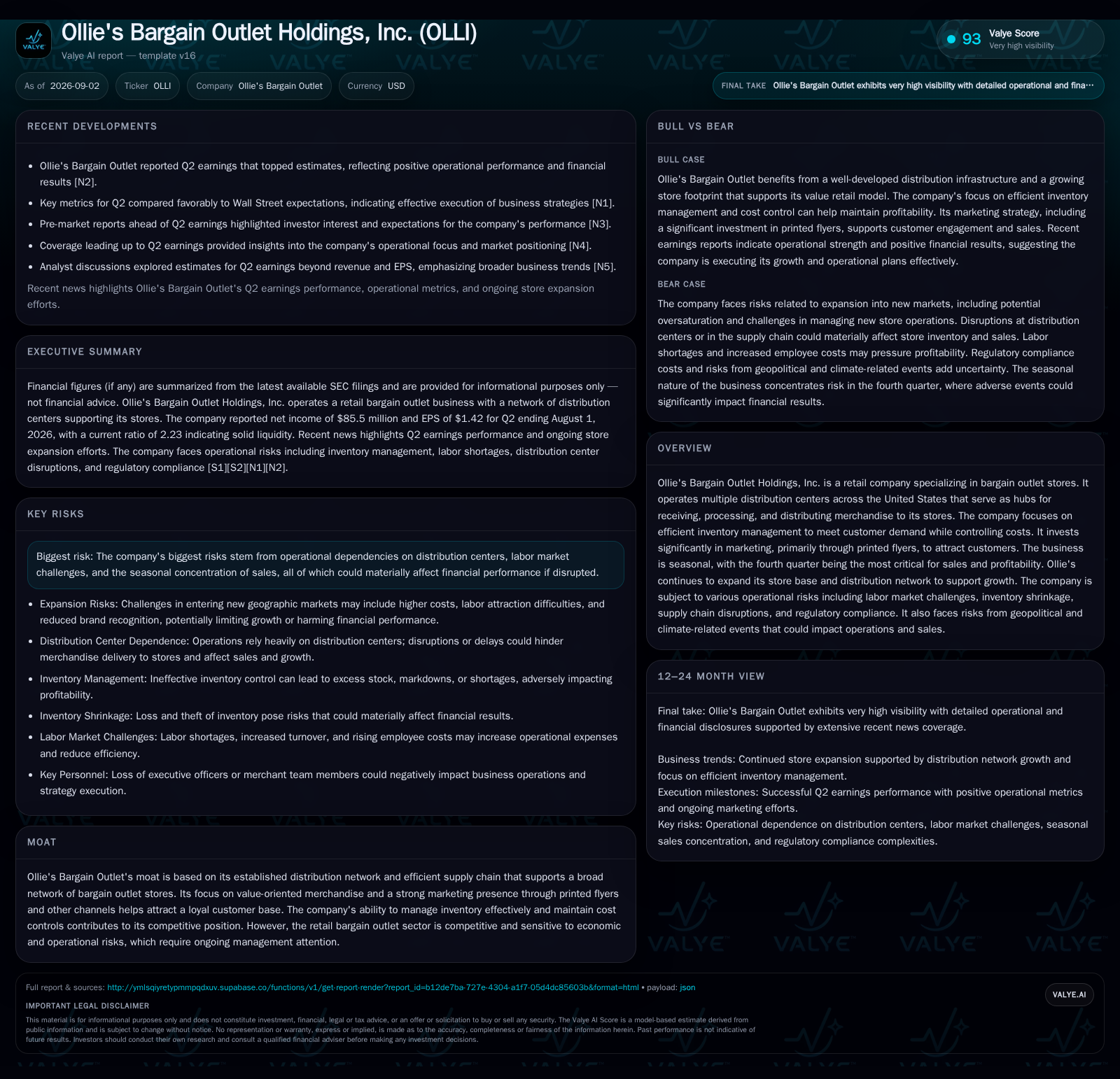
Ollie's Bargain Outlet reported strong Q2 2026 results, driven by effective inventory and cost management alongside ongoing store expansion supported by a multi-region distribution network. While the company’s operational strengths underpin its value retail model, risks from geographic expansion challenges, labor market pressures, and supply chain disruptions remain salient. The business model’s fixed-capital intensity in distribution centers and marketing mix creates operating leverage but also sensitivity to execution missteps, especially given the seasonal revenue concentration in Q4. Investors should focus on the company’s ability to manage inventory shrinkage, maintain labor efficiency, and execute multi-market growth to sustain profitability and competitive positioning.
Ollie's Bargain Outlet Holdings, Inc. (OLLI) reported Q2 2026 results that outpaced expectations, reflecting operational discipline and effective execution of its value retail strategy. Central to Ollie's business model is a growing network of bargain outlet stores supported by strategically located distribution centers that enhance inventory flow and cost efficiency. The company relies heavily on efficient inventory management, targeted marketing primarily through printed flyers, and disciplined cost controls to drive profitability. However, the expansion into new geographies, labor market tightness, and supply chain vulnerabilities present ongoing challenges. Ollie's ability to maintain operating leverage and sustain margin growth amid these headwinds will be pivotal for its medium-term trajectory.
Latest Operating Snapshot
For the quarter ended August 1, 2026, Ollie's Bargain Outlet reported net income of $85.5 million and diluted EPS of $1.42, surpassing Wall Street estimates and indicating robust operational performance [N2][N1]. This earnings beat underscores effective execution of its inventory management and cost control strategies amid ongoing store expansion. The company continues to open new stores and expand its distribution network, with distribution centers located in York, PA; Commerce, GA; Lancaster, TX; and Princeton, IL, which are critical nodes in its supply chain [S1][S2].
Liquidity remains solid, with a current ratio of 2.23 as of August 1, 2026, supported by cash and cash equivalents of $120.8 million against current liabilities of $411.6 million, reflecting prudent working capital management [S2]. Marketing efforts remain heavily weighted toward printed flyers, which accounted for over 40% of advertising spend in 2025, signaling the importance of traditional channels in customer engagement [S1]. Seasonal dynamics continue to dominate, with the fourth fiscal quarter remaining the most critical period for sales and profitability, concentrating execution risk in that timeframe [S1].
Business Model and Unit Economics
Ollie's business model centers on sourcing value-priced merchandise through its merchant teams who negotiate terms and purchase inventory, which is then funneled through a network of distribution centers before reaching retail stores. The company’s revenue generation depends on the volume of goods sold at bargain prices, with profitability hinging on inventory turnover, pricing mix, and cost control. Inventory management is pivotal; excess stock can lead to markdowns that erode margins, while shortages risk lost sales. The company’s cost structure includes significant fixed elements such as distribution center operations and marketing spend, alongside variable costs tied to labor and logistics.
Operating leverage is embedded in the fixed costs of distribution centers and marketing infrastructure, meaning that volume growth can positively leverage profitability if incremental sales cover fixed overhead. However, the capital intensity of expanding distribution capacity and opening new stores requires careful balancing of growth and return on invested capital. Labor costs and efficiency in distribution centers and stores directly impact operating margins, making workforce management a crucial lever. Pricing power is constrained by the bargain outlet positioning, so volume and cost discipline remain the primary drivers of margins.
Moat, Competition and Counterforces
Ollie's moat derives principally from its established distribution network that enables cost-efficient inventory flow to a growing store base, supporting its value retail model. The company’s marketing strategy, especially its reliance on printed flyers, helps sustain customer foot traffic in a segment where consumers are highly price sensitive and brand loyalty is moderate. Effective inventory management and sourcing expertise help differentiate the company by ensuring merchandise availability and value perception. These factors generate moderate switching frictions for customers seeking bargain merchandise with a consistent shopping experience.
Competitive pressures stem from other off-price retailers, discount chains, and e-commerce platforms that compete for similar price-conscious consumers. The retail bargain outlet sector's low barriers to entry mean new entrants could erode pricing or customer share. Geographic expansion introduces competitive variability as local market dynamics, customer demographics, and competitor presence differ, challenging Ollie's standardized model. External risks include inflationary pressures on labor and transportation costs and the risk of inventory shrinkage, which can dilute margins and operational efficiency.
Bull Case
In an optimistic scenario, Ollie's continues to leverage its distribution infrastructure and operational expertise to expand its store footprint profitably across new geographies. Efficient inventory management prevents markdowns and shrinkage, preserving margins, while labor productivity gains offset rising wage pressures. The company’s marketing mix, notably the effective use of printed flyers combined with digital channels, sustains and grows customer traffic, reinforcing sales volume growth. Solid execution in the critical fourth quarter drives outsized profitability, enabling the company to deploy capital into further network expansion, feeding a virtuous cycle of scale economies and margin expansion.
Confirming evidence would include sustained margin improvements, consistent inventory turnover metrics, and successful entry into new markets without margin dilution. Key falsification tests would be a decline in comparable store sales, rising markdown frequency, or deteriorating labor efficiency that pressures costs beyond manageable levels.
Base Case
Under the base case, Ollie's maintains steady growth with moderate store expansion and stable operational performance. Inventory management remains effective but faces occasional disruption, leading to some markdowns and shrinkage that weigh on margins. Labor market challenges cause incremental wage inflation but are partially offset by operational adjustments and moderate price increases consistent with the bargain retail positioning. Marketing effectiveness plateaus, maintaining customer engagement without significant growth. Seasonal fourth quarter sales experience typical variability but do not materially disrupt annual profitability.
This scenario assumes ongoing but manageable risks from distribution center operations and supply chain disruptions, with no major geopolitical or climate events impacting the business. The company’s financial metrics and liquidity remain sufficient to support capital investments and working capital needs without stress.
Bear Case
In a downside scenario, Ollie's faces significant challenges expanding into new markets, encountering oversaturation and operational inefficiencies that depress returns. Disruptions at distribution centers or supply chain bottlenecks cause inventory shortages and lost sales. Labor shortages intensify, driving sharply higher employee costs and turnover, which the company cannot fully offset with productivity improvements. Increased inventory shrinkage and markdowns erode margins, while marketing channels lose effectiveness amid intensifying competition, leading to declining customer traffic.
External shocks such as geopolitical instability, climate-related disruptions, or regulatory cost increases exacerbate operational risks. The business’s heavy reliance on fourth quarter sales amplifies the impact of adverse events in this period, potentially triggering a material decline in earnings. Signs confirming this scenario would include margin compression, negative same-store sales growth, and deteriorating liquidity metrics. Conversely, signs of recovery or cost control would argue against this bear case.
What Matters Next
Key performance indicators to watch include comparable store sales growth, inventory turnover rates, and markdown frequency, which together signal inventory management effectiveness and demand trends. Labor cost trends and employee turnover rates will indicate pressure or relief in operational efficiency and margin sustainability. Expansion metrics such as new store openings and distribution center capacity utilization measure growth execution and capital efficiency.
Marketing ROI, particularly the effectiveness of printed flyers versus digital campaigns, will reveal customer engagement sustainability. Seasonal sales performance in the fourth quarter is critical to overall profitability and risk concentration. Monitoring supply chain stability and shrinkage rates will provide early warning of operational disruptions. Finally, regulatory compliance costs and external event impacts such as geopolitical or climate disturbances remain important external risk factors to assess.
Disclaimer: This is research-only, informational analysis and not investment advice. It may include AI-generated interpretation and general industry context. Always verify important details using primary sources.

Comments