
Pasqal Holding SA: Strategic Expansion in Quantum Computing Amid Execution and Market Uncertainties
Pasqal Holding SA, a nascent French quantum technology company, leverages proprietary neutral-atom quantum computing and strategic Middle East partnerships to build market presence and technology capabilities. However, its path to commercial viability is tempered by execution risks, limited financial transparency, and the uncertain adoption curve of quantum computing.
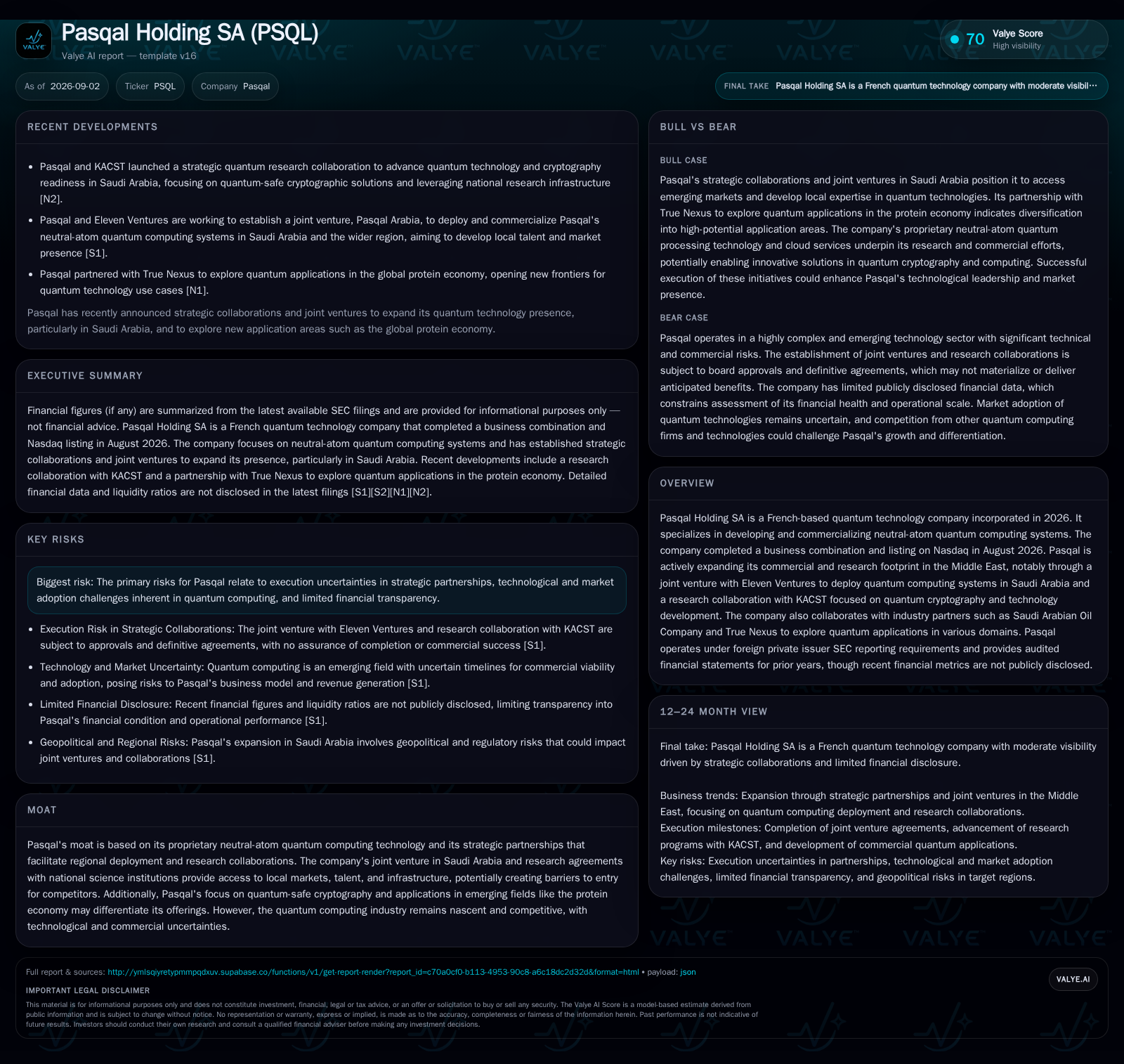
Pasqal Holding SA, newly listed on Nasdaq and focused on neutral-atom quantum computing, is actively expanding through strategic joint ventures and research collaborations in Saudi Arabia and partnerships exploring novel quantum applications. While these moves could establish regional footholds and diversify use cases, challenges remain around execution of agreements, market adoption, competitive positioning, and financial visibility.
Pasqal Holding SA, incorporated in 2026 and recently listed on Nasdaq, represents an emergent player in the quantum computing space focused on neutral-atom technology. The company is pursuing a strategic expansion primarily through partnerships and joint ventures in the Middle East, notably Saudi Arabia, aiming to commercialize and deploy quantum systems while fostering local talent and research capabilities. Despite the promise of its proprietary technology and collaborative approach, Pasqal faces significant execution risks amid the inherently uncertain quantum computing market and limited financial transparency. This analysis unpacks the company’s business model, competitive dynamics, and potential pathways to value creation or downside outcomes.
Latest Operating Snapshot
Pasqal Holding SA completed its business combination and Nasdaq listing in August 2026, marking its public-market debut as a French-incorporated quantum technology company specializing in neutral-atom quantum computing systems [S1][S2]. This milestone provides Pasqal with access to capital markets, enhancing its potential to fund R&D and commercial expansion but also increasing scrutiny and reporting obligations.
The company is actively building a presence in the Middle East through strategic initiatives: a joint venture with Eleven Ventures named Pasqal Arabia aims to deploy and operate Pasqal's quantum systems in Saudi Arabia, subject to board approvals and definitive agreements [S1]. Concurrently, Pasqal has launched a research collaboration with King Abdulaziz City for Science and Technology (KACST) focused on advancing quantum-safe cryptography and quantum technology research [N2][S1]. These developments are complemented by partnerships with industry players such as Saudi Aramco and True Nexus to explore quantum applications in energy and the protein economy sectors [S1][N1]. The regional focus reflects a strategic choice to leverage emerging markets with strong government and institutional interest in quantum technologies.
Notably, Pasqal has not publicly disclosed recent financial figures or liquidity ratios in its SEC filings, limiting external evaluation of its capital resources and operational scale [S1]. This opacity complicates assessment of runway and investment capacity, especially given the high capital intensity and long development cycles typical in quantum computing.
The company's reliance on foreign private issuer status and filing of annual Form 20-F and material events on Form 6-K with the SEC ensures some level of regulatory compliance and transparency, but detailed financial and operational metrics remain sparse [S1].
Business Model and Unit Economics
Pasqal generates value primarily through the development, deployment, and operation of neutral-atom quantum computing systems. Its business model appears to blend hardware sales or deployments with cloud-based quantum processing services, particularly in cryptographic and computational research applications. Revenue drivers likely include system sales or leases to strategic partners and customers, recurring cloud service fees, and potentially licensing of proprietary technology or specialized applications developed through collaborations.
Neutral-atom quantum computing technology, distinguished by trapping and manipulating individual atoms using lasers, offers theoretical advantages in scalability and lower error rates compared to other qubit platforms, such as superconducting or trapped-ion systems. However, commercial-scale systems require significant upfront capital investment in precision hardware and infrastructure, implying high fixed costs and capital intensity. Operating leverage could emerge as Pasqal scales cloud service offerings and expands deployment, with incremental utilization improving margin profiles if fixed costs are absorbed over growing customer bases.
Volume economics remain uncertain given the nascent market; demand depends on the pace of quantum adoption and the relevance of Pasqal’s technology to target use cases. Pricing likely reflects a premium given the cutting-edge nature of the technology, but competitive pressures and evolving industry standards may influence pricing power. Customer willingness to pay will depend on demonstrated quantum advantage, integration complexity, and switching frictions created by proprietary technology or platform ecosystems.
Pasqal’s joint ventures and collaborations introduce shared capital and operational commitments, potentially mitigating capital needs and enabling local talent development. However, these arrangements also introduce execution risk and rely on successful commercialization pathways. The firm’s cloud services and application partnerships suggest a move toward recurring revenue streams, which if successfully scaled, could improve revenue predictability and operating leverage.
Moat, Competition and Counterforces
Pasqal’s primary moat derives from its proprietary neutral-atom quantum computing technology, which may offer competitive advantages in qubit coherence times, scalability, and system stability. This technological differentiation, if validated at scale, could create a barrier to entry against incumbents focused on superconducting or ion-trap qubits. Additionally, its strategic partnerships and joint ventures—especially in Saudi Arabia—facilitate access to emerging markets, local regulatory support, and specialized talent pools, potentially erecting geographic and institutional moats.
However, the quantum computing sector remains highly fragmented and nascent, with multiple competing platforms and no clear market standards. Larger, well-funded players such as IBM, Google, IonQ, and Rigetti pursue alternative technologies with significant R&D investments, which could outpace or marginalize Pasqal’s approach if it fails to demonstrate superior performance or scalability.
The joint venture model introduces dependency on partner execution and alignment, which may weaken control and dilute competitive advantage. Moreover, Pasqal’s focus on quantum-safe cryptography and emerging applications in the protein economy indicates an attempt at horizontal diversification, but these markets are themselves in early stages with uncertain commercial dynamics.
Countervailing forces include rapid technological advances by competitors, the risk of alternative quantum architectures gaining dominant standards, and geopolitical or regulatory changes affecting international collaborations. The company must also contend with talent competition, intellectual property challenges, and evolving customer requirements that could erode its differentiation.
Bull Case
In the bull scenario, Pasqal successfully executes its joint venture with Eleven Ventures, establishing Pasqal Arabia as a regional hub for quantum computing deployment and talent development. This foothold enables early access to Middle Eastern markets where government and industrial customers have strong quantum ambitions and funding, facilitating recurring revenue from system operations and cloud services. The collaboration with KACST accelerates development of quantum-safe cryptography solutions, positioning Pasqal as a key provider in a critical cybersecurity niche with tangible commercial demand.
Further, the partnership with True Nexus advances Pasqal’s application portfolio into the protein economy, unlocking novel, high-value use cases that demonstrate quantum advantage and attract additional clients. Pasqal’s neutral-atom platform proves scalable and reliable, delivering competitive performance relative to incumbent quantum technologies, which strengthens pricing power and industry reputation. Confirming evidence includes definitive joint venture agreements, growing order book or subscription numbers, successful technology milestones, and expanding intellectual property. Falsification would occur if partnerships dissolve, technology fails to scale, or credible competitors dominate target markets.
Base Case
Pasqal manages to secure definitive agreements for its joint venture and maintains active research collaborations, but commercial deployment progresses slowly due to the inherent technical challenges and cautious customer adoption typical in quantum computing. The company secures pilot projects and limited deployments with regional partners, generating modest revenues primarily from cloud and research services rather than large-scale system sales. The neutral-atom technology remains competitive but does not decisively outperform alternative platforms, leading to a fragmented market presence.
Financially, Pasqal maintains adequate capital to fund near-term R&D and operational expenses through its Nasdaq listing proceeds and partner contributions but continues to require incremental funding rounds. Revenue growth is gradual, and operating leverage remains limited as fixed costs persist without scale. The company’s diversification into cryptography and protein economy applications yields experimental results but not immediate commercial impact. Confirming evidence includes executed joint venture agreements, modest revenue growth, and ongoing technology validation. Falsification would be rapid contract cancellations, inability to raise capital, or technology obsolescence.
Bear Case
In a downside scenario, Pasqal fails to finalize its joint venture or research agreements, stalling regional expansion and limiting market access. The technical complexity of neutral-atom quantum systems leads to development delays or performance shortfalls relative to competitors, undermining customer confidence and eroding pipeline opportunities. The broader quantum computing market adoption timeline extends significantly, constraining revenue generation and increasing cash burn.
Financial opacity and lack of disclosed liquidity raise concerns about Pasqal’s ability to sustain operations without dilutive funding, increasing risk of capital shortfall. Geopolitical tensions or regulatory constraints in Saudi Arabia could disrupt partnerships or technology transfer, exacerbating growth challenges. Failure to translate research collaborations into commercial products or to secure meaningful customer contracts would confirm this bear thesis. Conversely, securing at least limited commercial deployments or visible technology progress would falsify it.
What Matters Next
Key performance indicators to watch include finalization and board approval of the Pasqal Arabia joint venture agreements, which will signal commitment and resource allocation for regional expansion. The pace and scale of system deployments and quantum processing unit utilization in Saudi Arabia, especially with strategic customers like Saudi Aramco, will indicate commercial traction and operational capability.
Technological milestones such as improvements in qubit count, error rates, and system stability for the neutral-atom platform will be critical to validating the company’s competitive positioning. Progress in quantum-safe cryptography solutions developed through the KACST collaboration, including pilot implementations or government endorsements, will reflect strategic relevance.
Financial disclosures on capital raises, cash runway, and revenue breakdowns will be essential to assess capital intensity, operating leverage, and sustainability. Additionally, developments in the partnership with True Nexus targeting quantum applications in the protein economy could reveal new growth avenues or diversification success.
External factors such as geopolitical stability in the Middle East, regulatory environments for technology exports and collaborations, and competitive moves by alternative quantum technology providers will influence Pasqal’s strategic options and risk profile.
Disclaimer: This is research-only, informational analysis and not investment advice. It may include AI-generated interpretation and general industry context. Always verify important details using primary sources.

Comments