
Credo Technology Group Holding Ltd: Strategic Positioning in AI-Driven High-Speed Connectivity
Credo Technology capitalizes on its proprietary SerDes and DSP technologies to address the accelerating demand for high-speed, power-efficient interconnect solutions in AI and cloud data center infrastructure, navigating competitive pressures and execution risks amid significant growth opportunities in optical products.
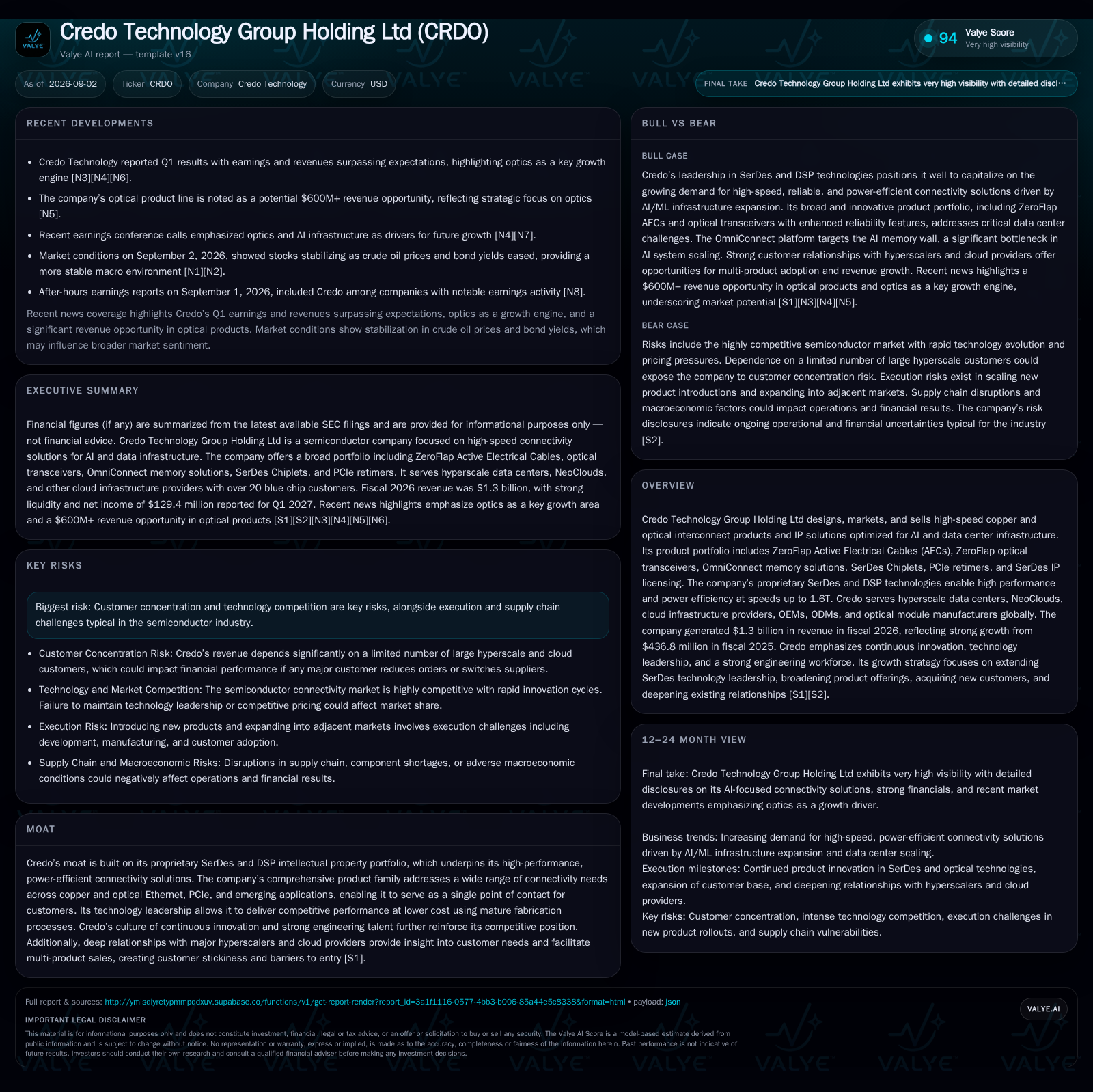
Credo Technology, specializing in high-speed copper and optical interconnect semiconductors, reported $1.3 billion revenue in fiscal 2026 with reported liquidity position and expanding margins. Its moat derives from proprietary SerDes/DSP IP and a broad product portfolio focused on AI data infrastructure. The company’s growth hinges on extending technology leadership, deepening hyperscale customer relationships, and scaling optics—a segment poised for $600M+ annual revenue. Key risks include customer concentration, intense competition, and execution complexity. The outlook depends on sustained innovation, successful product launches, and market adoption amid evolving AI infrastructure needs.
Credo Technology Group Holding Ltd operates at the nexus of semiconductor innovation and AI infrastructure growth, delivering high-speed copper and optical interconnect solutions optimized for hyperscale data centers and cloud providers. Leveraging proprietary SerDes and DSP intellectual property, Credo’s expansive portfolio—including ZeroFlap Active Electrical Cables and optical transceivers—addresses critical bottlenecks in data throughput and power efficiency. Fiscal 2026 revenues more than tripled to $1.3 billion, reflecting successful market penetration and product diversification, particularly into optics, which now presents a $600 million-plus revenue opportunity. The company’s competitive advantage centers on technology depth and close partnerships with leading hyperscalers, yet its future depends on navigating execution risks and competitive dynamics in a rapidly evolving semiconductor landscape.
Latest Operating Snapshot
Credo Technology reported fiscal 2026 revenue of $1.3 billion, a nearly threefold increase from $436.8 million in fiscal 2025, underscoring rapid growth fueled by expanding demand for AI-focused data infrastructure connectivity solutions [S1]. The first quarter of fiscal 2027 saw net income of $129.4 million with EPS of $0.70 basic and $0.67 diluted, reflecting improving profitability alongside revenue expansion [S2].
The company’s liquidity position is robust, with $466.9 million in cash and $297.4 million in short-term investments, resulting in a current ratio of 7.4 and a cash ratio of 3.86 as of August 1, 2026, indicating strong capacity to fund R&D and operational expansion [S2]. Recent earnings reports highlighted optics as a key growth driver, with management identifying a $600 million-plus revenue opportunity in optical products, signaling strategic emphasis on this segment [N3][N5][N6].
Business Model and Unit Economics
Credo’s revenue derives from the design, manufacturing, and sale of high-speed copper and optical interconnect products and IP licensing, including SerDes Chiplets and PCIe retimers. Pricing dynamics likely combine per-unit hardware sales with IP licensing fees, where volume growth is driven by data center scaling and AI infrastructure expansion. The company's portfolio diversification into optics and memory solutions broadens addressable markets and mitigates reliance on any single product line [S1].
Operating leverage emerges from fixed R&D and engineering costs relative to variable manufacturing costs. The company’s emphasis on mature fabrication processes for cost efficiency supports margin expansion as volumes scale. However, capital intensity remains moderate compared to pure foundries, with investment focused on design and testing capabilities more than heavy manufacturing. Sustained growth hinges on scaling newer products like optical transceivers and OmniConnect memory solutions to leverage fixed engineering investments and dilute overhead.
Moat, Competition and Counterforces
Credo’s moat is anchored in its proprietary SerDes and DSP technology portfolio, delivering differentiated power efficiency and performance at speeds up to 1.6T. This technology backbone supports a broad product suite that addresses diverse connectivity needs across copper and optical domains, enabling integrated solutions for hyperscale customers seeking simplified supply chains and multi-product sourcing [S1]. Continuous innovation and a strong engineering workforce of 616 further reinforce competitive barriers.
Nevertheless, the semiconductor connectivity market is fiercely competitive and rapidly evolving, with competitors ranging from established semiconductor giants to emerging startups focused on optical interconnects and AI accelerators. Customer concentration risk is material, as Credo depends heavily on a limited number of hyperscale and cloud providers. Execution risks in new product launches and market expansion, as well as supply chain vulnerabilities, could erode advantages if not managed carefully [S2].
Bull Case
In a favorable scenario, Credo continues to extend its SerDes and DSP technology leadership, capturing outsized market share as AI/ML workloads drive explosive demand for high-speed, power-efficient connectivity. The company successfully scales its optical product line, capitalizing on the identified $600M+ revenue opportunity, supported by the ZeroFlap optical transceiver innovations. Strong multi-product adoption by hyperscalers and NeoClouds drives rising average selling prices and recurring revenue streams from IP licensing.
Confirming evidence would include sustained revenue growth above 50%, margin expansion from scale, and consistent wins with major cloud providers. Falsification would occur if competitors deliver superior technology at lower cost or if hyperscalers diversify supply away from Credo, leading to revenue stagnation or contraction.
Base Case
The base case anticipates continued solid growth driven by data center and AI infrastructure expansion, with Credo maintaining technology leadership but facing incremental pricing pressures. Optical products grow steadily but do not fully realize the $600M potential within the next several years. Customer concentration remains manageable, and new product introductions achieve moderate success, balancing R&D investment against returns.
Evidence supporting this view includes steady revenue growth near 30-40%, stable gross margins amid competitive pricing, and gradual expansion of the customer base. Signs contradicting this would be significant margin erosion, loss of a major customer, or delays in product ramp-ups that stall growth.
Bear Case
Downside risks manifest if rapid technological shifts or competitor breakthroughs diminish Credo’s SerDes/DSP advantage, leading to market share loss. Execution difficulties scaling optical and memory product lines could inflate costs and depress margins. Customer concentration exposes the firm to revenue shocks if one or more hyperscalers reduce orders or switch suppliers. Additionally, supply chain disruptions or macroeconomic downturns could constrain production and demand simultaneously.
Evidence of bear-case unfolding would be declining revenues, compressing margins, missed product milestones, and deteriorating customer relationships. Conversely, new strategic partnerships or technology breakthroughs would mitigate such risks.
What Matters Next
Key performance indicators to monitor include quarterly revenue growth rates, especially in optical products; gross margin trends indicating operating leverage; new product shipment volumes and customer adoption rates; diversification of customer base beyond top hyperscalers; and R&D spending efficiency reflecting innovation output.
Additional milestones include successful integration and commercialization of OmniConnect memory solutions, expansion of IP licensing revenue streams, and supply chain stability metrics. External conditions such as AI infrastructure investment cycles and competitor technology developments will also critically influence Credo’s trajectory.
Disclaimer: This is research-only, informational analysis and not investment advice. It may include AI-generated interpretation and general industry context. Always verify important details using primary sources.

Comments