
PVH Corp. (PVH) Equity Analysis: Navigating Tariffs, Transformation, and Margin Pressure in Global Apparel
PVH is a major global apparel company balancing legacy brand strength and distribution breadth against tariff headwinds, operational transitions, and profitability erosion. Its future hinges on digital innovation, wholesale strategy execution, and margin restoration amid competitive and macroeconomic challenges.
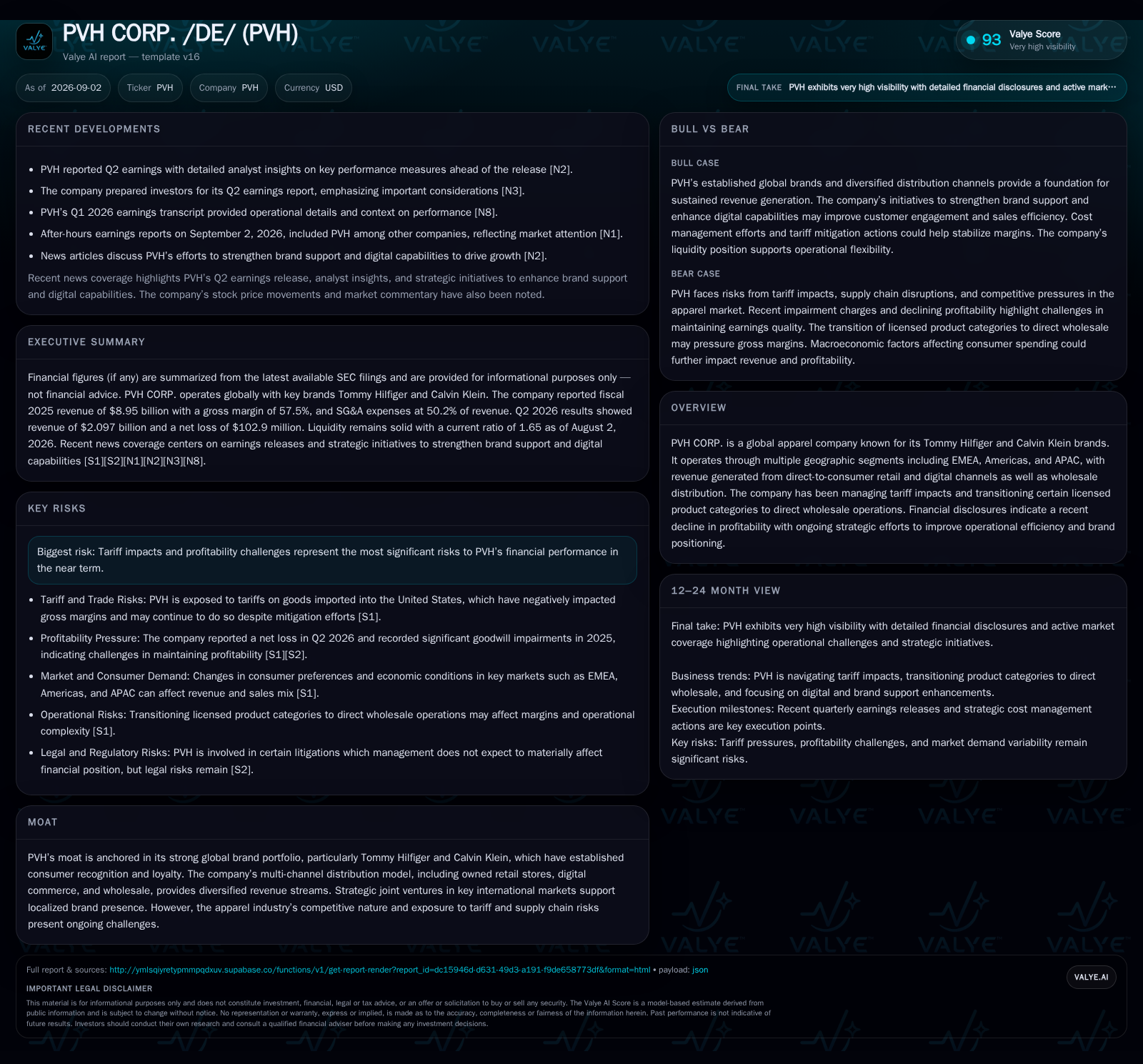
PVH operates globally with iconic brands Tommy Hilfiger and Calvin Klein, generating nearly $9 billion in revenue through retail, digital, and wholesale channels. Despite solid liquidity, the company faces margin contraction from tariffs, product mix shifts, and promotional intensity. Transitioning licensed categories to direct wholesale introduces complexity that could pressure margins further. Strategic emphasis on strengthening brand support and digital capabilities aims to enhance customer engagement and operational efficiency. The business model offers diversified revenue streams and geographic exposure but contends with intense competition and macroeconomic sensitivity. The path to profitability recovery depends on effective tariff mitigation, cost control, and successful wholesale integration.
PVH Corp. stands at a crossroads where its heritage brands and global scale confront significant operational and profitability challenges. The apparel giant’s 2025 results showed modest revenue growth but shrinking gross margins, reflecting tariff headwinds and changing product mix dynamics. In Q2 2026, PVH reported a substantial net loss amid ongoing cost pressures and strategic shifts, including the transition of previously licensed product categories to direct wholesale channels. This move, combined with intensified promotional activity and supply chain complexities, tests the company’s operational leverage and margin resilience. PVH’s capacity to leverage its brand strength and diversified distribution through digital enhancements and cost controls will shape its trajectory in a highly competitive, tariff-impacted global apparel market.
Latest Operating Snapshot
PVH reported full-year 2025 revenue of $8.95 billion, a 3% increase over 2024, driven primarily by growth in the Americas and EMEA regions, while APAC experienced declines. Gross profit totaled $5.149 billion but gross margin receded to 57.5% from 59.4% the prior year, reflecting tariff impacts, product mix shifts, and greater promotional intensity. Selling, general & administrative expenses were $4.492 billion or 50.2% of revenue, slightly lower as a percentage despite absolute growth. The company recorded a $480 million goodwill and intangible asset impairment charge in Q1 2025 attributable to increased discount rates, signaling challenges in asset valuation and earnings quality [S1].
In Q2 2026, PVH reported revenue of approximately $2.097 billion but a net loss of $102.9 million, with basic and diluted EPS at -$2.23. Liquidity remains solid with cash and cash equivalents of $965.9 million and a current ratio of 1.65, indicating capacity to meet short-term liabilities. The company’s business model spans direct-to-consumer retail, digital commerce, and wholesale distribution, with recent strategic shifts transitioning certain previously licensed product categories to direct wholesale operations. Tariff mitigation efforts continue amid persistent cost pressures [S1][S2].
Business Model and Unit Economics
PVH generates revenue primarily through two channels: direct-to-consumer (DTC) retail and digital sales, and wholesale distribution to third-party retailers. Its portfolio includes premium lifestyle brands Tommy Hilfiger and Calvin Klein, which serve a broad demographic spectrum. Pricing power is moderate, constrained by competitive apparel markets and consumer sensitivity to price promotions, which the company has increased to drive volume amid weaker demand. Volume growth is geographically mixed, with Americas and EMEA showing expansion while APAC declines reflect regional challenges.
Economically, PVH bears significant fixed costs in brand marketing, retail store operations, and global supply chain management, with SG&A running above 50% of revenue. This high fixed cost base amplifies operating leverage, making profitability sensitive to volume and margin shifts. Tariffs on imports into the U.S. add to landed cost, compressing gross margins unless offset by pricing or supply adjustments. Transitioning licensed product categories to direct wholesale suggests a shift toward higher-margin revenue but adds operational complexity and working capital demands, potentially increasing capital intensity in the near term. Digital investments may improve margin efficiency over time but require sustained execution.
Moat, Competition and Counterforces
PVH’s moat rests on its globally recognized brands, particularly Tommy Hilfiger and Calvin Klein, which benefit from established consumer loyalty and broad geographic reach. Its multi-channel distribution—encompassing owned retail stores, e-commerce platforms, and wholesale partners—diversifies revenue streams and reduces dependence on any single segment. Strategic joint ventures in markets like Mexico, India, Brazil, and North America enhance localized market penetration and brand support. These factors create switching frictions for consumers familiar with the brands and retailers reliant on their inventory.
However, the apparel industry’s competitive landscape is intense, populated by fast fashion, luxury brands, and digitally native vertical brands that can rapidly capture shifting consumer preferences. Tariff exposure and supply chain disruptions act as structural headwinds, eroding cost competitiveness. The transition from licensing to direct wholesale operations may dilute margin benefits if scale or integration challenges arise. Consumer behavior volatility and economic cycles further pressure demand and pricing power, limiting the sustainability of the moat without continual innovation and brand reinvigoration.
Bull Case
If PVH successfully executes its strategy to strengthen brand support and enhance digital capabilities, it could improve customer engagement, increase direct sales, and reduce reliance on promotional discounts. This would enhance pricing power and gross margins. Effective tariff mitigation—through supply chain diversification, nearshoring, or cost pass-through—could stabilize input costs and protect profitability. The transition of licensed product categories into direct wholesale channels may unlock higher-margin revenue streams if operational integration is smooth and scale efficiencies emerge.
Confirming evidence for this scenario would include margin expansion, stabilization or growth in operating income, positive free cash flow generation, and improvements in digital sales penetration. A clear reduction in tariff-related cost impacts and successful joint venture partnerships supporting localized growth would further validate this path. Conversely, failure to improve margins despite revenue growth or recurring quarterly losses would falsify this bull case.
Base Case
PVH continues to generate stable revenue growth in core markets, supported by its brand portfolio and diversified channels, but margin expansion remains elusive due to ongoing tariff pressures and competitive promotional activity. The transition of licensed categories to direct wholesale proceeds but introduces operational complexities and modestly compresses margins in the near term. Digital initiatives improve customer touchpoints but do not fully offset cost headwinds. Profitability remains pressured with modest or flat operating income, and liquidity supports operations without major capital constraints.
This scenario envisions gradual recovery in profitability as tariff mitigation and cost control measures mature but full margin restoration requires several quarters or years. Evidence supporting this view includes persistent gross margin pressure offset by controlled SG&A growth, continued net losses or low single-digit operating margins, and incremental but not transformational gains in digital sales. A stable but unimpressive earnings trajectory without significant impairment charges would align with the base case.
Bear Case
PVH encounters sustained profitability deterioration driven by escalating tariff costs, intensifying promotional competition, and operational disruptions from the wholesale transition. The goodwill impairment recorded in 2025 signals potential overvaluation of intangible assets that may worsen if brand momentum weakens or consumer preferences shift away from PVH’s core brands. Consumer demand softness in key markets, worsened by macroeconomic downturns, further depresses volume and pricing power. The company’s fixed cost structure magnifies operating losses, and capital requirements for digital transformation and inventory management strain liquidity.
Confirming evidence includes consecutive quarterly net losses, downward revisions to revenue or margin guidance, additional impairment charges, shrinking market share, or cash flow deficits necessitating financing. The bear case would be falsified if tariffs recede materially, operational execution improves with margin recovery, or brand rejuvenation drives a sustained sales rebound.
What Matters Next
Key performance indicators to monitor include gross margin trends, especially in relation to tariff impacts and product mix shifts, as these directly affect profitability. Operating income and net earnings will reveal if cost controls and strategic initiatives are effective. Digital sales penetration metrics and comparable store sales growth in DTC channels will indicate success in customer engagement improvements. The pace and profitability of transitioning licensed categories to direct wholesale operations are critical, as is inventory turnover reflecting supply chain efficiency.
Liquidity metrics such as cash flow from operations and current ratio should be tracked to assess potential financial flexibility. Tariff developments and related mitigation effectiveness remain external factors that could alter cost structures. Finally, monitoring impairment charges or goodwill valuations offers insight into asset quality and management’s confidence in brand value sustainability.
Disclaimer: This is research-only, informational analysis and not investment advice. It may include AI-generated interpretation and general industry context. Always verify important details using primary sources.

Comments