
CIENA’s AI-Driven Optical Network Growth: Navigating Innovation and Competitive Pressures
CIENA’s recent surge in AI-led cloud demand has propelled strong revenue growth, but sustaining this momentum depends on its ability to leverage integrated hardware-software solutions, manage capital intensity, and navigate evolving competitive and technological challenges in optical networking.
CIENA reported a robust Q3 2026 with 37% revenue growth driven by AI-enabled cloud infrastructure demand, underpinned by its diversified optical networking and automation software portfolio. The company’s business model combines hardware sales with increasingly software-driven automation services, creating opportunities for operating leverage but also requiring sustained innovation and capital investment. Competitive pressures and rapid technology shifts pose risks, yet CIENA’s integrated solutions and customer relationships provide a foundation for potential durable advantage. The key question is whether CIENA can maintain growth and margin expansion amid intensifying competition and evolving customer spending patterns.
CIENA’s Q3 2026 results highlight the company’s pivotal role in supporting AI-led cloud infrastructure through its optical networking and automation solutions, delivering a 37% revenue increase year-over-year. This surge underscores the growing importance of high-capacity, automated network platforms tailored for data centers and cloud operators. However, sustaining such momentum requires CIENA to navigate the inherent challenges of a capital-intensive industry, evolving customer demands, and competitive pressures from both legacy telecom equipment providers and new cloud-native entrants. This analysis explores CIENA’s business economics, competitive positioning, and plausible future scenarios shaping its trajectory in the rapidly transforming networking landscape.
AI Demand Sparks Revenue Surge in Optical Networking
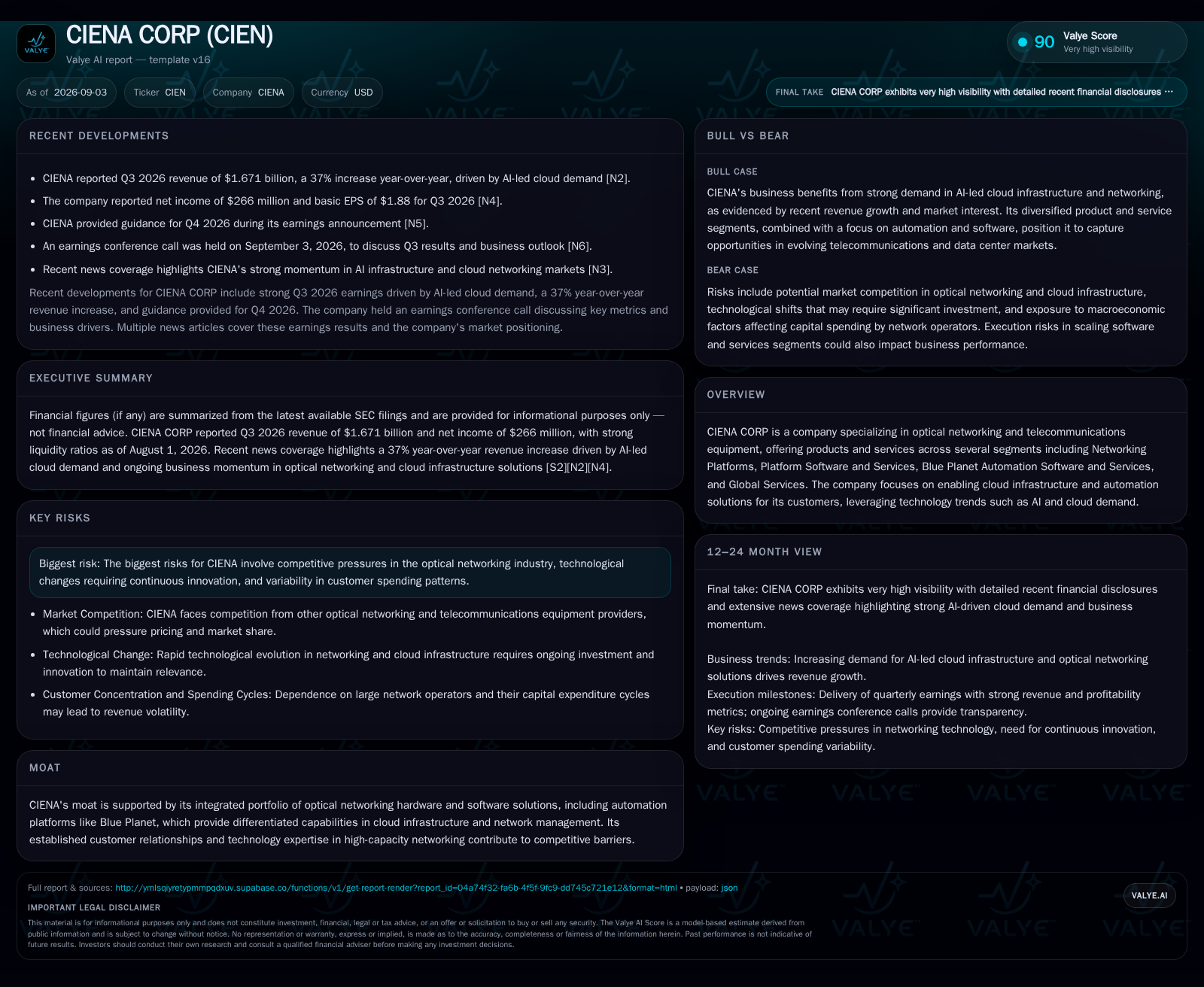
CIENA reported Q3 2026 revenue of $1.671 billion, reflecting a 37% increase year-over-year primarily driven by AI-led cloud demand [N2][S2]. The company’s net income reached $266 million, with basic EPS at $1.88, signaling strong profitability alongside revenue growth [S2][N4]. These figures demonstrate the company’s ability to capitalize on the accelerating need for high-bandwidth, low-latency optical networks to support AI workloads in cloud data centers.
Liquidity remains robust, with a current ratio of 3.8 and cash plus equivalents totaling approximately $2.45 billion as of August 1, 2026 [S2]. This potential financial flexibility supports ongoing investments in R&D and potential acquisitions necessary to maintain technological leadership. CIENA’s Q3 earnings call further emphasized sustained momentum in cloud networking and automation software, positioning the company to benefit from structural tailwinds in AI infrastructure buildout [N6][N3].
Blending Hardware Sales with Software-Driven Automation Services
CIENA’s revenue model is anchored in the sale of optical networking hardware, including high-capacity transponders and switching equipment, complemented by software platforms such as Blue Planet Automation and associated services [S1][S2]. Hardware sales are typically capital intensive with discrete order cycles tied to network operator capex budgets, while software and services offer higher margin, recurring revenue potential and opportunities for operating leverage as adoption scales.
Pricing dynamics depend on volume growth driven by cloud providers’ demand for AI infrastructure and network operators’ upgrade cycles. Mix improvements from software and automation services could expand margins if CIENA successfully transitions customers from pure hardware purchases to integrated solutions. However, significant R&D and manufacturing investments are required to keep pace with technology evolution, limiting near-term fixed-cost leverage. The key margin inflection point likely hinges on the scale and stickiness of software platform adoption and ongoing service renewals.
Integrated Solutions Provide Moat, But Market Pressures Mount
CIENA’s competitive advantage rests on its integrated portfolio that combines optical hardware with automation software like Blue Planet, enabling customers to optimize network performance and reduce operational complexity. Established relationships with large telecom operators and cloud providers create switching frictions and enhance customer retention, supporting a defensible position in a concentrated market [S1].
Nonetheless, the competitive landscape features dominant players such as Cisco, Nokia, and Huawei in optical equipment, along with emerging cloud infrastructure specialists who may bypass traditional network equipment vendors by leveraging software-defined networking and white-box hardware. Pricing pressures are also elevated due to commoditization trends in optical components, requiring CIENA to continuously innovate and differentiate through automation capabilities and service integration to sustain pricing power.
Becoming the Backbone for AI Cloud Infrastructure Networks
In a favorable scenario, CIENA captures a disproportionate share of AI-driven cloud infrastructure investment by embedding its optical platforms and Blue Planet automation software deeply into hyperscale data center networks. This would drive accelerating hardware sales volumes alongside exponential growth in software subscriptions and managed services, enabling meaningful operating leverage and margin expansion.
Confirming evidence would include sustained double-digit growth in software revenue, increasing multi-year contracts with cloud operators, and successful integration of emerging technologies like programmable optics or AI-enabled network orchestration. Conversely, a failure to deepen software adoption or loss of key cloud customers to competitors would falsify this scenario, signaling challenges in scaling beyond traditional hardware sales.
Steady Growth Amid Competitive and Cyclical Challenges
The most plausible path sees CIENA maintaining mid-to-high single-digit organic growth driven by steady demand from telecom operators and moderate expansion in cloud infrastructure spending. Hardware sales remain substantial but face margin pressure from component commoditization, while software and services grow gradually, offsetting some headwinds.
CIENA’s continued focus on automation and cloud-friendly networking solutions supports customer retention but incremental gains in operating leverage are moderate. Confirmation of this scenario would come from consistent quarterly revenue growth aligned with industry capex trends, stable gross margins, and gradual software revenue increase. Significant deviation from these patterns, such as disproportionate margin compression or stagnating software adoption, would challenge this view.
Technological Disruption and Spending Cyclicality Weigh on Results
A downside trajectory involves accelerated commoditization of optical hardware and faster-than-expected disruption by cloud-native network architectures that reduce reliance on traditional equipment vendors. Combined with macroeconomic headwinds leading to sharp declines in capital expenditures by major network operators, this could compress revenues and margins.
In this environment, CIENA may face intensifying price competition and slower adoption of its software platforms if customers delay investments or switch to alternative technologies. Confirming evidence would include sequential revenue declines, margin contraction, and loss of key customers. Conversely, resilient contract renewals and stable ASPs would falsify this downside, indicating ongoing relevance and pricing power.
Key Metrics to Gauge CIENA’s Strategic Execution and Market Position
Investors should monitor software revenue as a percentage of total sales and the growth rate of Blue Planet platform subscriptions, which serve as proxies for shifting business mix toward higher-margin, recurring revenue streams. Quarterly guidance consistency and announced awards disclosure, if provided, would offer insight into demand visibility.
Additional KPIs include gross margin trends, especially hardware ASPs, to detect pricing pressures; R&D spend relative to revenue, signaling innovation investment; and customer concentration metrics to assess exposure to large operators’ capex cycles. Tracking multi-year contract wins or expansions with hyperscale cloud providers would also inform long-term growth prospects.
Disclaimer: This is research-only, informational analysis and not investment advice. It may include AI-generated interpretation and general industry context. Always verify important details using primary sources.

Comments