
Sprinklr’s Unified AI Customer Experience Platform Faces Margin Pressure Amid Growth
Sprinklr’s expansive AI-native CXM platform drives subscription growth but rising cloud and AI costs pressure margins, challenging future profitability and customer retention dynamics.
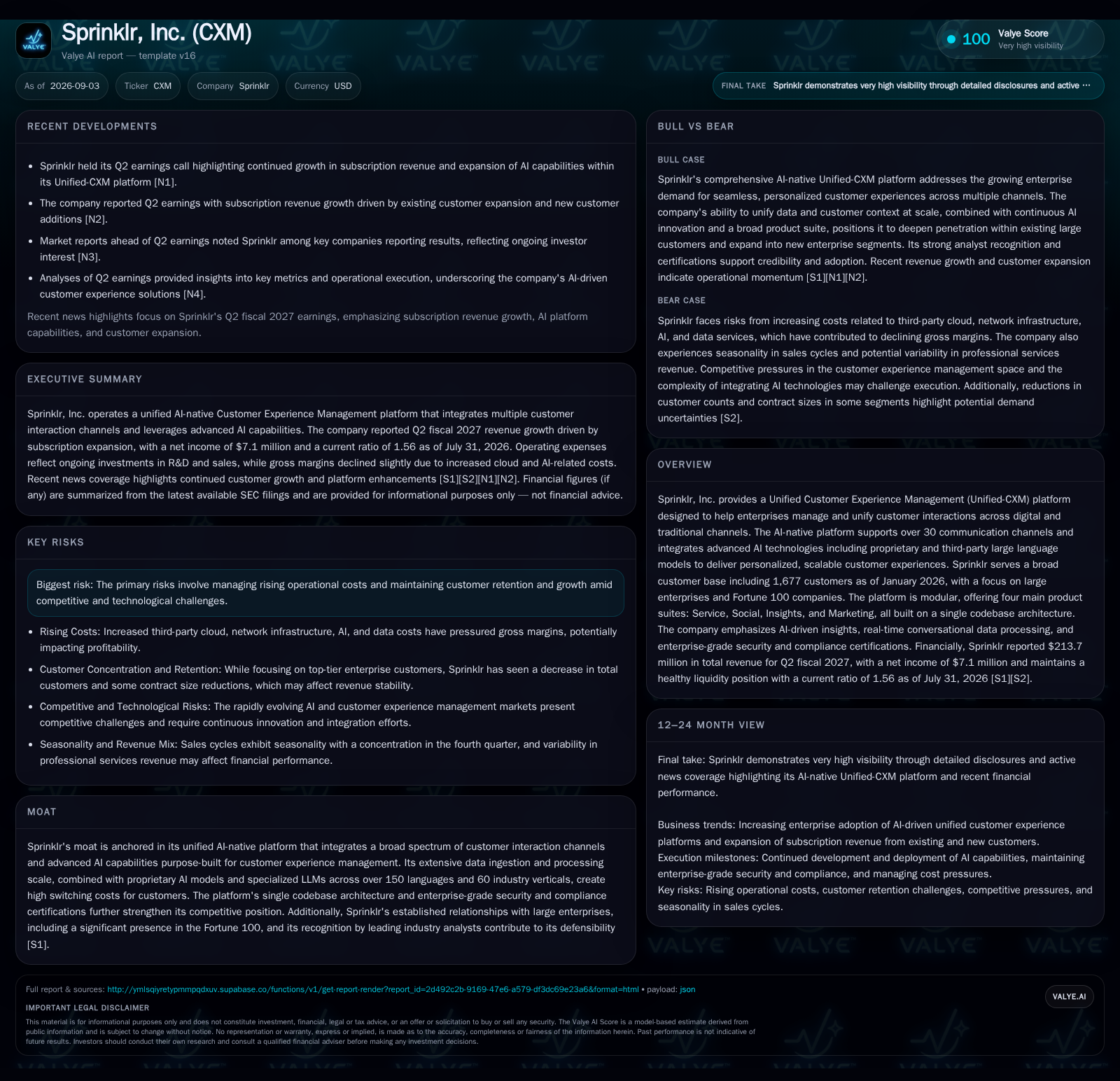
Sprinklr's Unified Customer Experience Management platform leverages advanced AI and multi-channel integration to service large enterprises, fueling steady subscription revenue growth. However, rising third-party infrastructure and AI model costs have compressed gross margins, raising questions about long-term operating leverage. Customer expansion within large accounts supports revenue gains but offset by some contract downsizing and attrition. Competitive and technological risks persist in a rapidly evolving AI-driven CX market. Key factors to watch include cost control, retention rates of million-dollar-plus customers, AI innovation pace, and margin trends.
Sprinklr, Inc. stands at the intersection of AI innovation and enterprise customer experience management with its Unified-CXM platform that integrates over 30 communication channels and advanced AI capabilities. The company’s strategic emphasis on large enterprise customers, including 59% of the Fortune 100, underpins steady subscription revenue growth, reaching $194.8 million in Q2 fiscal 2027. However, rising third-party cloud and AI infrastructure costs are eroding gross margins, posing challenges to profitability and operating leverage. Meanwhile, customer dynamics show both expansion and contraction, underscoring the importance of retention and contract optimization amid intense competitive pressure. How Sprinklr balances investment, margin sustainability, and customer stickiness will shape its medium-term trajectory.
Subscription Expansion and Margin Headwinds Define Sprinklr’s Latest Quarter
Sprinklr reported $213.7 million in total revenue for Q2 fiscal 2027, with subscription revenue accounting for $194.8 million, marking a 3% year-over-year increase. This growth was primarily driven by existing customers expanding platform usage alongside new customer additions, offset partially by contract size reductions and some customer non-renewals. The customer base comprises 1,677 clients, including 141 generating over $1 million in annual subscription revenue, highlighting concentration in large enterprise accounts [S1][S2].
Gross margin on subscription revenue declined to 74% from 77% the prior year, mainly due to increased costs for third-party cloud services, network infrastructure, and AI compute resources. Operating expenses remain significant, with sales and marketing consuming 33% of revenue and R&D at 11%, reflecting ongoing investments in platform innovation and customer acquisition. The company also experienced restructuring-related insurance recoveries linked to prior workforce reductions [S2]. These financial and operational factors frame the current backdrop of Sprinklr’s business as it seeks to leverage AI capabilities while managing cost pressures and customer dynamics.
Balancing High-Value Subscription Revenue Against Rising Infrastructure and AI Costs
Sprinklr’s business model centers on subscription revenue generated from its unified AI-native CXM platform, which provides modular suites for service, social, insights, and marketing. Pricing likely reflects enterprise-scale contracts with tiered usage and feature sets, where large customers contribute significant annual revenues. The platform’s integration of over 30 channels and advanced AI features requires substantial cloud infrastructure and computational resources, contributing to variable costs linked to usage volumes and AI model complexity. Professional services provide additional but smaller revenue streams, adding some revenue mix variability.
Operating leverage potential exists if subscription growth outpaces infrastructure and R&D cost increases, leveraging fixed platform development expenses over a growing base. However, rising third-party cloud and AI costs have pressured gross margins, suggesting that cost inflation risks could cap margin expansion near term. Sales and marketing expenses at 33% of revenue indicate a capital-intensive customer acquisition and retention effort, typical in enterprise software with long sales cycles. Research and development investment at 11% supports ongoing AI innovation but adds to fixed costs, requiring scale to improve profitability. The key economic challenge is whether Sprinklr can sustain subscription growth and contract expansion to offset rising variable costs and maintain operating leverage.
An AI-Enabled Unified Platform in a Crowded and Rapidly Evolving Customer Experience Market
Sprinklr’s competitive moat is anchored in its AI-native Unified-CXM platform architecture that integrates data and interactions across over 30 channels, supported by proprietary and third-party large language models powering more than 100 AI-driven features. This breadth and depth could increase switching costs as enterprises consolidate fragmented CX tools. The company’s strong foothold among Fortune 100 enterprises and recognition by leading analysts such as Gartner and Forrester reinforce its credibility and market positioning. The single codebase architecture and compliance certifications further enhance its enterprise appeal.
Nevertheless, the CXM space is intensely competitive, featuring legacy CRM vendors, emerging AI platform providers, and specialized customer engagement tools. Competitors with deeper pockets or more focused AI innovation could erode Sprinklr’s share, especially if they offer simpler integration or lower cost solutions. The rapid evolution of AI technologies requires continuous investment and agility. Customer concentration risk and some recent contract size reductions suggest competitive pressures and potential demand variability. Maintaining innovation leadership and customer intimacy will be critical to defending and growing its competitive position.
Accelerated Enterprise Adoption Drives Subscription Growth and AI Monetization
In a favorable scenario, Sprinklr leverages its AI-native platform to deepen penetration within existing large enterprise customers, expanding seat counts, channels, and AI feature usage. Continuous AI innovation, including proprietary LLM enhancements and autonomous agents, could unlock new monetization avenues such as outcome-based pricing or AI-driven insights as a service. Broadening the product suite’s appeal across marketing, service, and social functions may drive cross-selling and increase customer wallet share.
Confirming evidence would include sustained double-digit subscription revenue growth, improving gross margins from scale and cost optimization, and increasing average contract values among million-dollar-plus customers. Positive customer retention and expansion metrics, coupled with industry analyst upgrades, would validate this trajectory. A falsification test would be a plateau or decline in subscription growth, persistent margin compression despite scale, or loss of key enterprise clients to competitors, signaling challenges in realizing the platform’s full commercial potential.
Modest Subscription Growth Amid Margin Pressure and Competitive Challenges
The most plausible scenario envisions Sprinklr maintaining steady subscription revenue growth in the low single digits, driven by a mix of new customer additions and expansion within existing accounts, offset by some churn and contract downsizing. Rising third-party cloud and AI costs continue to pressure gross margins, partially offset by operational efficiencies and selective price adjustments. Operating expenses remain elevated as the company invests in R&D to keep pace with AI developments and in sales to secure and retain enterprise clients.
Evidence supporting this includes reported Q2 results of 3% subscription revenue growth and a decline in gross margin from 77% to 74%. Continued customer concentration with a sizeable cohort of million-dollar-plus accounts but some attrition suggests mixed retention dynamics. Falsification would occur if subscription growth accelerates significantly or margins improve materially, indicating stronger operating leverage, or conversely if revenue growth stalls or declines, or costs escalate uncontrollably, undermining profitability and growth prospects.
Rising Costs and Customer Attrition Undermine Profitability and Growth
A downside scenario features sustained increases in third-party cloud, AI compute, and network infrastructure costs that outpace subscription revenue growth, compressing gross margins and eroding profitability. Competitive pressure leads to increased pricing concessions, contract downsizing, and customer churn, particularly among mid-tier accounts. Integration complexity and AI technology execution challenges slow new feature rollouts, reducing customer satisfaction and renewal rates.
Confirming evidence would be continued margin declines below current levels, shrinking million-dollar account counts, negative subscription net retention, or sizeable non-renewals in key segments. Increased seasonality or variability in professional services revenue could exacerbate financial volatility. A falsification test would be stabilization or improvement in margins, customer retention metrics, and successful deployment of new AI capabilities attracting new customers or enabling upsells.
Critical Metrics and Milestones to Gauge Sprinklr’s Trajectory
Subscription Revenue Growth Rate: Monitors demand momentum and customer adoption of the platform’s AI capabilities. Not currently segmented by customer tier but would be a useful metric if disclosed.
Gross Margin on Subscription Revenue: Tracks the impact of cloud and AI infrastructure cost inflation and operational efficiency improvements.
Million-Dollar-Plus Customer Count and Retention: Key indicator of customer concentration and revenue stability; Sprinklr currently reports 141 such customers.
Net Expansion Rate Among Existing Customers: Measures upsell and cross-sell success within the installed base, critical for leveraging operating leverage.
Disclaimer: This is research-only, informational analysis and not investment advice. It may include AI-generated interpretation and general industry context. Always verify important details using primary sources.

Comments