
Grayscale Bitcoin Cash Trust Navigates Passive Exposure Amid BCH Volatility and Liquidity Constraints
As a regulated vehicle offering direct exposure to Bitcoin Cash without leverage or active management, Grayscale Bitcoin Cash Trust balances transparency and simplicity against inherent digital asset price swings and restricted investor liquidity.
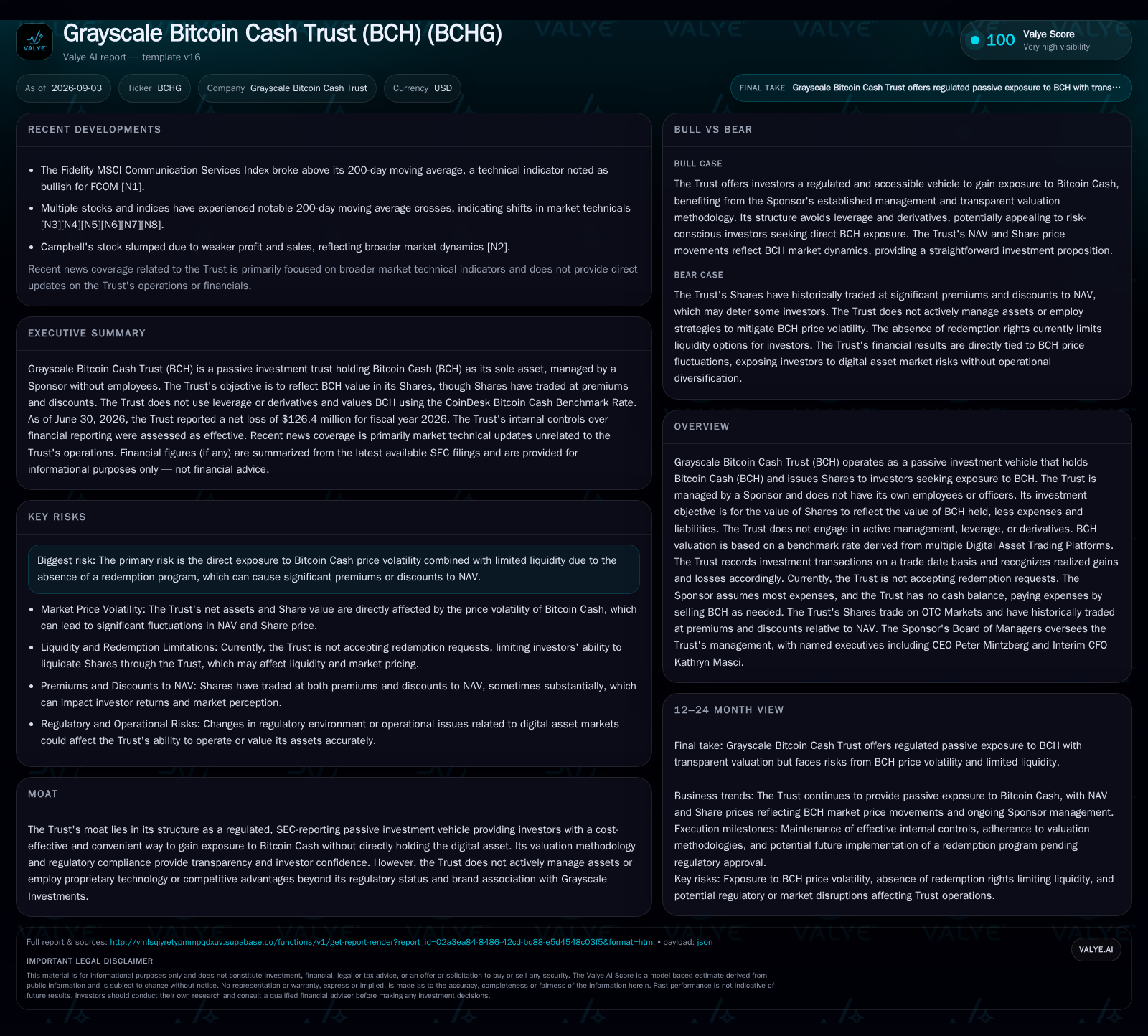
Grayscale Bitcoin Cash Trust (BCH) provides investors a regulated, passive investment in Bitcoin Cash, tracking BCH’s market value through Shares that may trade at premiums or discounts. The Trust’s economics hinge on BCH price dynamics and expense-related asset sales, with no leverage or active strategy to mitigate volatility. Its competitive edge rests on regulatory compliance and transparent valuation, but limited redemption options constrain liquidity. Favorable scenarios depend on BCH price recovery and possible redemption program approval, while downside risks center on continued BCH depreciation and persistent discounts. Key investor watchpoints include BCH market price trends, NAV and Share premium/discount spreads, redemption program developments, and regulatory changes.
Grayscale Bitcoin Cash Trust (BCH) offers a regulated, passive investment vehicle allowing investors to gain exposure to Bitcoin Cash without directly holding the cryptocurrency. Managed by a Sponsor without employees and employing no leverage or active trading strategies, the Trust’s Shares seek to reflect the value of BCH held, less expenses and liabilities. However, BCH’s price volatility, combined with the Trust’s current lack of redemption programs, creates potential for significant premiums or discounts to net asset value (NAV). As of mid-2026, the Trust reported substantial net losses tied to BCH price declines and continues to cover expenses through asset sales. These dynamics frame the investment’s risk profile and potential pathways forward.
Recent Financials Highlight BCH Price Impact and Liquidity Constraints
As of March 31, 2026, Grayscale Bitcoin Cash Trust reported net assets of approximately $181 million, reflecting depreciation in BCH prices and ongoing Sponsor fees [S2]. The reported NAV per Share stood at $3.84, with the principal BCH market price at $470.22 per coin [S2]. The Trust recorded a net loss of $126.4 million for fiscal year 2026, driven by realized and unrealized losses due to BCH price declines [S2]. Notably, the Trust does not maintain a cash balance and covers expenses by selling BCH holdings as needed, directly linking expense management to asset price movements [S2].
The Trust currently does not accept redemption requests, limiting investor liquidity options, with any future redemption program subject to SEC approval and Sponsor discretion [S2]. Shares trade on OTC Markets and have historically experienced premiums and discounts relative to NAV, reflecting market supply-demand imbalances and liquidity limitations [S1]. Internal controls over financial reporting were assessed as effective as of June 30, 2026, supporting operational transparency and regulatory compliance [S1]. These factors collectively frame the Trust’s operational context amid ongoing digital asset market volatility.
Passive Exposure Model Rooted in BCH Price Movements and Expense-Driven Asset Sales
The Trust’s business model centers on passively holding Bitcoin Cash as its sole asset, with no leverage, derivatives, or active management strategies employed [S2]. Revenue and returns to investors derive entirely from BCH price appreciation or depreciation, less the impact of expenses and liabilities. The Trust’s pricing mechanism for BCH valuation relies on the CoinDesk Bitcoin Cash Benchmark Rate, which aggregates prices across selected digital asset trading platforms [S2], providing a transparent yet market-dependent reference.
Operating expenses, primarily management fees and administrative costs, are paid by selling BCH holdings since the Trust holds no cash balance [S2]. This creates a structural friction where ongoing expenses can erode NAV if BCH prices are stagnant or declining. Fixed costs are low given the Sponsor-managed structure without employees, but variable economics are tightly coupled with BCH market price levels and trading liquidity. Operating leverage is limited because the Trust neither scales expenses significantly with asset size nor employs strategies to buffer BCH price swings. Thus, profitability and NAV stability remain highly sensitive to BCH market dynamics.
Regulatory Status and Transparent Valuation Underpin Accessibility Amid Intense Digital Asset Competition
The Trust’s main competitive advantage lies in its status as a regulated, SEC-reporting vehicle that offers investors a convenient, transparent way to gain exposure to Bitcoin Cash without direct custody or technical complexity. The Sponsor’s established management, including named executives and effective internal controls, enhances credibility within a complex digital asset market [S1]. The Trust’s valuation methodology based on a reputable benchmark rate adds further transparency compared to less regulated alternatives.
However, the passive structure limits differentiation in a competitive landscape featuring other digital asset trusts, exchange-traded products, and direct coin custody platforms. Importantly, the absence of redemption rights currently restricts liquidity relative to some peers that offer periodic redemptions or active management features. Competitors may include other Grayscale products or ETFs focused on digital assets, as well as decentralized finance protocols offering BCH exposure with different risk-return profiles. The Trust’s niche is primarily regulatory compliance and ease of access rather than active performance enhancement or liquidity innovation.
BCH Market Recovery Coupled with Redemption Program Boosts Investor Confidence and NAV Alignment
In a favorable scenario, renewed investor interest and broader adoption of Bitcoin Cash drive significant price appreciation, reversing recent depreciation trends. This would increase the Trust’s NAV and reduce net losses, enhancing the attractiveness of Shares. Concurrently, the Sponsor secures SEC approval to implement a redemption program, addressing current liquidity limitations and enabling investors to redeem Shares at NAV or near-NAV prices. This would likely narrow premiums and discounts, improving market pricing efficiency and investor confidence.
Confirming evidence would include sustained BCH price rallies supported by network growth, regulatory clarity favoring digital assets, and formal announcements from the Sponsor regarding redemption program timelines. Conversely, failure to launch a redemption program despite improving BCH prices, or persistent large premiums/discounts despite market rallies, would challenge this upside thesis. A falsification test would observe continued Share price volatility disconnected from BCH price improvements or regulatory setbacks limiting redemption options.
Continued BCH Volatility and Redemption Uncertainty Maintain NAV and Share Price Disparities
The most plausible mid-path scenario sees BCH prices experiencing ongoing volatility with periods of recovery offset by intermittent declines. The Trust’s NAV correspondingly fluctuates, while Share prices continue to trade at varying premiums or discounts due to limited liquidity and absence of redemption rights. The Sponsor maintains current operating procedures, including BCH valuation methodology and expense coverage through BCH sales, but does not introduce a redemption program in the near term due to regulatory or market uncertainties.
Investor demand remains steady but cautious, recognizing the Trust as a transparent, regulated exposure to BCH but constrained by market risks and liquidity gaps. Confirming evidence includes persistent BCH price variability, stable but unspectacular net asset levels, and continued OTC trading with moderate premium/discount ranges. Falsification would occur if BCH stabilizes at significantly higher or lower levels or if the Sponsor announces a definitive redemption program launch, altering liquidity dynamics.
Prolonged BCH Price Decline and Redemption Program Delays Erode NAV and Amplify Market Discounts
A downside scenario features sustained declines in BCH market prices driven by diminished adoption, regulatory headwinds, or negative market sentiment. This leads to further erosion of the Trust’s NAV and magnifies net realized losses. Compounding this, the Sponsor fails to initiate a redemption program, leaving investors trapped with illiquid Shares trading at wide discounts to NAV. Expense-driven asset sales in a falling market exacerbate NAV degradation, creating a negative feedback loop.
Investor confidence deteriorates, potentially reducing trading volumes and liquidity on OTC Markets and increasing volatility in Share prices. Confirming evidence would include persistent BCH price declines below critical technical levels, formal statements delaying or abandoning redemption program plans, and expanding spreads between Share prices and NAV. Falsification would involve BCH price stabilization or recovery, initiation of investor liquidity solutions, or regulatory improvements facilitating Trust operations.
Monitoring BCH Price Trends, Redemption Program Progress, and Premium/Discount Dynamics
Key metrics to watch include the market price of Bitcoin Cash on principal trading platforms, as it directly affects the Trust’s NAV and investor returns. Tracking BCH price trends, volatility measures, and adoption metrics provides insight into the Trust’s asset value trajectory. Additionally, the development and SEC approval status of any proposed redemption program represent critical milestones that could materially alter liquidity and valuation dynamics.
Investor returns are also influenced by the premium or discount of Shares relative to NAV, a useful indicator of market sentiment and liquidity constraints. Observing trading volumes and bid-ask spreads on OTC Markets can shed light on demand-supply balances and market efficiency. Other important factors include Sponsor announcements regarding expense management, internal control assessments, and broader regulatory developments affecting digital asset investment vehicles.
Disclaimer: This is research-only, informational analysis and not investment advice. It may include AI-generated interpretation and general industry context. Always verify important details using primary sources.

Comments