
Concrete Pumping Holdings Navigates Scale and Cyclicality in Construction Services
With a large, modern fleet and diversified service lines across U.S. and U.K. markets, Concrete Pumping Holdings leverages operational scale and customer retention but faces cyclical demand and fragmented competition risks.
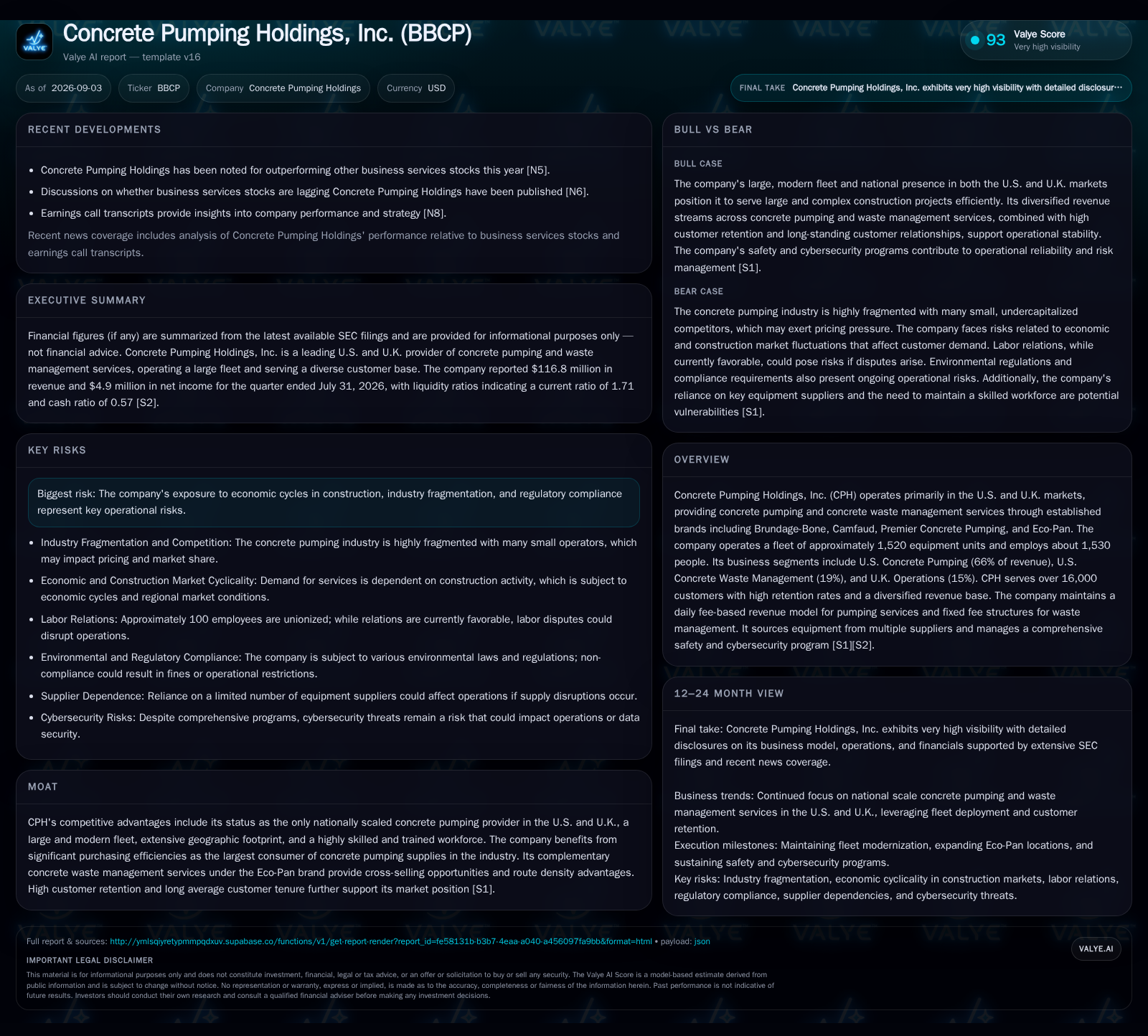
Concrete Pumping Holdings, Inc. operates a substantial concrete pumping and waste management business with a predominantly daily fee-based revenue model serving over 16,000 customers. Its scale and fleet modernization underpin operational efficiency and market reach, while high retention and diversified services provide stability. However, industry fragmentation, exposure to construction cycles, labor and regulatory risks, and supplier dependence pose challenges. The company’s future hinges on balancing fleet utilization, pricing discipline, and expanding waste management cross-selling, with cybersecurity and safety programs supporting operational resilience.
Concrete Pumping Holdings, Inc. (CPH) stands out in the U.S. and U.K. concrete services markets through its scale, diversified service portfolio, and operational rigor. Operating over 1,500 equipment units and serving a broad customer base with high retention, the company leverages daily fee-based and fixed-fee contracts to generate stable cash flows. However, the nature of the construction industry and a fragmented competitive landscape impose cyclical demand and pricing pressures. Management’s ability to sustain fleet utilization, expand waste management penetration, and navigate regulatory and labor risks will determine whether CPH capitalizes on its operational footprint or faces margin compression amid industry headwinds.
Significance of Scale and Diverse Revenue Streams Amid Industry Cyclicality
Concrete Pumping Holdings operates approximately 1,520 equipment units, including boom pumps, placing booms, telebelts, stationary pumps, and waste management trucks, across about 150 U.S. and U.K. locations [S1]. This large fleet and broad geographical footprint underpin its service capacity and customer reach. The company’s revenue composition is notably diversified: 66% from U.S. concrete pumping, 19% from U.S. concrete waste management, and 15% from U.K. operations [S1].
The business model relies mainly on a daily fee-based structure for pumping services, with negotiated pricing based on time and volume plus additional fuel and travel charges [S1]. Waste management uses fixed fees with incremental charges for extended usage or irregular waste, adding a complementary revenue stream [S1]. Serving over 16,000 customers with high retention rates—90% among the top 500 and 100% among the top 100—reflects strong customer relationships and recurring business potential [S1]. Recent quarterly financials show $116.8 million in revenue and $4.9 million net income, with liquidity ratios supporting operational funding [S2]. These facts matter because they highlight the company’s operational scale, revenue diversification, and financial stability, which are critical in a capital-intensive and cyclical industry.
Revenue Drivers and Operating Leverage in Fleet-Intensive Service Model
Concrete Pumping Holdings generates revenue primarily through negotiated daily fees linked to equipment usage time and concrete volume pumped, supplemented by fuel and travel surcharges [S1]. This pricing structure aligns incentives to maximize utilization and efficient scheduling, as revenue scales with both time and throughput. Waste management services, conversely, are billed at fixed fees with incremental charges for extended use or non-standard waste, providing stable, predictable cash flow components [S1]. The mix between variable volume-based and fixed fees influences margin stability and cash flow visibility.
The company’s cost structure involves significant fixed costs — capital investment to maintain and modernize its fleet, skilled labor (operators and mechanics), and branch operational expenses — combined with variable costs tied to fuel, maintenance, and travel [S1]. Operating leverage can emerge from higher fleet utilization and route density gains, especially by cross-selling waste management services alongside pumping. However, capital intensity of equipment purchases from suppliers like Schwing and Putzmeister requires continuous investment to avoid fleet aging beyond the current average of 8 years [S1]. Effective labor management and operational scheduling are crucial to converting fixed fleet costs into scalable margins.
Fleet Scale, Customer Loyalty, and Cross-Selling as Defensible Advantages
CPH’s largest competitive advantage is its status as the only nationally scaled concrete pumping provider in the U.S. and U.K., operating a modern, diversified fleet and an extensive geographic footprint [S1]. This scale enables purchasing efficiencies as the top concrete pumping supplies consumer and supports service consistency across markets. High customer retention rates and longstanding relationships—top 10 customers represent less than 10% of revenue with average tenure over 25 years—reduce churn risks and increase pricing power [S1].
Complementary concrete waste management services under the Eco-Pan brand provide cross-selling and route density advantages, enhancing asset utilization and customer stickiness [S1]. However, the industry remains highly fragmented with many smaller operators exerting pricing pressure and limiting pricing power [S1]. Competitors include regional and local contractors that may compete on price or specialized service niches. Labor union presence and regulatory compliance add layers of operational complexity that can challenge smaller peers, potentially reinforcing CPH’s scale advantage if managed well.
Growth from Fleet Utilization Optimization and Waste Management Expansion
In a favorable scenario, Concrete Pumping Holdings capitalizes on its fleet scale by improving equipment utilization and expanding its concrete waste management business. The daily fee-based revenue model incentivizes efficient scheduling and higher volume throughput, which could yield significant operating leverage given the fixed costs of fleet ownership. Cross-selling waste management services could increase route density, reduce per-unit expense, and deepen customer integration, enhancing pricing power and margin expansion.
Confirming evidence would include rising utilization rates, increased revenue contribution from Eco-Pan services, sustained or improved customer retention, and margin improvement despite raw material or labor cost inflation. The company’s ability to maintain a modern fleet through disciplined capital spending and retain skilled operators would also support this scenario. A falsification test would be persistent utilization declines, flat or shrinking waste management penetration, or margin compression due to pricing pressure or cost overruns, signaling operational scaling challenges or competitive encroachment.
Balanced Outcomes Amid Construction Cycles and Competitive Market Dynamics
The most plausible scenario is that Concrete Pumping Holdings continues to deliver stable revenue and modest margin improvement, but faces cyclical fluctuations tied to construction market activity and pricing pressure from fragmented competition. Its large, modern fleet and diversified services provide some insulation, but demand volatility and price competition limit upside in utilization and pricing.
Customer retention remains high, anchoring baseline revenue, while fleet aging and labor cost inflation necessitate ongoing capital and operational investments, constraining margin gains. Waste management services grow modestly as a supplementary revenue stream but do not dramatically change overall profitability. Confirming evidence would be steady revenue and earnings growth aligned with construction cycles, stable customer metrics, and manageable capital expenditures. Falsification would occur if demand weakens materially or competitor pricing erodes margins beyond current levels.
Margin Erosion from Economic Downturn, Labor Disputes, and Regulatory Costs
A downside risk involves a significant decline in construction activity leading to reduced demand for concrete pumping and waste management, pressuring fleet utilization and pricing. Given the industry’s fragmentation, pricing power could weaken further, squeezing margins. Labor relations, while currently favorable, present a vulnerability; union disputes or labor shortages could drive wage inflation or operational disruptions.
Additionally, increased environmental regulations or compliance costs could raise waste management expenses or restrict operational flexibility. Dependency on key equipment suppliers exposes the company to supply chain disruptions or higher capital costs. Confirming evidence would include declining utilization rates, margin contraction, labor grievances, regulatory penalties, or supply chain constraints. Falsification would be demonstrated by stable or improving operational and financial metrics despite macroeconomic or regulatory headwinds.
Monitoring Fleet Utilization, Customer Stability, and Operational Risk Factors
Investors should monitor equipment utilization rates and fleet age to gauge operational efficiency and capital expenditure needs. Tracking revenue and margin contribution from concrete waste management services will indicate success in cross-selling and route density improvements. Customer retention rates, particularly within the top 500 and top 100 clients, provide insight into demand stability and pricing power.
Labor relations developments, including union negotiations and workforce skill retention, are important to assess cost and service continuity risks. Regulatory compliance costs and environmental fines or restrictions should be watched to anticipate margin impacts. Lastly, cybersecurity incident frequency and response effectiveness remain material, given the company’s comprehensive risk management but ongoing threat exposure.
Disclaimer: This is research-only, informational analysis and not investment advice. It may include AI-generated interpretation and general industry context. Always verify important details using primary sources.

Comments