
Five Below's Expansion and Dynamic Merchandising Drive Growth Amid Retail Challenges
Five Below leverages a differentiated value retail model centered on trendy, sub-$5 products and a vibrant in-store experience. Its rapid store expansion and operational discipline underpin recent strong earnings, but sustaining momentum hinges on navigating execution risks, competitive pressures, and evolving consumer trends.
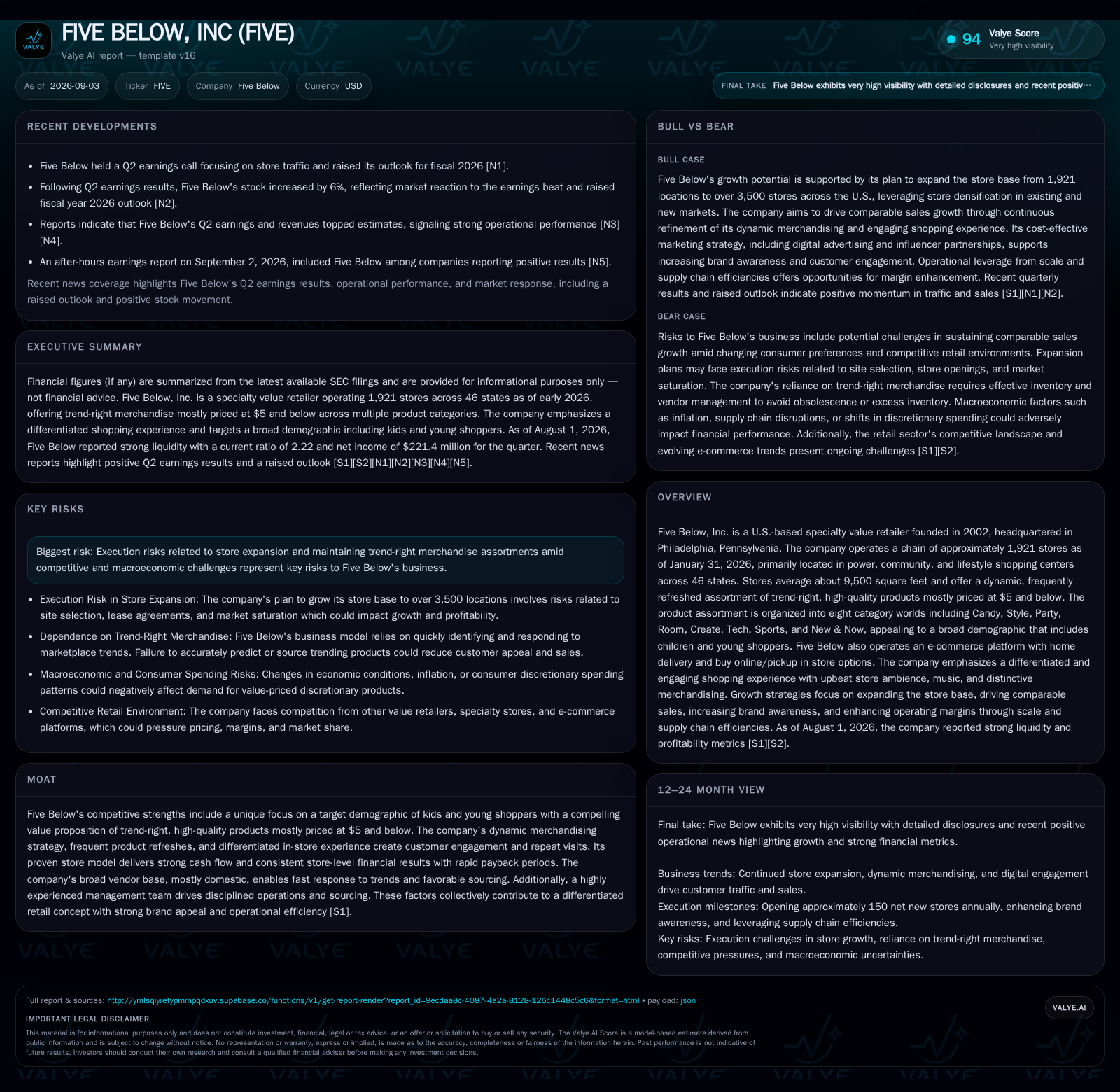
Five Below operates nearly 2,000 stores with a focused assortment of trend-right products mostly priced at $5 and below, targeting young shoppers. The company reported strong Q2 2026 results, raising its full-year outlook amid robust traffic and sales. Its growth strategy emphasizes store densification, dynamic merchandising, and supply chain efficiency to build operating leverage. However, execution risks in opening new stores, dependence on timely trend identification, and competitive retail dynamics present challenges. Key performance indicators and operational milestones over the next 12 to 24 months will clarify whether Five Below can maintain its growth trajectory and margin expansion.
Five Below, Inc. has demonstrated robust growth and profitability as of mid-2026, driven by its specialty value retail concept that combines a highly curated assortment of trendy, low-priced merchandise with a vibrant, engaging shopping environment. Operating 1,921 stores across 46 states, the company’s strategy to expand its footprint to over 3,500 locations is complemented by efforts to boost comparable sales through dynamic merchandising and digital marketing. Its recent Q2 earnings beat and raised fiscal 2026 outlook underscore operational momentum. However, sustaining this trajectory requires managing execution complexity, maintaining merchandise relevance, and navigating intensifying competition and consumer spending uncertainties.
Strong Q2 Earnings and Aggressive Store Expansion Fuel Investor Optimism
Five Below reported net income of $221.4 million for the quarter ended August 1, 2026, with basic and diluted EPS of $4.02 and $3.99, respectively. The company’s Q2 earnings and revenues surpassed analyst estimates, prompting a 6% increase in its stock price and a raised outlook for the full fiscal year. Management highlighted increases in store traffic as a key driver behind the strong results and optimism for continued growth [S2][N1][N2][N3][N4][N5].
At the end of January 2026, Five Below operated 1,921 stores across 46 U.S. states, primarily located in power, community, and lifestyle shopping centers, averaging approximately 9,500 square feet per location. The company plans to nearly double its store count to over 3,500 over time, with a growth strategy centered on densification in existing markets and selective entry into new ones. This expansion, combined with a dynamic product assortment mostly priced at $5 and below, supports its strategy to attract a broad demographic, including kids and young shoppers [S1][S2].
Value Retailing with Dynamic Merchandising and Operating Leverage Potential
Five Below’s revenue model relies on high-volume sales of trend-right, low-priced merchandise organized into distinct category worlds such as Candy, Style, and Tech. The company benefits from a relatively fixed-store cost structure, with rent and labor representing significant fixed expenses, while merchandise costs scale more linearly with sales volume. This mix creates operating leverage potential as comparable sales increase, particularly through product mix optimization and supply chain efficiencies that can reduce cost of goods sold and logistics expenses [S1].
Capital expenditures are driven primarily by new store openings, with an average store size around 9,500 square feet. The reported average payback period of about one year for new stores indicates efficient capital deployment. E-commerce sales, integrated into overall net sales, add a complementary revenue channel but likely represent a smaller margin compared to physical stores due to fulfillment costs. As Five Below scales, supply chain improvements and increased bargaining power with vendors—largely domestic and capable of quick trend response—could further enhance margins, though sustaining growth requires continual investment in inventory freshness and store experience.
Differentiated Youth-Focused Value Proposition Faces Growing Retail Competition
Five Below’s competitive advantage stems from its focus on a youth-oriented demographic seeking affordable, trend-driven merchandise in an engaging shopping atmosphere. Its frequent product refreshes and upbeat store environment with music and distinctive fixtures create a compelling reason for repeat visits, differentiating it from traditional discount retailers. The broad vendor base and domestic sourcing capability facilitate rapid response to evolving trends, a critical factor in maintaining consumer appeal [S1].
However, the company operates in a crowded retail landscape that includes other value retailers, specialty stores targeting younger consumers, and increasingly sophisticated e-commerce platforms. Competitors with deeper pockets or larger scale could apply pricing pressure or invest heavily in digital capabilities. Additionally, shifts in consumer preferences toward online shopping or alternative experiential retail formats could erode Five Below’s market share or compress margins. Maintaining a balance between price, product relevance, and in-store experience is thus essential for sustaining its competitive position.
Successful Densification and Digital Engagement Accelerate Scale and Profitability
In a favorable outcome, Five Below’s execution of store densification and expansion into new markets proceeds smoothly, enabling the company to approach its target of over 3,500 locations without substantial cannibalization or lease inefficiencies. Complemented by effective digital marketing and community engagement, this drives sustained increases in store traffic and comparable sales. Operational scale unlocks further supply chain efficiencies and enhances vendor negotiating leverage, compressing costs and expanding gross margins.
Confirming evidence would include consistent quarter-over-quarter comparable store sales growth above inflation rates, steady improvement in operating margins, and strong cash flow supporting continued reinvestment. A falsification test would be a plateau or decline in store-level economics as density increases or digital engagement fails to convert into meaningful traffic gains, signaling saturation or diminishing returns on marketing spend.
Measured Growth with Margin Pressure Balanced by Operational Discipline
The most plausible trajectory envisions steady but moderate growth in store count, with Five Below expanding at a pace of roughly 150 net new stores annually. Comparable sales growth remains positive but slows amid competitive pressures and consumer spending variability. The company continues to refresh its product assortment dynamically, maintaining relevance but facing occasional inventory risks tied to trend missteps. Operating margins improve gradually through incremental supply chain gains and cost controls, offsetting some inflationary pressures.
This scenario’s confirming evidence would be stable comparable sales growth in the low single digits, incremental margin expansion, and consistent new store payback periods near one year. A falsification would be sustained margin compression due to rising costs or inventory write-downs, or material weakness in comparable store sales indicating waning customer engagement.
Execution Challenges and Shifting Consumer Preferences Erode Growth and Profitability
Downside risks materialize if Five Below encounters significant execution difficulties in opening new stores, such as poor site selection, unfavorable lease terms, or local market saturation, leading to slower expansion and higher capital intensity. Compounding this, failure to maintain a compelling, trend-right merchandise mix could reduce customer traffic and sales volume, exacerbated by intensifying competition from both brick-and-mortar and online retailers.
Macroeconomic headwinds, including inflation-induced discretionary spending cuts, could further depress demand. Confirming evidence includes rising inventory obsolescence, declining comparable store sales, and margin contraction. A falsifying scenario would be a quick rebound in sales or successful product innovation restoring customer interest, or strategic cost reductions offsetting volume declines.
Key Operational and Financial Metrics to Gauge Five Below’s Growth Trajectory
Comparable Store Sales Growth: A critical indicator of ongoing customer engagement and merchandising effectiveness, typically disclosed quarterly. Sustained positive growth confirms demand resilience.
New Store Opening Rate and Payback Period: Tracks execution on expansion plans and capital efficiency. The company targets approximately 150 net new stores annually and a one-year payback period; deviations signal execution risks or changing store economics.
Gross and Operating Margins: Reflects supply chain efficiencies, pricing power, and cost controls. Margin trends help assess operating leverage and profitability sustainability.
Inventory Turnover and Write-Downs: Measures merchandise freshness and trend accuracy. Rising write-downs may signal challenges in managing the dynamic assortment.
Disclaimer: This is research-only, informational analysis and not investment advice. It may include AI-generated interpretation and general industry context. Always verify important details using primary sources.

Comments