
Navigating Transition and Competitive Pressures: Lands’ End’s Path Through Leadership Change and Digital Growth
Lands’ End faces a critical juncture balancing recent earnings volatility and market competition with digital expansion, a strategic leadership handover, and shareholder returns amid resolved legal uncertainties.
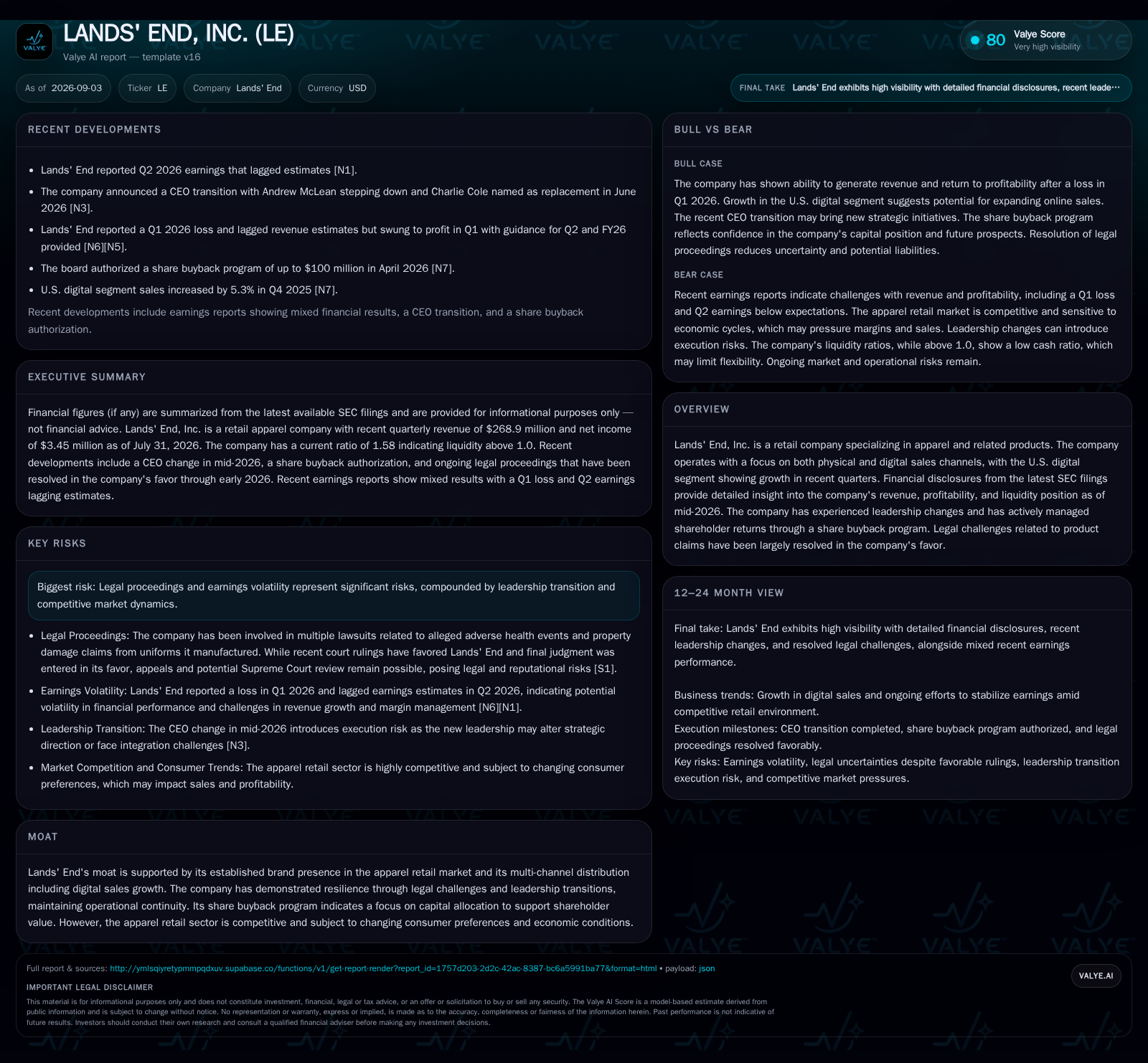
Lands' End reported mixed financial results with a Q1 2026 loss followed by Q2 earnings below expectations, reflecting challenges in revenue growth and margin management amid a competitive apparel retail environment. The company’s digital U.S. segment shows modest growth, offering a potential lever for future expansion. A mid-2026 CEO transition introduces execution risks but also an opportunity for strategic realignment. Shareholder value is actively managed through a significant share buyback authorization. Legal disputes have been resolved favorably, removing a key overhang. The company’s liquidity remains adequate though cash reserves are limited, raising questions about potential financial flexibility. The key to Lands’ End’s medium-term trajectory lies in stabilizing earnings performance, capitalizing on digital momentum, and navigating evolving consumer trends.
Lands’ End, Inc. is at a strategic crossroads as it contends with recent earnings underperformance, a shifting leadership team, and competitive pressures in the apparel sector. The company’s modest digital sales growth contrasts with broader revenue challenges, underscoring the need for operational agility and innovation. The CEO transition completed mid-2026 could reshape strategic priorities amid a challenging retail landscape. Meanwhile, the company’s commitment to shareholder returns via a sizable share repurchase program reflects confidence despite liquidity constraints. Favorable resolution of longstanding legal disputes removes a significant risk, allowing management to focus on growth and margin recovery. This analysis explores Lands’ End’s business economics, competitive positioning, and plausible future trajectories amid these intersecting dynamics.
Mixed Earnings and Leadership Changes Highlight Near-Term Uncertainty
Lands’ End reported revenue of $268.9 million and net income of $3.45 million for the quarter ended July 31, 2026. However, the company’s Q1 2026 results included a loss, and Q2 earnings fell short of analyst expectations, reflecting challenges in revenue growth and margin management in a competitive retail market [S2][N1][N6].
In June 2026, the company announced a CEO transition with Andrew McLean stepping down and Charlie Cole taking over, marking a significant leadership change during a period of operational turbulence [N3]. Additionally, Lands’ End authorized a share buyback program of up to $100 million in April 2026, signaling a strategic focus on shareholder value despite uneven earnings trends [N7]. Meanwhile, legal proceedings regarding product claims have been largely resolved favorably, reducing overhangs that previously clouded the company’s outlook [S1].
Revenue Drivers and Cost Structure Amid Digital Expansion and Retail Challenges
Lands’ End generates revenue primarily through apparel sales across physical stores, catalogs, and digital channels. Pricing power is constrained in the competitive retail apparel sector, suggesting that volume and mix shifts—especially growth in digital sales—are critical to top-line expansion. The 5.3% growth in the U.S. digital segment in Q4 2025 indicates some success in increasing online penetration, which could improve gross margins given the lower costs relative to brick-and-mortar formats [N7].
Operating expenses likely include significant fixed components such as store leases and logistics infrastructure, limiting short-term operating leverage. Capital intensity is moderate, with investments focused on digital platforms and supply chain efficiency. The share buyback program reflects confidence in free cash flow generation, but the low cash ratio (0.06) suggests limited liquidity cushion, which could constrain aggressive investments or cushion against margin pressures. Stabilizing operating margins will depend on balancing discounting necessary to drive volume with cost control and efficiency gains, especially online.
Facing Intense Apparel Retail Competition with Brand Legacy and Digital Growth
Lands’ End competes in the crowded apparel retail sector characterized by shifting consumer preferences, price sensitivity, and rapid digital transformation. Its established brand and multi-channel presence provide some customer recognition and distribution breadth. However, competitors include both large omnichannel retailers and pure digital entrants that may offer more compelling value propositions or faster innovation cycles.
The company’s modest growth in digital sales suggests progress but not yet a commanding position. Durable competitive advantages could emerge from proprietary customer data, loyalty programs, or exclusive product lines, but current disclosures do not confirm strong switching costs or ecosystem lock-in. The CEO transition introduces uncertainty about the ability to execute strategic initiatives to enhance differentiation and respond to competitive threats effectively.
Digital Channel Expansion and Strategic Leadership Drive Earnings Recovery
In a favorable scenario, Lands’ End leverages its 5.3% digital sales growth into broader omnichannel integration, improving customer acquisition and retention with personalized marketing and seamless shopping experiences. The new CEO implements strategic initiatives focused on innovation, cost efficiency, and product differentiation, stabilizing revenue growth and expanding margins.
Confirmation would come from sequential quarterly revenue gains, margin expansion, and positive guidance revisions supported by rising digital sales proportions and improved inventory turnover. Conversely, a failure to achieve these operational improvements or further earnings misses would falsify this scenario.
Gradual Stabilization Amid Persistent Market and Execution Challenges
The most plausible trajectory sees Lands’ End navigating a slow recovery with modest revenue growth supported by digital channel gains offsetting flat or declining physical retail sales. Earnings remain volatile due to competitive pressures and execution risks from the CEO transition, but cost control prevents major margin erosion.
This is confirmed by stable but unimpressive quarterly revenue and earnings, with limited margin expansion. Digital sales growth continues at low single digits without transformative scale. The company’s liquidity remains sufficient for operating needs but restricts major capital investments. Evidence of renewed momentum or margin contraction would respectively falsify or reinforce this base case.
Sustained Earnings Pressure and Market Share Erosion Under Competitive Strain
A downside path arises if Lands’ End fails to stabilize earnings amid intensifying competition, unfavorable consumer trends, or ineffective leadership execution. Revenue could decline due to loss of customer relevance or pricing pressure, compressing already thin margins. The legal risk, though reduced, remains a reputational overhang that could resurface.
This scenario would be confirmed by continued quarterly earnings misses, declining digital sales growth, inventory markdowns, or cash flow deterioration. Significant liquidity stress or a reversal in shareholder return policies, such as buyback cancellations, would further underscore financial distress. Conversely, a clear turnaround in operational metrics would challenge this negative outlook.
Key Indicators to Monitor Lands’ End’s Strategic and Financial Trajectory
Investors should track quarterly revenue growth segmented by digital versus physical channels to assess the pace of digital adoption and overall sales momentum. Gross and operating margin trends will reveal cost management effectiveness and pricing power.
Management commentary and execution on the CEO’s strategic initiatives, including innovation, supply chain improvements, and marketing effectiveness, are critical to evaluate operational momentum. Monitoring the pace and impact of the $100 million share buyback program will provide insight into capital allocation priorities and confidence levels.
Legal developments remain relevant despite favorable rulings; any resurgence would add risk. Lastly, liquidity metrics, particularly cash flow from operations and cash ratio changes, will indicate potential financial flexibility amid ongoing market pressures.
Disclaimer: This is research-only, informational analysis and not investment advice. It may include AI-generated interpretation and general industry context. Always verify important details using primary sources.

Comments