
Grayscale CoinDesk Crypto 5 ETF Navigates Volatile Digital Asset Terrain with Passive Exposure Model
GDLC offers diversified, regulated digital asset exposure through a passive ETF structure but faces inherent challenges from asset price swings, minimal cash buffers, and operational dependencies.
Grayscale CoinDesk Crypto 5 ETF (GDLC) is a passive vehicle providing exposure to a basket of six major digital assets, tracked via the CoinDesk 5 Index and traded on NYSE Arca since late 2025. With no leverage or derivatives and portfolio adjustments governed by transparent rules, the Fund offers investors a straightforward digital asset investment tool. However, recent significant declines in net assets largely reflect the volatility and depreciation of underlying cryptocurrencies. The Fund’s economics center on asset value appreciation, with little operational margin or active management leverage, exposing it to crypto market swings and dependence on the Manager’s administrative efficiency. Future performance hinges on digital asset market recovery, regulatory evolution, and the Fund’s ability to maintain liquidity and investor confidence amid crypto market fluctuations.
Launched in late 2025, Grayscale CoinDesk Crypto 5 ETF (GDLC) offers investors regulated, passive exposure to a basket of six leading digital assets, including Bitcoin and Ether. Its design centers on replicating the CoinDesk 5 Index through periodic rebalancing, transparent valuation methodologies, and large-block creation/redemption mechanisms. While this structure facilitates accessibility and cost-effective diversification, the Fund’s recent financial disclosures reveal steep declines in net asset value, underscoring the persistent volatility of underlying cryptocurrencies. Without active management or leverage, GDLC’s returns mirror crypto market swings directly, posing challenges for capital preservation and liquidity management. Understanding the Fund’s economics, competitive positioning, and potential future scenarios is essential for assessing its investment viability amid evolving digital asset landscapes.
Recent Fund Performance Reflects Crypto Market Volatility and Operational Structure
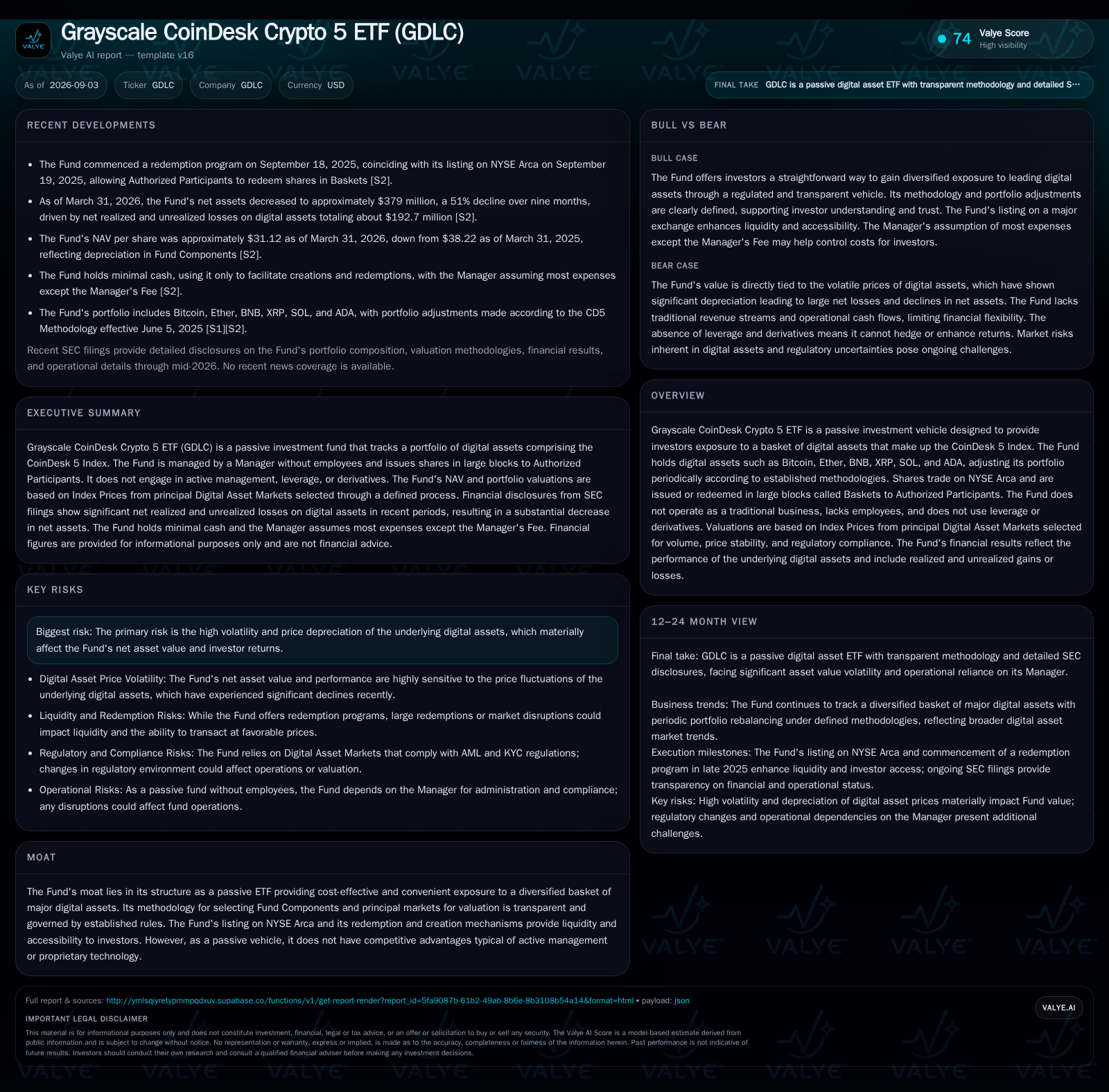
As of March 31, 2026, GDLC’s net assets stood at approximately $379 million, a 51% decline from $603 million a year earlier, primarily due to realized and unrealized losses of about $192.7 million on its portfolio of digital assets [S2]. This sharp contraction aligns with broad depreciation trends in major cryptocurrencies such as Bitcoin, Ether, and others included in the Fund’s CoinDesk 5 Index components.
The Fund’s shares began trading on NYSE Arca in September 2025, with shares issued and redeemed in large blocks called Baskets (10,000 shares each) exclusively to Authorized Participants [S2]. The Fund maintains minimal cash balances, using cash solely to facilitate creations and redemptions, while the Manager assumes most operating expenses except the Manager’s Fee [S2]. This operational model underscores a passive structure highly sensitive to underlying asset price movements without active portfolio intervention.
Passive Exposure Model Ties Revenues and Risks Directly to Digital Asset Prices
GDLC’s economic model centers on replicating the CoinDesk 5 Index by holding a fixed basket of digital assets—Bitcoin, Ether, BNB, XRP, SOL, and ADA—adjusted periodically according to transparent methodologies [S1][S2]. The Fund does not engage in leverage, derivatives, or active trading, meaning its net asset value (NAV) and returns depend almost exclusively on the price movements of these underlying tokens.
Operating costs are low relative to traditional active funds because the Manager’s role is primarily administrative. The Fund incurs minimal variable expenses, with management fees charged but no payroll or active research costs. However, the lack of active management means there is no operating leverage or margin expansion potential beyond scale benefits in creation/redemption volumes. Capital intensity is low since the Fund holds digital assets directly without leverage or complex instruments, but this also limits risk mitigation avenues.
The passive exposure model, while straightforward, inherently limits the Fund's ability to respond dynamically to market shocks or capitalize on short-term arbitrage opportunities. This rigidity means that GDLC's returns are almost entirely a function of the underlying asset price performance, creating a direct correlation between investor outcomes and crypto market cycles. From a unit economics perspective, the absence of active management reduces operational costs but also eliminates potential alpha generation through tactical asset allocation or hedging strategies. Investors should consider that the Fund effectively trades off potential outperformance for cost efficiency and simplicity, which may appeal to those seeking pure beta exposure but could be a disadvantage during periods of heightened market stress or structural shifts in digital asset valuations.
GDLC’s Passive ETF Structure Provides Transparency but Faces a Fragmented Digital Asset Market
GDLC’s primary competitive advantage lies in offering regulated, transparent, and cost-effective exposure to a diversified basket of leading cryptocurrencies through a passive index model. Its listing on a major exchange (NYSE Arca) and clearly defined portfolio methodologies enhance investor trust and liquidity compared to less regulated crypto investment vehicles.
However, the digital asset ETF landscape is increasingly crowded, with competitors offering varying baskets, active strategies, or leverage. The Fund’s lack of leverage and derivatives limits its ability to differentiate via return enhancement or hedging. Furthermore, the absence of employees or active management may reduce operational responsiveness. The regulatory environment and evolving investor preferences could shift competitive dynamics, potentially favoring funds with broader product ecosystems or active risk management.
The Fund's minimal cash holdings and reliance on large-block creations and redemptions introduce liquidity nuances that merit close attention. While the creation/redemption mechanism supports arbitrage and helps keep the ETF's market price aligned with its NAV, the concentration of these transactions among Authorized Participants can lead to episodic liquidity bottlenecks, especially during market downturns when redemption pressures intensify. This dynamic may exacerbate bid-ask spreads and increase volatility in the ETF's share price relative to the underlying assets. Furthermore, the Fund's operational model assumes that Authorized Participants remain willing and able to transact efficiently; disruptions in their capacity or incentives could impair liquidity, presenting a potential risk factor that investors should monitor through trading volume patterns and market depth metrics.
Recovery in Crypto Markets Could Restore NAV and Attract New Investors
A favorable scenario for GDLC involves a sustained rebound in the prices of its underlying digital assets, driven by renewed institutional adoption, improved regulatory clarity, or macroeconomic tailwinds boosting crypto demand. This would directly uplift the Fund’s NAV and share price, reducing redemption pressures and improving investor sentiment.
Such a recovery could also increase trading volumes and creation/redemption activity, enhancing liquidity and operational scale. Confirmation would come from rising NAV per share, net asset growth, and stable or expanding bid-ask spreads on NYSE Arca. Conversely, failure of prices to sustain gains or renewed regulatory crackdowns could falsify this scenario.
Competitive pressures in the digital asset ETF space could influence GDLC's positioning over time, particularly as new entrants introduce innovative product features or adopt active management approaches. While GDLC benefits from regulatory clarity and a transparent index methodology, these attributes alone may not suffice to sustain market share if competitors offer differentiated risk management tools such as volatility hedging, leverage, or exposure to emerging crypto sectors like decentralized finance or non-fungible tokens. Moreover, the Fund's passive approach may limit its appeal to investors seeking tactical allocation or downside protection amid crypto market turbulence. Observing shifts in investor preferences and product launches within the ETF ecosystem will be critical to assessing GDLC's long-term competitive moat and growth prospects.
Continued Volatility Maintains Pressure on Fund Value but Liquidity and Transparency Support Persistence
The most plausible scenario sees ongoing digital asset price volatility with episodic recoveries but no sustained bull market in the near term. GDLC’s NAV and assets under management fluctuate accordingly, reflecting the inherent volatility of the underlying tokens. In this environment, the Fund remains a viable passive exposure tool for investors seeking regulated access to major cryptocurrencies.
Liquidity supported by the creation/redemption mechanism and the Fund’s transparent methodologies help maintain investor confidence despite price swings. The Manager’s low-cost operational structure provides stability but limits flexibility to mitigate losses. Confirming evidence includes stable trading volumes on NYSE Arca and consistent SEC filings reflecting ongoing portfolio adjustments. Large-scale redemptions or regulatory shocks could undermine this stability and falsify the base case.
Prolonged Crypto Downturn and Regulatory Hurdles Could Erode Fund Viability
A downside path involves sustained or worsening declines in digital asset prices, driven by adverse regulatory actions, loss of investor confidence, or macroeconomic headwinds. This would further depress GDLC’s NAV and net assets, potentially triggering accelerated redemptions and liquidity challenges given the Fund’s minimal cash reserves.
Additionally, regulatory tightening could affect the principal Digital Asset Markets used for valuation or impose operational constraints on the Fund’s Manager, increasing costs or limiting portfolio rebalancing. Confirmation would include continued NAV erosion, shrinking net assets, and wider bid-ask spreads. Falsification would be marked by price stabilization or easing regulatory environment.
In a prolonged downturn scenario, the Fund's operational resilience and investor confidence become paramount. The minimal cash buffer constrains the Manager's ability to absorb redemption shocks without forced asset sales, which could further depress NAV and exacerbate negative feedback loops. Additionally, regulatory developments that impose stricter reporting, custody, or capital requirements could increase operational costs or limit the Fund's flexibility in portfolio rebalancing, potentially impairing performance. Investors should watch for signs of stress such as widening bid-ask spreads, declining trading volumes, or increased redemption activity that could signal deteriorating liquidity and market confidence. Stress-testing the Fund's structural assumptions against adverse market and regulatory conditions can help identify vulnerabilities and inform risk management strategies.
Key Indicators to Assess GDLC’s Market Reception and Resilience
Investor demand and net asset trends: Monitoring net assets under management and creation/redemption activity reveals investor appetite and liquidity conditions. Sudden outflows may signal waning confidence.
NAV per share movements relative to underlying asset prices: Discrepancies or premium/discount patterns could indicate market inefficiencies or liquidity constraints.
Trading volume and bid-ask spreads on NYSE Arca: Higher volumes and tighter spreads suggest healthy liquidity and market-maker engagement.
Regulatory developments affecting digital asset markets and ETF operations: Changes in AML/KYC rules, asset custody regulations, or ETF approval pathways could materially impact Fund operations.
Disclaimer: This is research-only, informational analysis and not investment advice. It may include AI-generated interpretation and general industry context. Always verify important details using primary sources.

Comments