
Latigo Biotherapeutics Navigates Clinical-Stage Challenges Amid Insider Confidence and Financial Constraints
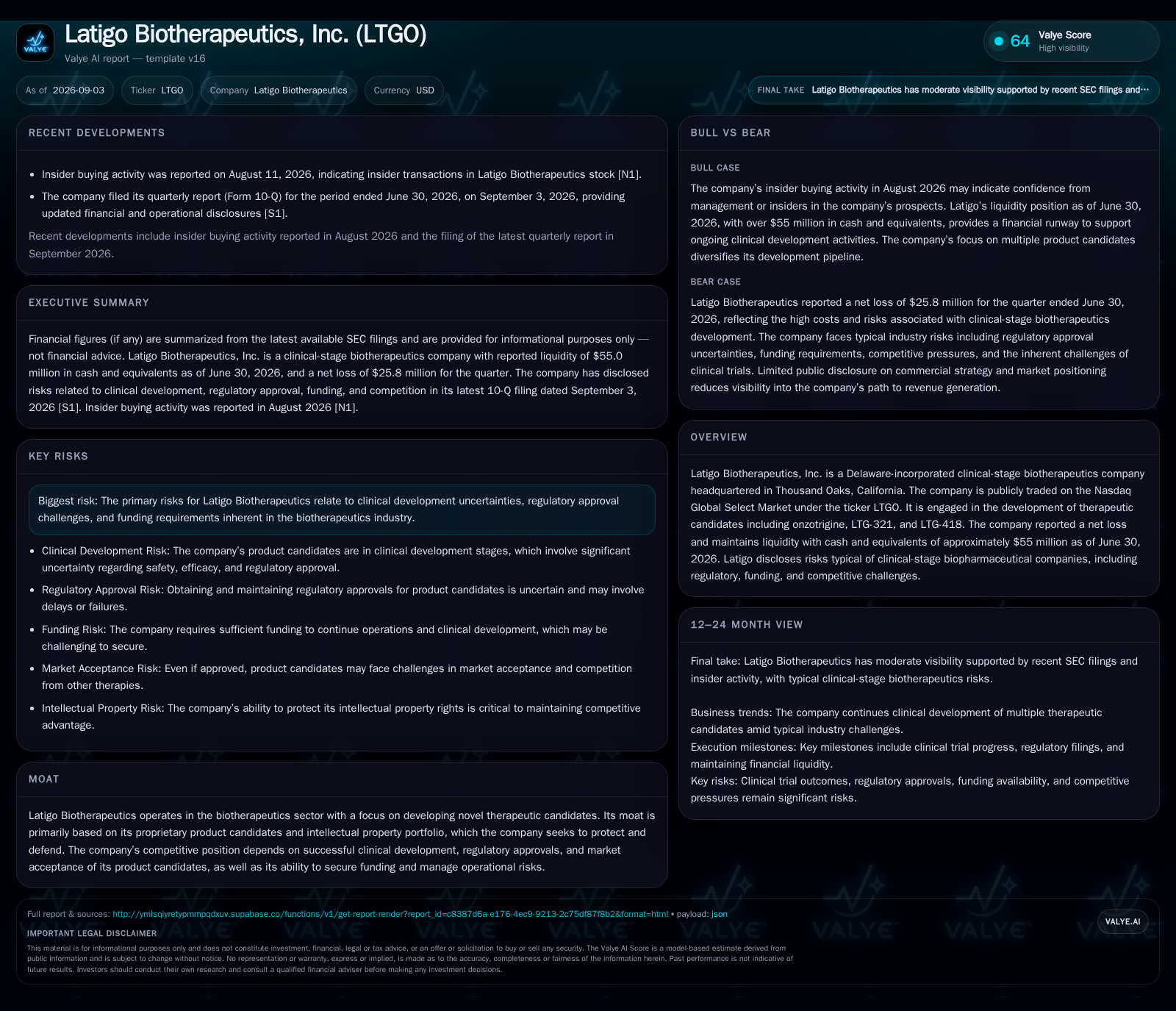
Latigo Biotherapeutics remains in its critical clinical development phase with multiple therapeutic candidates, balancing substantial net losses against a moderate cash runway and recent insider buying activity. The company’s future hinges on clinical outcomes, regulatory approvals, and its capacity to extend funding, all while contending with competitive biotherapeutics dynamics.
Latigo Biotherapeutics, a clinical-stage biotherapeutics firm, is advancing multiple product candidates but faces the typical high-risk, capital-intensive challenges of drug development. Its liquidity position provides a limited runway to support operations, while insider purchases suggest some internal optimism. The company's economic model relies heavily on successful clinical milestones and regulatory approvals to unlock value. Competitive pressures and funding needs pose ongoing risks. Key indicators include clinical trial progress, regulatory interactions, cash burn rate, and potential partnerships or financing rounds.
Latigo Biotherapeutics operates at the intersection of innovation and risk, with a clinical-stage pipeline that embodies promise but requires navigating steep challenges. The company’s financial disclosures as of mid-2026 show a cash balance sufficient for near-term operations but a significant quarterly net loss underscores the capital-intensive nature of drug development. Insider buying activity in August hints at internal confidence, yet the fundamental value creation depends heavily on clinical and regulatory progress. Understanding Latigo’s business economics, competitive positioning, and potential future trajectories is essential to assess its investment case amid the high stakes typical of clinical-stage biotherapeutics.
Latigo’s Financial Position and Insider Buying Reveal Mixed Signals
As of June 30, 2026, Latigo Biotherapeutics reported cash and cash equivalents of approximately $55 million with current liabilities near $51.6 million, yielding a current ratio of 1.15 and a cash ratio slightly above 1. This liquidity snapshot indicates that while the company can cover its short-term obligations, the margin is narrow, emphasizing the need for careful financial stewardship [S1]. The reported net loss of $25.8 million in Q2 2026 underscores the ongoing burn rate typical for clinical-stage biotherapeutics, where R&D and administrative expenses dominate the cost structure.
Notably, insider buying activity recorded in August 2026 introduces a nuanced dynamic, suggesting some degree of confidence from management or affiliated parties despite the company’s high-risk profile and financial losses [N1]. While insider purchases can be interpreted as a positive signal, the ultimate value realization depends on successful clinical and regulatory milestones. These facts contextualize Latigo’s current status: an enterprise with modest liquidity supporting a high-cost development model and internal stakeholders betting on future upside.
Capital-Intensive Development Model with High Operating Leverage Potential
Latigo’s business economics are characteristic of clinical-stage biotherapeutics, where revenue generation is typically absent until product commercialization. The company’s current financials reflect substantial fixed costs related to R&D, clinical trials, and regulatory activities, producing negative operating leverage in the short term. The net loss of $25.8 million in one quarter highlights the intensity of investment required to progress multiple therapeutic candidates (onzotrigine, LTG-321, LTG-418). Variable costs are less significant at this stage compared to fixed commitments to clinical sites, manufacturing scale-up for trials, and personnel expenses.
The company’s ability to leverage operating expenses depends on achieving key milestones that unlock inflection points—such as positive clinical data, regulatory filing approvals, or partnerships—that can lead to licensing revenues or commercial launch. Capital needs remain high and recurring, with the current cash position implying limited runway without additional funding. The absence of commercial revenue means cash flow generation is negative, and the operating model hinges on financing capacity and milestone-driven valuation uplift rather than traditional pricing or volume-based revenue dynamics.
Pipeline Diversity Offers Potential Edge Amid Intense Biotherapeutics Competition
Latigo’s competitive position centers on its proprietary therapeutic candidates and associated intellectual property, which constitute the main source of potential competitive advantage. The pipeline’s diversity—spanning onzotrigine, LTG-321, and LTG-418—may mitigate single-product risk and provide multiple shots on goal. However, this advantage is contingent on successful clinical development and regulatory approvals, which remain uncertain and capital-intensive. In the crowded biotherapeutics sector, the company competes against well-funded peers with deeper clinical pipelines and established commercialization capabilities.
Switching frictions and adoption curves in biotherapeutics depend heavily on demonstrated clinical efficacy and safety, as well as reimbursement and market acceptance. Latigo’s lack of commercial products means it faces zero switching costs today but must build clinical differentiation to establish future pricing power. Intellectual property protection is vital to defend eventual market share, but emerging biosimilars and competing modalities could erode long-term exclusivity. The competitive landscape demands continuous innovation and successful navigation of regulatory pathways to translate pipeline assets into sustainable advantage.
Positive Clinical Readouts Catalyze Strategic Partnerships and Funding Inflows
In a favorable trajectory, Latigo achieves positive clinical trial outcomes for one or more candidates, particularly onzotrigine, which could validate the company’s scientific approach and safety profile. Such data would likely improve investor sentiment and attract strategic partners seeking to license or co-develop promising therapies, enabling the company to share development costs and accelerate commercialization efforts. Confirming evidence would include successful trial enrollment, interim efficacy signals, and regulatory feedback supporting filing pathways.
This scenario would also ease funding pressures by opening venture or public markets for capital infusions and potentially improving share price, reducing dilution risk. The key falsification test would be failure to meet primary endpoints or emergent safety concerns, which would undermine partnership prospects and increase financing costs. Insider buying should continue or increase as a confirming signal of internal confidence. Absence of such clinical progress or regulatory setbacks would invalidate this optimistic path.
Gradual Progress with Sustained Cash Burn and Funding Reliance
The most plausible scenario involves steady but unspectacular clinical development progress, with Latigo advancing trials without major safety issues but also without definitive positive efficacy signals in the near term. This path would maintain investor interest at a moderate level but keep the company reliant on periodic capital raises to fund operations. Quarterly net losses and cash burn rates remain elevated, consuming liquidity over the next 12 to 18 months.
The company likely manages its pipeline prioritization to conserve cash, possibly delaying or deprioritizing less promising candidates. Confirming evidence would be incremental trial updates, regulatory communications indicating standard review timelines, and manageable financing rounds at reasonable valuations. Insider buying may be subdued but not reversed. The falsification test for this scenario includes either dramatic clinical failure or breakthrough success altering funding needs and market sentiment. This scenario illustrates the high-risk, capital-dependent nature of clinical-stage biotherapeutics.
Clinical Setbacks and Funding Challenges Threaten Operational Viability
In a downside case, Latigo encounters significant clinical trial failures, such as missing efficacy endpoints or unexpected adverse events, which would severely damage the perceived value of its pipeline. Combined with an inability to secure additional funding on favorable terms, this could force operational cutbacks, asset divestitures, or restructuring. The company’s narrow liquidity margin and ongoing net losses amplify vulnerability to financing disruptions.
Confirming evidence would include clinical data releases showing negative outcomes, regulatory warnings or trial suspensions, and failed financing efforts or dilution at steep discounts. Insider selling or cessation of insider buying might accompany deteriorating confidence. Falsification of this scenario requires successful trial data or new capital inflows stabilizing operations. This scenario underscores the existential risks clinical-stage biotherapeutics face when scientific and financial headwinds converge.
Key Milestones and Metrics That Will Define Latigo’s Trajectory
Monitoring Latigo’s clinical trial progress across its pipeline candidates is critical—key milestones include enrollment completion, primary endpoint readouts, and regulatory interactions. These events provide tangible evidence of scientific validation or failure and influence investor sentiment and partnership opportunities. Additionally, tracking quarterly cash burn and remaining cash runway will clarify the company’s financing needs and operational sustainability.
Insider transaction patterns offer a useful sentiment gauge; continued insider buying may indicate confidence, whereas selling could signal concern. The company’s ability to secure new funding rounds or strategic partnerships is another pivotal metric that will impact its capacity to advance development and eventually commercialize products. Intellectual property developments and competitive landscape shifts should also be observed, as they affect long-term franchise potential.
Disclaimer: This is research-only, informational analysis and not investment advice. It may include AI-generated interpretation and general industry context. Always verify important details using primary sources.

Comments