
Phreesia Navigates Complex Healthcare Tech Terrain Amid Q2 Revenue Shortfall
Phreesia’s integrated platform and strategic acquisition underpin a sizable market opportunity, but heightened competition and regulatory complexity challenge near-term financial momentum.
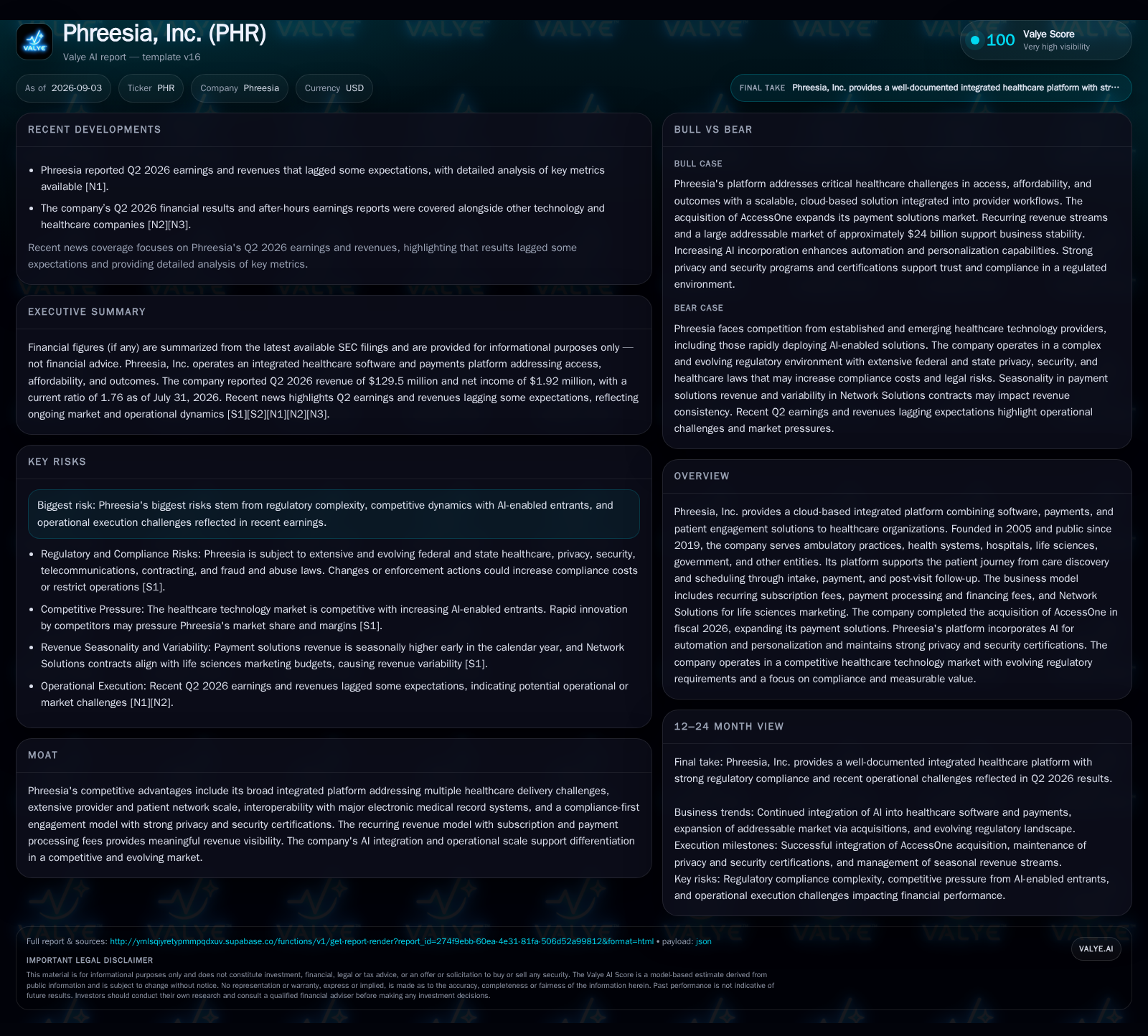
Phreesia, Inc. combines cloud-based software, payments, and patient engagement to serve a substantial portion of U.S. ambulatory visits. Its 2026 acquisition of AccessOne broadens payment solutions capabilities within a $24 billion market opportunity. Despite a recurring revenue base and AI-enhanced platform, Q2 2026 earnings missed expectations, spotlighting operational execution and competitive headwinds. The company’s business economics hinge on subscription and payment volumes, tempered by seasonality and regulatory costs. Long-term value depends on sustaining integration scale, navigating evolving compliance, and differentiating amid accelerating AI competition.
Phreesia, Inc. operates an integrated healthcare technology platform encompassing software, payment solutions, and patient engagement tools, embedded deeply into provider workflows across the U.S. healthcare ecosystem. Its fiscal 2026 milestone acquisition of AccessOne signals a strategic expansion into payment cards, broadening the company’s addressable market within a highly regulated, competitive environment. However, Phreesia’s Q2 2026 earnings and revenue performance fell short of expectations, underscoring the operational complexities and market pressures it faces. Understanding how Phreesia’s business economics interact with competitive dynamics, regulatory demands, and technology adoption will be critical to assessing its medium-term trajectory.
Q2 2026 Results Reveal Operational and Market Headwinds After Strategic Expansion
Phreesia reported Q2 2026 revenue of $129.5 million and net income of $1.92 million, with earnings and revenues below some analyst expectations. This shortfall occurred despite the company’s platform facilitating approximately 180 million patient visits in fiscal 2026, representing a significant share—about one in six—of U.S. ambulatory visits [S1][S2][N1][N2].
The acquisition of AccessOne Parent Holdings, Inc. in fiscal 2026 expanded Phreesia’s healthcare payment card capabilities and broadened its total addressable market toward $24 billion, comprising subscription services, payment fees, and Network Solutions for life sciences [S1]. These developments set a foundation for longer-term growth but also add integration and operational execution risks amid a competitive and regulatory environment.
Recurring Subscriptions Coupled With Volume-Driven Payment Revenues Define Profitability Levers
Phreesia’s revenue model blends subscription and related services—characterized by relatively stable, recurring annual contracts—with payment solutions tied to processing volumes and financing fees, which are subject to seasonality, peaking early in the calendar year. Network Solutions revenues linked to life sciences marketing budgets tend to fluctuate in the second half of the fiscal year [S1]. This mix introduces complexity in revenue predictability and margin management.
Operating leverage potential hinges on scaling fixed costs in platform development and sales while growing volume-driven payment revenues. Capital intensity is moderate, focused on cloud infrastructure, compliance certifications, and R&D emphasizing AI integration for automation and personalization. However, margin expansion could be constrained if regulatory compliance costs rise or competitive pricing pressures intensify, particularly as payment processing is sensitive to transaction volumes and fee structures.
Platform Breadth and Compliance Credentials Counterbalance Rising AI-Enabled Rivals
Phreesia’s integrated platform, which supports interoperability with major electronic medical record (EMR) systems and embeds into provider workflows, creates multi-dimensional value by addressing access, affordability, and outcomes. Its comprehensive privacy and security certifications (HITRUST, PCI-DSS Level 1, SOC 2) reinforce trust in a highly regulated healthcare ecosystem [S1]. These factors contribute to moderate switching costs and customer retention potential.
Nevertheless, the healthcare technology landscape is increasingly crowded with AI-enabled entrants rapidly deploying advanced automation and analytics. Larger incumbents and nimble startups alike intensify competition on platform functionality, pricing, and customer experience. Thus, Phreesia’s ability to innovate AI features and demonstrate measurable clinical and financial value will be crucial to sustaining its competitive moat.
Successful Integration and AI-Driven Differentiation Unlock Market Share and Margin Expansion
In a favorable scenario, Phreesia fully integrates AccessOne’s payment card capabilities, enabling seamless end-to-end payment solutions that enhance customer stickiness and capture a larger share of the payments addressable market. Coupled with accelerated AI adoption, the platform could deliver superior automation and personalized patient engagement, improving provider outcomes and operational efficiency, thus justifying premium pricing and expanding margins.
Confirming evidence would include sequential growth in payment processing volumes beyond seasonal norms, continued-adoption indicators improvements in subscription contracts, and positive customer feedback on AI-enabled features. Market share gains against AI-savvy competitors and stable compliance costs despite regulatory changes would further validate this scenario. Conversely, failure to integrate AccessOne’s offerings or stagnation in AI product development would challenge this positive path.
Steady Growth With Margin Pressure Amid Competitive and Regulatory Headwinds
The most plausible scenario sees Phreesia maintaining its strong penetration in ambulatory care while growing payment volumes and Network Solutions revenues in line with historical seasonal patterns. The recurring subscription base provides revenue stability, but payment processing margins face pressure from competition and fee compression. Regulatory compliance costs rise gradually, offsetting some operating leverage benefits from scale and AI efficiencies.
Evidence supporting this scenario includes moderate revenue growth consistent with sector trends, stable customer retention, and ongoing investment in compliance and AI capabilities without dramatic margin improvement. Q2 2026’s revenue miss may reflect transitional challenges in this context. A falsification would be rapid margin expansion or material loss of customers due to competitive disruption.
Integration Failures and Accelerating Competition Undermine Financial Performance
A downside scenario involves operational execution issues in integrating AccessOne’s payment solutions, resulting in customer dissatisfaction or delayed revenue synergies. Concurrently, intensifying competition from AI-driven healthcare platforms erodes Phreesia’s market share and forces price reductions. Regulatory compliance burdens escalate sharply due to new federal or state mandates, increasing costs disproportionately and constraining margins.
Confirming evidence would be persistent revenue shortfalls, declining continued-adoption indicators, loss of key clients, and rising legal or compliance expenses. Negative customer feedback on platform usability or payment features would also signal distress. Recovery signs would include successful remediation of integration issues or regulatory cost stabilization.
Key Metrics to Monitor Platform Adoption, Revenue Quality, and Regulatory Impact
Investors should track subscription continued-adoption indicators and net new client additions to gauge recurring revenue stability and platform adoption. Payment processing volumes and associated fee margins are critical to assess the health of the payment solutions segment and seasonal variability.
Network Solutions contract wins and revenue timing aligned with life sciences marketing budgets provide insight into that segment’s contribution. Monitoring R&D spend and AI feature rollouts will clarify innovation trajectory. Compliance-related expenses and any regulatory enforcement actions should be watched closely for potential margin impact. Finally, integration milestones for AccessOne and customer satisfaction scores would illuminate execution effectiveness.
Disclaimer: This is research-only, informational analysis and not investment advice. It may include AI-generated interpretation and general industry context. Always verify important details using primary sources.

Comments