
Market Technology Acquisition Corp Faces Critical Execution Window Amid Liquidity Challenges
As a newly listed SPAC with limited operational data and low liquidity, Market Technology Acquisition Corp must navigate a narrow timeframe to consummate a Business Combination or risk delisting and value erosion.
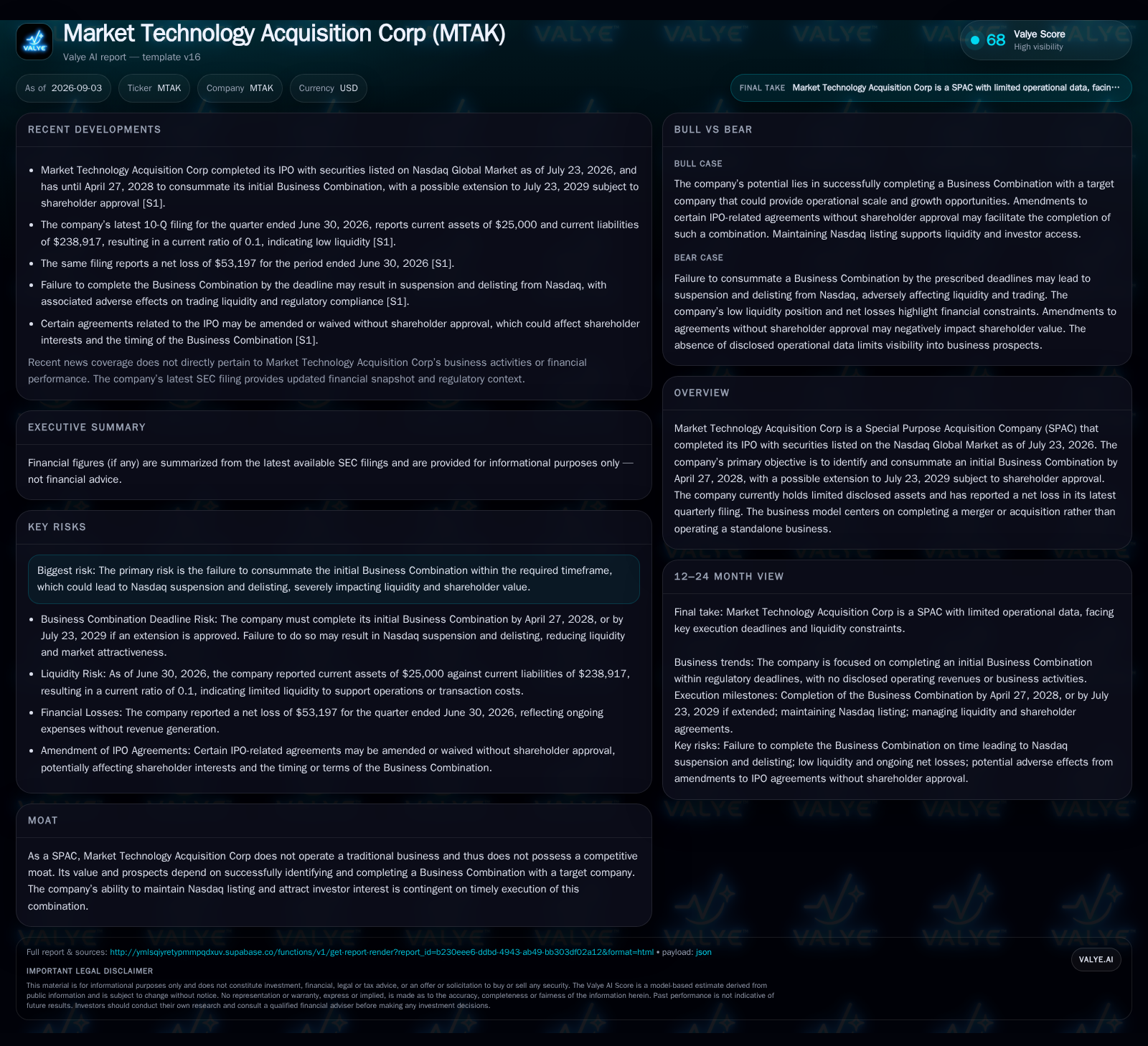
Market Technology Acquisition Corp (MTAK) launched its Nasdaq IPO in July 2026 with a mandate to complete a Business Combination by April 2028, extendable to July 2029. The company currently holds negligible assets, reports net losses, and faces significant liquidity constraints. Its value proposition hinges entirely on identifying and closing a suitable merger or acquisition target within the deadline to avoid Nasdaq suspension and delisting. The economics reflect typical SPAC dynamics—no operating revenues and costs primarily tied to transaction execution. The key uncertainties involve financing the deal, managing shareholder interests amid agreement amendments, and preserving market listing. The path forward involves high execution risk balanced by potential upside if a compelling target emerges and the combination proceeds smoothly.
Market Technology Acquisition Corp (MTAK) is a newly public Special Purpose Acquisition Company (SPAC) with a clear but narrow mandate: complete a Business Combination by April 2028, subject to extension. The company’s financial snapshot reveals minimal assets and significant liabilities, underscoring liquidity challenges typical of early-stage SPACs that have yet to secure a merger target. Without operating revenues or an active business, MTAK’s valuation and future depend entirely on its ability to identify, negotiate, and close a transaction that meets investor and regulatory expectations. This juncture highlights the critical balance between execution risk, regulatory compliance, and shareholder interests as the company approaches a pivotal deadline.
Nasdaq Listing Pressures and Tight Liquidity Define MTAK’s Near-Term Outlook
Market Technology Acquisition Corp completed its IPO on July 23, 2026, securing a listing on the Nasdaq Global Market with the objective to consummate a Business Combination by April 27, 2028. This deadline is extendable to July 23, 2029, but only with shareholder approval, creating a hard regulatory and market-imposed timeline that governs the company’s strategic decisions [S1].
The company’s latest 10-Q filing for the quarter ending June 30, 2026, reveals a precarious liquidity position—current assets of just $25,000 against current liabilities of $238,917. This translates to a current ratio of 0.1, signaling very limited financial resources to cover short-term obligations or fund transaction-related expenses [S1]. Moreover, reporting a net loss of $53,197 during this period reflects ongoing administrative and operational costs without offsetting revenues, consistent with the SPAC business model [S1].
SPAC Structure Drives Zero-Operating-Revenue Model With Capital-Intensive Transaction Focus
Market Technology Acquisition Corp operates as a typical blank-check vehicle—no revenues or operating cash flows are generated, and costs primarily stem from administrative expenses and business combination-related legal and advisory fees. The economics center around raising investor capital through the IPO and then deploying these funds to acquire a target company, with shareholder approval. Without a completed Business Combination, no traditional operating margin or unit economics exist.
Capital intensity is concentrated in funding the initial transaction rather than ongoing operations. The company’s fixed costs include regulatory compliance and corporate overhead, while variable costs spike around due diligence and deal execution. Operating leverage is thus limited until a target is acquired, and scale economies will emerge only post-merger if the combined entity operates efficiently. The low liquidity ratio signals a critical risk: insufficient capital to navigate the costly combination phase without external financing or amendments to IPO agreements.
The structural economics of SPACs like Market Technology Acquisition Corp inherently create a binary investment outcome: either a successful Business Combination is consummated, unlocking potential upside derived from the target’s operating business, or the SPAC liquidates at or near the trust value, often resulting in capital loss after administrative expenses. This binary nature amplifies the importance of timing and liquidity management. If the SPAC lacks sufficient capital to cover deal-related expenses, it may be forced to seek costly external financing or amend IPO terms, which can dilute shareholder value or delay transaction timelines. Investors should monitor the company’s burn rate relative to remaining time and available cash, as these dynamics critically influence the probability of reaching a value-creating combination.
Absence of Operational Moat Shifts Competitive Focus to Transaction Execution and Timing
As a SPAC, Market Technology Acquisition Corp inherently lacks a product, customer base, or proprietary technology that could create a durable competitive advantage. Its competitive position depends entirely on the ability of its management team to identify, negotiate, and close an attractive Business Combination before regulatory deadlines. The company competes with numerous other SPACs seeking attractive targets, emphasizing the importance of deal sourcing capabilities, reputation, and access to capital markets.
The competitive environment is shaped by the broader SPAC market conditions, investor appetite, and regulatory scrutiny. Larger or more specialized SPACs with established sponsor credibility may have advantages in accessing high-quality targets and negotiating favorable terms. MTAK’s low liquidity and limited disclosed assets may weaken its negotiating leverage and attractiveness to target companies compared to better-capitalized peers.
Successful Business Combination Unlocks Value Through Scale and Market Listing Preservation
In the favorable scenario, MTAK identifies a compelling target company that complements its strategic criteria and successfully consummates the Business Combination by the April 2028 deadline (or extended deadline). Completion preserves Nasdaq listing, maintaining trading liquidity and investor access. The combined entity may benefit from operational scale, diversified revenue streams, and a market valuation reflective of the target’s underlying business fundamentals.
Further upside could emerge if amendments to IPO-related agreements expedite or smooth the combination process without diluting shareholder interests materially. Confirming evidence for this scenario includes announcements of a definitive merger agreement, shareholder approval, and subsequent positive market reception. A falsification test would be failure to secure a target, inability to finance the deal, or shareholder rejection of proposed terms.
The absence of an operational moat in SPACs like MTAK means that competitive advantage is transient and largely contingent on sponsor reputation, network access, and timing. While the broader SPAC market often experiences waves of investor enthusiasm and regulatory scrutiny, these external factors can compress or expand the window of opportunity for deal sourcing. For instance, increased regulatory hurdles or market volatility can reduce the pool of viable targets or increase transaction costs, disproportionately disadvantaging SPACs with weaker balance sheets or less experienced management teams. Conversely, a well-connected sponsor with prior deal execution experience may mitigate some of these risks by leveraging relationships and market insight to identify off-market or undervalued targets.
Moderate Progress Toward Combination Accompanied by Liquidity Management Challenges
The most plausible middle-path scenario involves MTAK making incremental progress toward identifying a target but encountering delays due to liquidity constraints or negotiation complexities. The company may need to amend IPO agreements to secure additional financing or extend deadlines with shareholder consent. Operating losses continue as administrative costs accrue but remain manageable if the company controls expenses prudently.
In this scenario, the Business Combination occurs close to the deadline, preserving Nasdaq listing but limiting upside potential due to compressed transaction timelines. Confirming evidence would be public disclosures of ongoing negotiations and shareholder votes on extensions. Failure to meet these milestones or persistent liquidity shortfalls would falsify this scenario and push the company toward distress.
From an upside perspective, the successful consummation of a Business Combination does not guarantee value creation unless the combined entity achieves operational synergies or market recognition that justify a premium valuation. Post-merger integration risks, including cultural mismatches, management turnover, or failure to meet growth projections, can erode anticipated benefits. Additionally, the preservation of Nasdaq listing is necessary but not sufficient; sustained investor confidence and liquidity depend on transparent communication, credible governance, and consistent financial performance. Investors should watch for early signs of integration progress and market reception to the combined company’s strategic direction as leading indicators of long-term value realization.
Failure to Close Transaction Triggers Nasdaq Suspension and Investor Value Erosion
The downside unfolds if MTAK fails to consummate a Business Combination by the mandated deadline, resulting in Nasdaq suspension or delisting. This outcome would severely restrict trading liquidity, reduce investor interest, and likely precipitate a decline in share value. Low current assets and ongoing net losses exacerbate the risk of operational insolvency or forced wind-down.
Additionally, amendments to IPO agreements conducted without shareholder approval could erode investor trust and complicate governance, further undermining shareholder value. Confirming evidence includes missed deadlines, regulatory notices of non-compliance, and adverse market reactions. Falsification would require evidence of secured financing, successful shareholder engagement, or an executed merger agreement prior to deadlines.
In the base scenario, liquidity management challenges may necessitate complex negotiations with shareholders or warrant amendments to the SPAC’s governing documents. Such amendments, while potentially enabling deal completion, can also introduce governance risks and shareholder dissent if perceived as dilutive or misaligned with investor interests. The timing of these negotiations is critical; protracted discussions may consume valuable runway, increasing the risk of missing regulatory deadlines. Furthermore, the need for additional financing or deadline extensions can signal underlying challenges in deal sourcing or valuation alignment, which may weigh on market sentiment and share price performance prior to transaction closure.
Key Milestones and Metrics to Assess MTAK’s Progress Toward Business Combination
- Announcement of a definitive Business Combination agreement—signals concrete progress and validates management execution capability. 2. Shareholder vote outcomes on deadline extensions or merger approvals—critical for regulatory compliance and transaction legitimacy. 3. Changes in liquidity position including cash reserves and access to financing—indicators of ability to fund transaction costs and ongoing operations. 4. Amendments to IPO-related agreements without shareholder approval—may affect governance and shareholder interests, requiring careful scrutiny. 5. Nasdaq compliance status updates—key to monitoring trading continuity and regulatory risk. 6. Quarterly net loss trends and expense management—provide insight into operational cost control in the pre-combination phase. 7. Investor communications on target search progress—inform market expectations and sentiment.
Disclaimer: This is research-only, informational analysis and not investment advice. It may include AI-generated interpretation and general industry context. Always verify important details using primary sources.

Comments