
Tilly's Navigates Apparel Retail Dynamics with Operational Strength Amid Sector Risks
Tilly's recent Q2 2026 results show revenue and profitability gains supported by solid liquidity, yet the company faces structural challenges from evolving consumer trends, competitive pressure, and operational execution in a volatile apparel retail landscape.
Tilly's reported strong Q2 2026 revenue and earnings performance exceeding market estimates, underpinned by a current ratio above 1 and positive net income. The company’s retail apparel business model relies on balancing product mix, inventory management, and consumer trend responsiveness amid competitive pressures. While recent operational results signal momentum, ongoing challenges include earnings volatility, execution risk, and the need to adapt to rapidly shifting consumer preferences. Key uncertainties revolve around sustaining growth, managing capital efficiently, and navigating sector risks that could impact profitability.
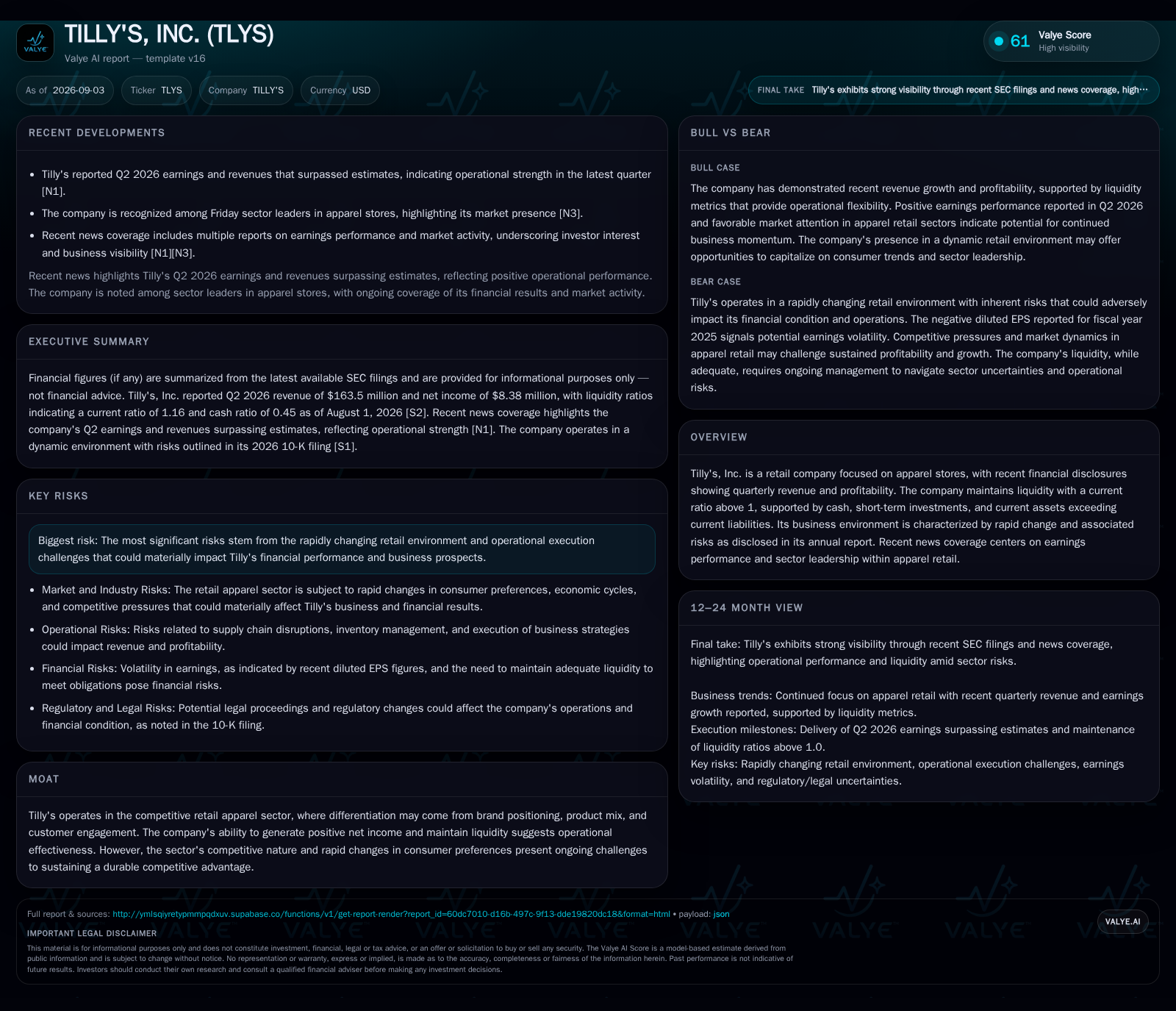
Tilly's, Inc., a retailer specializing in apparel stores, delivered Q2 2026 results that surpassed revenue and earnings estimates, signaling operational resilience in a competitive and fast-evolving retail environment. With revenue of $163.5 million and net income of $8.38 million, alongside liquidity metrics that underpin short-term obligations, Tilly's demonstrates the ability to generate positive cash flow and maintain financial stability. However, the apparel retail sector remains subject to rapid shifts in consumer preferences and market conditions, posing risks to sustained growth and profitability. The core issue is whether Tilly's can leverage its recent gains into durable competitive positioning amid these headwinds.
Recent Earnings Beat Highlights Operational Momentum Amid Sector Volatility
Tilly's reported Q2 2026 revenue of $163.5 million and net income of $8.38 million, exceeding market expectations and signaling a notable operational upswing [S2][N1]. This improvement in quarterly performance followed a fiscal year 2025 marked by a diluted EPS loss of $0.58, reflecting prior earnings volatility [S1][S2]. The latest earnings reveal effective cost management and revenue generation in the face of shifting consumer behaviors.
Liquidity metrics further contextualize the firm's operational health. With cash and equivalents at $52.3 million and a current ratio of 1.16 as of August 1, 2026, Tilly's maintains sufficient short-term asset coverage over liabilities, providing a buffer to manage working capital fluctuations [S2]. While not extraordinarily liquid, these figures suggest the company can support ongoing operations and inventory investment necessary in apparel retail, a sector that demands nimble supply chain and inventory control.
Apparel Retail Economics Demand Balance of Inventory, Pricing, and Consumer Trends
Tilly's business model centers on apparel retailing, where revenue derives primarily from unit sales of branded clothing and accessories. Pricing power is limited by competitive pressures and consumer price sensitivity, making volume and product mix critical to profitability. The company must optimize inventory assortments to match fast-changing fashion trends, balancing markdowns against full-price sales to protect margins. Fixed costs include store leases and payroll, while variable costs hinge on merchandise procurement and marketing. Operating leverage can emerge if incremental sales cover fixed expenses, but overstock or underperformance can quickly erode profits.
Capital intensity is moderate, with investments required in store infrastructure, inventory, and supply chain systems to maintain product freshness and availability. Operating leverage is closely linked to store productivity and inventory turnover. Given the apparel sector's seasonality and volatility, Tilly's must dynamically manage working capital to avoid cash flow strain. Smart inventory management and demand forecasting are pivotal in optimizing the pricing/volume/mix equation, as excessive discounting would undermine unit economics and dilute profitability.
Competitive Dynamics in Apparel Retail Challenge Differentiation and Margin Sustainability
Tilly's operates in a fiercely competitive apparel retail market characterized by numerous players ranging from specialty brands to mass-market chains and e-commerce platforms. Durable competitive advantage could stem from brand positioning, customer loyalty, exclusive product offerings, and efficient supply chain execution. However, apparel retail generally exhibits low switching costs for consumers, and rapid trend cycles favor nimble competitors with superior merchandising agility.
The company’s recent profitability improvement suggests operational effectiveness but does not yet confirm sustainable moat characteristics. Key competitors include larger multi-channel retailers and digitally native brands that can leverage scale and online reach. Tilly's ability to sustain margin and revenue growth depends on differentiated customer engagement, cost control, and adaptive product mix management. Without clear barriers to entry or strong brand loyalty, the competitive landscape remains a constant pressure point.
Strong Execution and Consumer Trend Alignment Drive Sustainable Growth Trajectory
In a favorable scenario, Tilly's leverages its operational momentum to achieve sustained revenue growth through enhanced product mix optimization, expanded store productivity, and improved omni-channel sales integration. Confirming evidence would include continued quarterly revenue beats, margin expansion driven by reduced markdowns, and improved customer retention metrics. Efficient inventory management would reduce working capital needs and support cash flow generation, facilitating reinvestment in growth initiatives.
This positive trajectory would also require Tilly's to anticipate and capitalize on emerging consumer trends ahead of competitors, strengthening brand relevance. A falsification test would be a return to margin compression or persistent inventory write-downs, signaling failure to adapt product assortments effectively or escalating competitive pressures undermining pricing power. Absence of sustained revenue growth or deteriorating liquidity would also challenge this scenario.
Moderate Growth with Earnings Volatility Amid Competitive and Consumer Uncertainty
The most plausible scenario reflects steady but unspectacular revenue growth, with earnings exhibiting periodic volatility due to inventory risks and competitive discounting. Tilly's maintains a measured pace of capital investment in store footprint and supply chain, balancing growth opportunities with margin preservation. Financial metrics remain stable but with limited operating leverage due to ongoing pressure on pricing and promotional intensity common in apparel retail.
Confirming evidence includes stable quarterly revenues near or slightly above estimates, consistent liquidity ratios around current levels, and modest net income fluctuations. This scenario assumes continued exposure to sector risks such as changing consumer preferences and economic cycles, which constrain upside but do not materially threaten solvency. A falsification test would be either a sustained earnings decline or sharp loss of sales momentum indicating deeper structural issues.
Execution Missteps and Market Shifts Trigger Earnings Decline and Liquidity Stress
Downside risk materializes if Tilly's fails to align inventory with consumer demand or cedes market share to competitors with stronger omni-channel capabilities. Increased markdowns to clear unsold stock would erode gross margins, while fixed cost absorption suffers from lower sales volume. This scenario could lead to losses, negative cash flow, and pressure on liquidity ratios, complicating working capital management.
Confirming evidence would include repeated quarterly earnings misses, negative operating cash flow, and declining current ratio below 1.0, indicating strained short-term financial health. A sharp decline in comparable store sales or increased inventory obsolescence would further validate downside risk. Conversely, evidence of inventory correction and margin stabilization would mitigate this scenario's likelihood.
Key Metrics to Monitor Tilly’s Financial Health and Market Responsiveness
Investors should track quarterly revenue growth and gross margin trends to gauge Tilly’s ability to balance pricing and product mix amid competitive pressures. Inventory turnover rates and markdown percentages are critical operational KPIs reflecting merchandise management effectiveness. Monitoring comparable store sales growth provides insight into consumer demand and brand strength.
Liquidity measures such as the current ratio and cash ratio remain essential to assess potential financial flexibility amid sector volatility. Earnings per share trends and operating cash flow are key profitability indicators. Additional useful metrics include online versus in-store sales mix evolution and customer retention or loyalty program engagement rates, which would illuminate shifts in channel strategy and consumer behavior adaptation.
Disclaimer: This is research-only, informational analysis and not investment advice. It may include AI-generated interpretation and general industry context. Always verify important details using primary sources.

Comments