
Grayscale Litecoin Trust: Navigating Volatile Litecoin Exposure Within a Passive Investment Framework
As a passive vehicle offering exposure to Litecoin (LTC), Grayscale Litecoin Trust balances the appeal of regulated access against the inherent volatility and liquidity constraints of cryptocurrency markets, while its Sponsor’s broader product expansion signals strategic diversification.
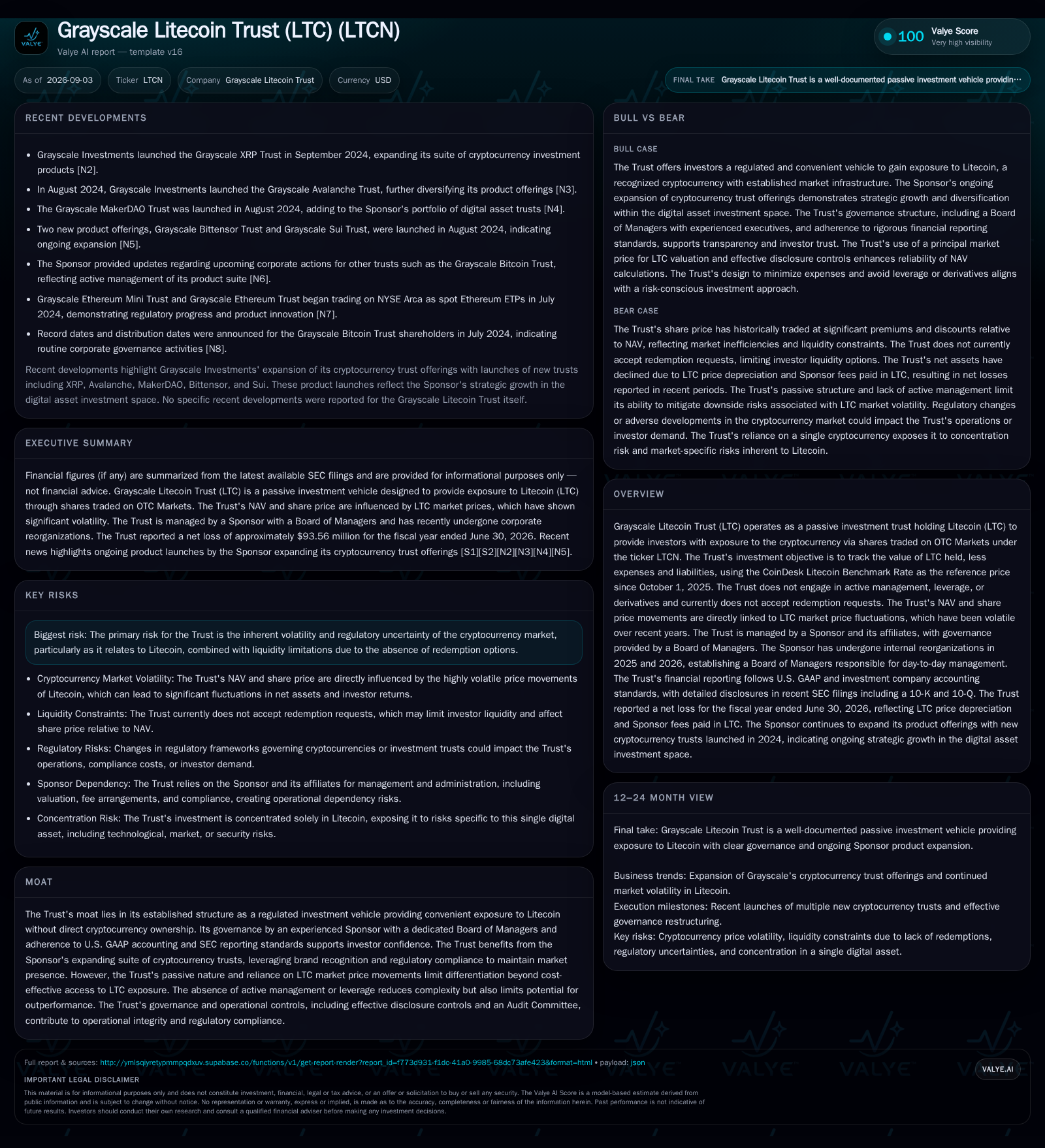
Grayscale Litecoin Trust (LTCN) provides investors a regulated and convenient way to gain exposure to Litecoin without direct ownership, using shares traded on OTC Markets. The Trust’s NAV and share price closely track LTC market price fluctuations, which have exhibited significant volatility. The Trust operates passively without leverage or derivatives, currently restricting redemptions, and has reported net losses driven by LTC depreciation and fees. Governance improvements and a Sponsor expanding its cryptocurrency trust suite support operational integrity and potential investor confidence, but risks around liquidity, concentration in LTC, and regulatory uncertainty remain material.
Grayscale Litecoin Trust (LTCN) functions as a passive investment vehicle designed to provide investors exposure to Litecoin’s price movements via publicly traded shares. By tracking the CoinDesk Litecoin Benchmark Rate and eschewing leverage or active management, the Trust offers a simplified product that appeals to investors seeking regulated access to LTC. However, its inability to process redemptions constrains liquidity, while the inherent volatility of Litecoin’s market price continues to pressure the Trust’s net assets and share valuation. Governance enhancements through a Board of Managers and the Sponsor’s broadening product suite suggest organizational maturation and strategic ambition within the evolving digital asset landscape.
Recent Governance and Market Dynamics Shape the Trust’s Operating Environment
As of September 3, 2026, Grayscale Litecoin Trust (LTCN) holds approximately $107 million in net assets, reflecting the cumulative impact of Litecoin price depreciation and Sponsor fees paid in LTC [S1]. The Trust’s NAV per share is derived from the CoinDesk Litecoin Benchmark Rate, which replaced its predecessor index on October 1, 2025, aiming to enhance price stability and accuracy in valuation. The Trust’s shares trade on OTC Markets and have historically experienced significant premiums and discounts relative to NAV, driven by market volatility and liquidity imbalances.
The Sponsor overseeing the Trust underwent corporate reorganizations in 2025, establishing a Board of Managers responsible for day-to-day operations, including CEO Peter Mintzberg and Interim CFO Kathryn Masci [S1]. These governance changes align with increased regulatory scrutiny and investor demand for transparency. In parallel, Grayscale Investments has expanded its suite of cryptocurrency trusts by launching XRP, Avalanche, MakerDAO, Bittensor, and Sui Trusts in 2024, signaling strategic diversification beyond LTC [N2][N3][N4][N5].
Passive Trust Model Limits Revenue Streams and Operating Leverage
Grayscale Litecoin Trust operates as a passive investment vehicle, holding LTC directly and issuing shares that reflect the underlying asset’s market value, less expenses and liabilities. The Trust’s revenue primarily comes from management fees paid in LTC to the Sponsor, which creates a direct drag on NAV as LTC prices fluctuate. Without leverage or derivatives, the Trust’s income is stable but limited, lacking mechanisms to amplify returns or hedge downside risk. This fee structure creates negative operating leverage when LTC prices decline, as the fee burden remains relatively fixed in LTC terms but translates into greater USD value loss.
The Trust’s capital requirements are minimal, focused on custody, administration, and compliance rather than active portfolio management. Variable costs are low, but fixed costs related to regulatory compliance and reporting remain. The absence of redemption rights constrains cash outflows but also limits the Trust’s ability to manage share supply dynamically. Consequently, the Trust’s operating leverage is constrained by LTC price volatility and fee payments, with limited potential to improve margins absent fee changes or structural shifts in the underlying LTC market.
Regulated Access and Sponsor Brand Provide Differentiated but Narrow Market Role
Grayscale Litecoin Trust’s competitive advantage stems from providing a regulated, SEC-reporting vehicle for exposure to Litecoin without requiring investors to hold or manage the cryptocurrency directly. This structure mitigates custody risks and regulatory concerns that might deter institutional or risk-averse investors. The Sponsor’s established reputation and recent governance enhancements add credibility and operational rigor, which support investor confidence relative to unregulated or less transparent crypto investment alternatives.
However, the Trust’s passive design and reliance on a single cryptocurrency asset limit differentiation beyond cost-effective access. Competing investment options include direct LTC ownership, futures-based products, or alternative cryptocurrency trusts with active management or leverage. The Trust’s lack of redemption also impairs liquidity, potentially weakening appeal compared to peers that offer more flexible liquidity or diversified digital asset exposure. Thus, the Trust’s moat is primarily structural and regulatory rather than technological or operational.
Strategic Sponsor Expansion and Market Recovery Could Strengthen Trust Value
A favorable trajectory would involve sustained appreciation in LTC market prices coupled with an expanding investor base attracted by the Sponsor’s growing suite of cryptocurrency trusts. This would enhance trading volume and reduce share price-NAV discounts, improving liquidity and investor returns. The Sponsor’s governance and operational improvements could further bolster confidence, potentially supporting fee premium retention or even modest fee increases. Additionally, regulatory clarity and acceptance of crypto investment vehicles could broaden institutional participation, enhancing demand for LTCN shares.
Confirming evidence would include narrowing of the LTCN discount to NAV, positive LTC price momentum, increased trading volumes, and successful capital raises or new product launches by the Sponsor. If the Sponsor leverages cross-product synergies, such as bundled offerings or innovation in secondary market structures, the Trust’s competitive position could further improve. A falsification test would be persistent discounts relative to NAV despite LTC price recovery or a failure by the Sponsor to sustain effective governance and compliance standards.
Continued Volatility and Fee-Driven NAV Pressures Maintain Status Quo
The most plausible scenario envisions LTC prices fluctuating within a broad range, driving corresponding NAV and share price volatility. The Trust’s passive design and fixed fee structure will likely continue to erode net assets during price downturns, while fees paid in LTC maintain a steady outflow of underlying assets. The absence of redemption rights means share liquidity and pricing will remain influenced by market sentiment and secondary market dynamics rather than direct asset flows. The Sponsor’s expanding product portfolio may diversify revenue streams but will not directly mitigate LTCN’s concentration risk.
Evidence supporting this scenario includes recurring net losses linked to LTC depreciation and fees, persistent share discounts relative to NAV, and steady but not accelerating trading volume. The Sponsor’s governance reforms and product expansion provide operational stability but not transformative growth for LTCN specifically. A falsification would occur if LTC prices stabilize at higher levels with significant reduction in NAV/share price divergence or if the Sponsor implements active risk management or liquidity solutions that improve investor experience.
LTC Price Declines and Regulatory Shocks Could Exacerbate NAV Erosion and Liquidity Constraints
A downside path involves sustained depreciation in LTC prices, driven by technological setbacks, loss of market interest, or adverse regulatory developments targeting cryptocurrency investment products. This would accelerate NAV erosion through both asset value decline and fixed fees paid in LTC, potentially leading to diminished investor confidence and trading volume. The Trust’s inability to process redemptions would exacerbate liquidity mismatches, possibly widening discounts to NAV and deterring new investors. Sponsor dependency risks emerge if operational disruptions or reputational damage occur amid market stress.
Confirming evidence would be extended periods of LTC price weakness, increasing share price-NAV disconnects, regulatory announcements restricting crypto trusts, or Sponsor governance challenges. Conversely, falsification would include regulatory clarity supporting crypto investment vehicles and LTC price stabilization or recovery, which could arrest NAV declines and improve liquidity dynamics.
Critical Indicators to Track Liquidity, Price Dynamics, and Sponsor Execution
Key performance indicators include the discount/premium of LTCN shares relative to NAV, which signals market liquidity and investor sentiment toward the Trust’s structure and underlying asset. Monitoring LTC price trends and volatility is essential as they directly drive NAV fluctuations and fee impacts. Trading volume and bid-ask spreads on OTC Markets provide insight into market depth and investor base engagement. Sponsor fee rates and any announced changes will affect net asset depletion and investor returns.
Additional watchpoints include regulatory developments impacting crypto investment products, updates on Sponsor governance or operational changes, and the performance or uptake of newly launched cryptocurrency trusts by Grayscale. Disclosure of redemption policy changes would materially affect liquidity profiles. Finally, examination of the Trust’s financial reporting effectiveness and audit committee communications offers insight into operational risk management.
Disclaimer: This is research-only, informational analysis and not investment advice. It may include AI-generated interpretation and general industry context. Always verify important details using primary sources.

Comments