
Pro-Dex’s Strategic Expansion and Customer Concentration Define Near-Term Prospects
Pro-Dex leverages patented technology and a growing aerospace manufacturing subsidiary but faces significant revenue concentration and competitive pressures that will shape its financial trajectory.
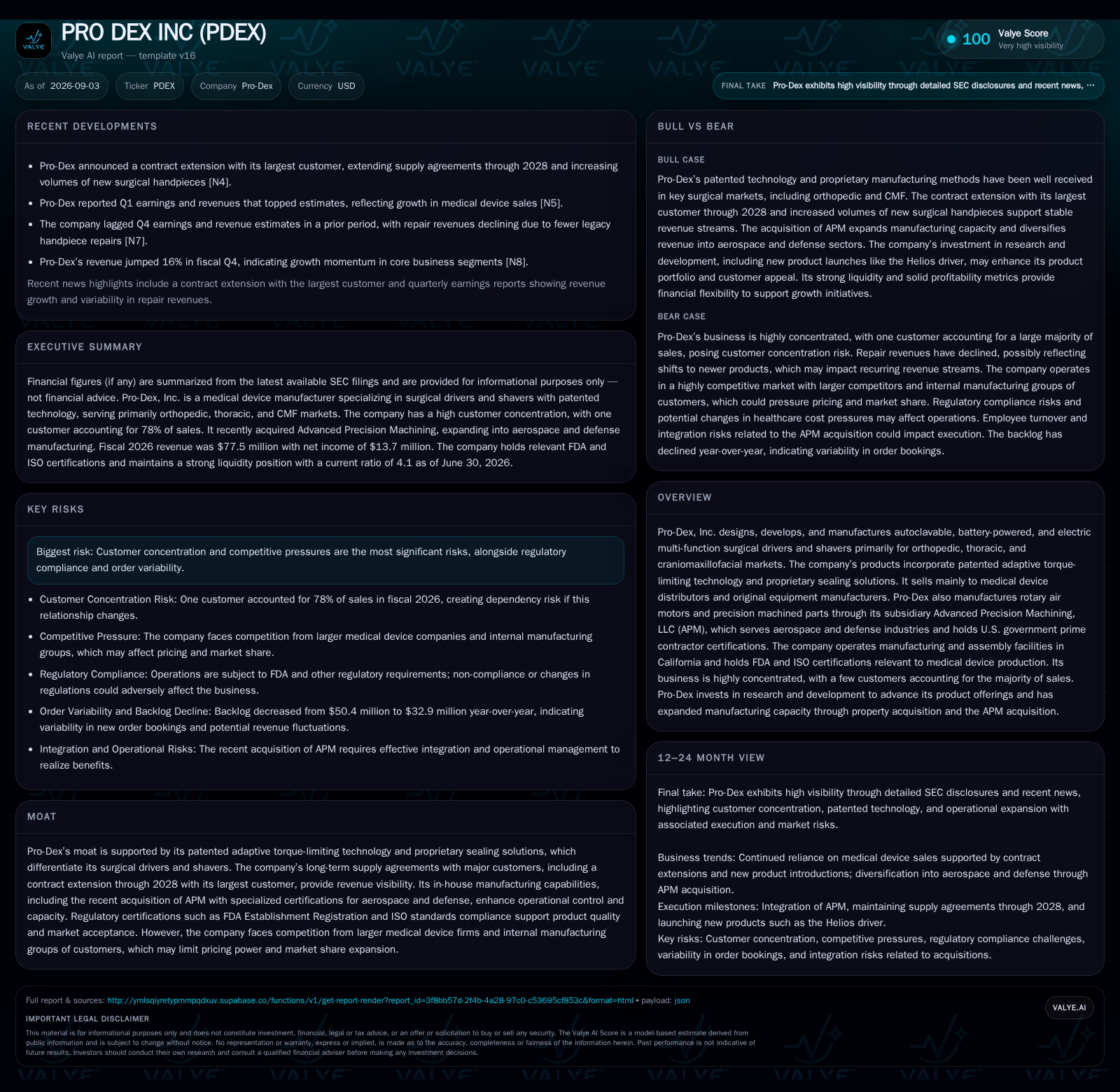
Pro-Dex, a niche medical device manufacturer with patented adaptive torque-limiting technology, relies heavily on a single customer that accounts for the majority of its revenue. The recent contract extension through 2028 and increased volumes of new surgical handpieces provide near-term revenue stability. Meanwhile, the acquisition of Advanced Precision Machining diversifies the business toward aerospace and defense, broadening manufacturing capabilities. However, decline in repair revenues, competitive pressure, and regulatory risks pose challenges. Operating leverage depends on scaling medical device volumes while managing integration risks from its industrial subsidiary. Key uncertainties center on customer retention, order variability, and successful product innovation.
Pro-Dex Inc. stands at a critical juncture balancing its entrenched position in the orthopedic and surgical device market with ambitions to diversify into aerospace manufacturing. The company’s patented adaptive torque-limiting technology and long-term supply agreement with its largest customer anchor its current revenue base but also concentrate risk. Expansion through the Advanced Precision Machining acquisition introduces new complexity and growth avenues outside core medical devices. While recent revenue growth and contract renewals signal operational strength, challenges from competitive pressures, declining repair revenues, and order fluctuations underscore the need for strategic focus. Pro-Dex’s near-term performance will hinge on managing customer dependencies and executing on its innovation and diversification plans.
Established Customer Partnership and Diversifying Manufacturing Footprint
Pro-Dex’s business is characterized by a highly concentrated customer base, with three customers accounting for 92% of sales in fiscal 2026 and a single customer representing 78% of total revenue [S1]. The strategic importance of this customer is underscored by the contract extension announced in late 2025, securing supply through calendar 2028 and increasing volumes of new surgical handpieces [N4]. This agreement not only provides revenue visibility but also reflects confidence in Pro-Dex’s adaptive torque-limiting technology and proprietary sealing solutions embedded in these products.
Meanwhile, the company has broadened its operational scope through the acquisition of Advanced Precision Machining, LLC (APM), which manufactures precision parts for aerospace and defense sectors and holds important certifications such as ITAR and JCP [S1]. This diversification mitigates some concentration risk by opening new markets, although aerospace currently represents a minority of revenue. Additionally, Pro-Dex expanded manufacturing capacity by acquiring a 25,000 square foot facility in Tustin, California, operational since late 2023 [S1]. These developments collectively position the company with a dual industrial focus but introduce integration and execution complexity.
Revenue Concentration and Operating Leverage Hinged on Medical Device Scale
Pro-Dex primarily generates revenue through the sale of autoclavable, battery-powered, and electric multi-function surgical drivers and shavers, with medical device products accounting for 80% of fiscal 2026 sales [S1]. Pricing dynamics are influenced by patented adaptive torque-limiting technology, which could command premium pricing if widely adopted. Volume growth, particularly via the largest customer’s increased order volumes, is the main lever to enhancing profitability. Repair revenues, previously a meaningful recurring component at 16% of sales, have declined, likely as customers replace older handpieces with next-generation units [S2]. This shift reduces recurring aftermarket income, potentially increasing the pressure to sustain new product sales at competitive prices.
The manufacturing footprint expansion and APM acquisition introduce capital intensity and fixed costs associated with aerospace production standards, including compliance with rigorous certifications (ISO 13485:2016 and AS9100D) [S1]. Operating leverage may emerge if medical device volumes scale sufficiently to absorb fixed costs, but the high customer concentration and order variability (backlog down from $50.4 million to $32.9 million year-over-year) inject uncertainty [S1]. Thus, the company’s margin expansion depends on successfully increasing sales volumes while managing the complexity and cost structure of diversified manufacturing operations.
Differentiation Through Patents Amidst Intense Competitive and Customer Pressures
Pro-Dex’s adaptive torque-limiting technology and proprietary sealing solutions constitute key competitive differentiators, especially in specialized surgical markets such as orthopedic and craniomaxillofacial segments [S1]. These patents could could increase switching costs and entrench customer relationships if the technology demonstrably improves surgical outcomes or operational efficiency. Furthermore, the company’s FDA registration and ISO certifications enhance its credibility and market acceptance, an essential factor in medical device procurement.
Nevertheless, the company faces significant challenges from much larger medical device firms with broader product portfolios and scale advantages, as well as from internal manufacturing groups within its largest customers [S1]. These competitors can exert pricing pressure and potentially erode market share. The company’s high customer concentration exacerbates vulnerability to competitive moves or shifts in procurement strategies. Additionally, the decline in repair revenues may reflect customers’ changing preferences or competitive substitutes, highlighting the need for continual product innovation and customer engagement.
Capturing Growth Through Innovation and Aerospace Diversification
In a favorable scenario, Pro-Dex leverages its patented adaptive torque-limiting technology to become an indispensable component supplier for its largest customer and expands penetration with other medical device distributors. The successful launch and adoption of new products like the Helios driver, which integrates advanced software features, could drive higher volumes and improved pricing power. Confirmation would come from sustained revenue growth beyond the current backlog, increasing repair revenue stabilization as installed base grows, and positive customer feedback on product performance [S1][S2].
Simultaneously, the APM acquisition proves accretive by opening aerospace and defense contracts, leveraging certifications and manufacturing scale. If APM scales production and secures additional prime contracts, it would diversify revenue streams and reduce reliance on the medical segment. Key falsification signals would be continued order volatility, declining APM margins, or failure to integrate operations effectively, which would undermine the expected upside.
Sustained Medical Device Focus with Controlled Expansion Risks
The most plausible middle path envisions Pro-Dex maintaining its core medical device revenue largely supported by the extended contract with its largest customer through 2028, resulting in relatively stable volumes and modest growth [N4]. New product introductions like the Helios driver contribute incremental revenue but face competitive hurdles limiting rapid market share gains. Repair revenues stabilize at a lower level as legacy product replacements slow, keeping aftermarket income from further erosion but without meaningful growth [S2].
APM’s aerospace and defense segment grows modestly, constrained by market cyclicality and integration challenges, contributing a small but steady revenue component. Operating leverage is mixed: fixed costs increase with capacity expansion, but scale benefits partially offset them. Confirmation of this scenario includes steady backlog levels around $30 million, consistent margins, and no major customer disruptions. Falsification would be sharp declines in medical device volumes or persistent integration costs outweighing aerospace gains.
Customer Loss or Competitive Displacement Triggering Revenue and Margin Pressure
The downside risk centers on losing the largest customer or experiencing significant volume reductions due to competitive displacement or strategic sourcing changes. Given the 78% revenue concentration in one customer, any disruption would materially impact top-line and operating leverage. Indicators of this risk include deteriorating order volumes, early contract renegotiations, or signs of customer internal manufacturing expansion [S1]. Concurrently, ongoing price pressures from larger competitors could compress margins, undermining profitability despite stable volumes.
Additionally, failure to integrate APM effectively or secure aerospace contracts would leave the company exposed to medical device market volatility without meaningful diversification. Declining repair revenues could accelerate, removing a buffer on revenue stability. Regulatory compliance issues or increased healthcare cost pressures may further constrain growth. Falsification of this scenario would be renewed volume growth, successful contract renewals, or expanding aerospace bookings mitigating medical segment softness.
Monitoring Customer Commitments, Order Bookings, and Product Adoption
Key metrics that will illuminate Pro-Dex’s trajectory include the renewal and volume details of supply agreements beyond 2028, especially with the dominant customer, as these govern revenue visibility and concentration risk. Tracking backlog trends quarterly will provide insight into new order intake and demand stability, given the notable year-over-year decline [S1]. Additionally, R&D expenditure allocation and timelines for new product launches like the Helios driver are crucial to evaluate innovation success and competitive positioning.
Performance and integration progress of the APM subsidiary warrant close observation, with certifications maintenance, contract awards, and margin trends serving as useful proxies for diversification effectiveness. Repair revenue trends will signal whether the installed base and aftermarket business remain viable or continue to erode. Lastly, monitoring regulatory compliance developments and employee turnover rates will offer early warnings on operational risks and workforce stability.
Disclaimer: This is research-only, informational analysis and not investment advice. It may include AI-generated interpretation and general industry context. Always verify important details using primary sources.

Comments