
B&R Technology Merger Corp. (BRTM): A SPAC at the Crossroads of Uncertainty and Opportunity
BRTM, a Cayman Islands-based special purpose acquisition company (SPAC), recently completed its IPO and faces the pivotal challenge of identifying and consummating a business combination within 36 months. With no current operating business, revenue, or disclosed liquidity, BRTM’s future hinges on execution in a competitive SPAC landscape marked by capital constraints and regulatory deadlines.
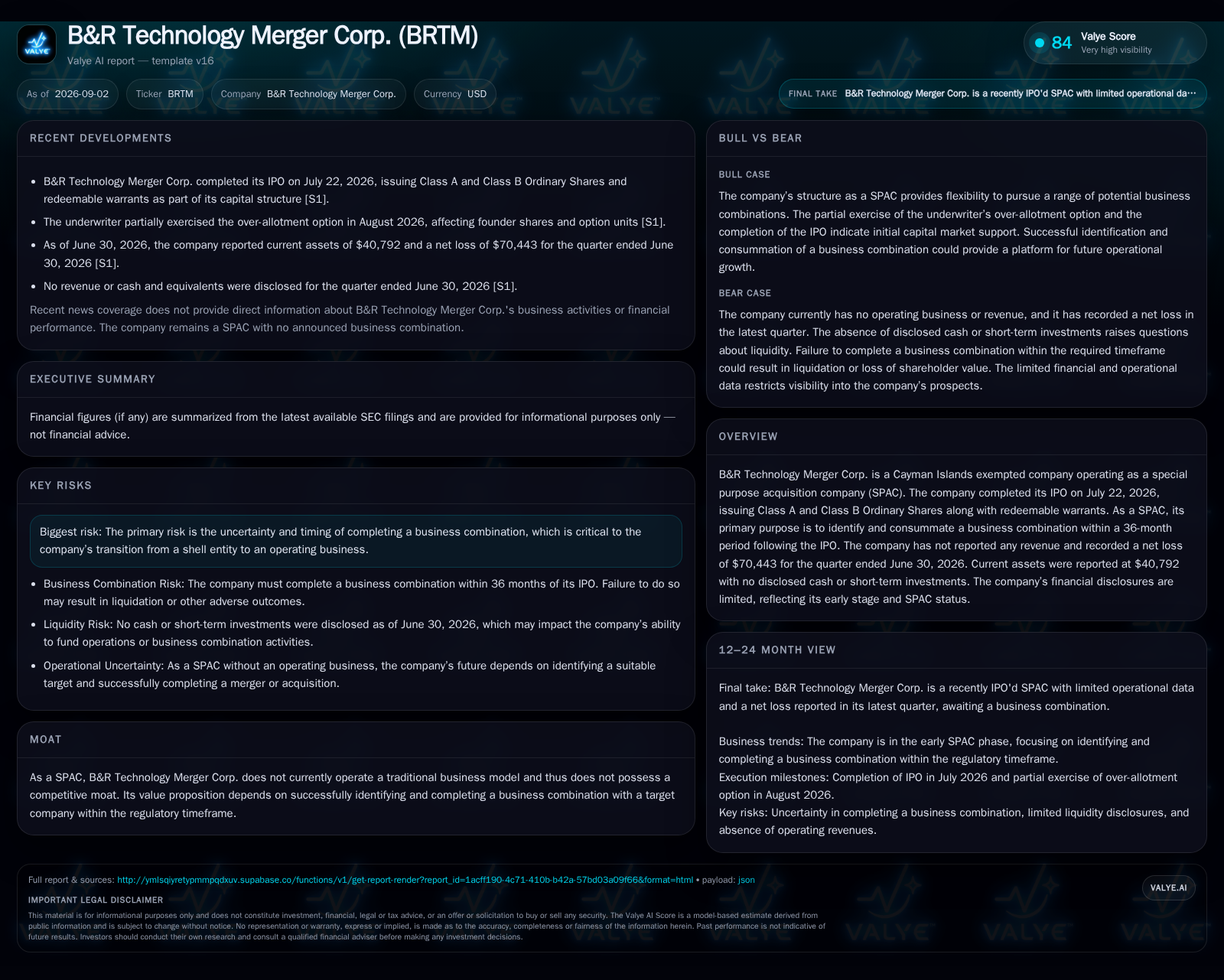
B&R Technology Merger Corp. is a newly public SPAC focused on completing a business combination within a regulatory time frame. It has no operating revenues and reported a net loss in its initial quarter. The company’s value depends on successful deal-making, with liquidity and execution risks prominent. Its business model lacks intrinsic operating leverage or moat absent a target acquisition. Key near-term milestones include deal announcements and capital management to avoid liquidation.
B&R Technology Merger Corp. (BRTM) represents a typical yet inherently transitional entity within the public markets: a special purpose acquisition company formed to identify and consummate a merger or acquisition within a fixed window. Having completed its IPO in mid-2026 and lacking operational revenues or cash reserves, BRTM stands at a crossroads where execution discipline, target selection, and capital management will determine its viability. The company’s business model is intrinsically nascent and dependent on external deal flow, while its financials reveal early-stage losses and limited disclosed liquidity. Understanding BRTM’s prospects requires dissecting the economics and competitive dynamics of SPACs, the nuanced risks of deal execution, and market appetite for de-SPAC transactions amid evolving regulatory and capital market conditions.
Latest Operating Snapshot
B&R Technology Merger Corp. completed its initial public offering on July 22, 2026, issuing 36.74 million Class A Ordinary Shares and 12 million Class B Ordinary Shares along with redeemable warrants exercisable at $11.50 per share [S1]. This capital raise and complex share structure reflect standard SPAC mechanisms to attract public investors while providing potential equity upside via warrants.
As of the quarter ended June 30, 2026, BRTM reported no revenue and a net loss of $70,443, consistent with its status as a shell entity without operations [S1]. Current assets were reported at $40,792 but notably, no cash or short-term investments were disclosed, raising questions about immediate liquidity. The underwriter partially exercised an over-allotment option in August 2026, which modestly increased founder shares and option units, indicating some market interest post-IPO [S1]. These facts matter as they frame BRTM’s early-stage financial position and the immediate challenge of funding operations and business combination activities.
Business Model and Unit Economics
BRTM operates as a SPAC, a corporate shell formed solely to raise capital through an IPO for the purpose of acquiring or merging with an existing private company within 36 months. As such, it has no traditional revenue streams or product lines. The primary value driver is identifying a target company whose business can be combined with BRTM’s capital and public listing to create a new operating entity.
The economics of a SPAC are distinct. Revenue generation and profitability depend entirely on post-merger operations of the acquired business, which remains unknown at this stage. Fixed costs are minimal and mostly related to administrative expenses and regulatory compliance, explaining the reported net loss. Capital intensity is front-loaded in the IPO and related underwriting fees, with operating leverage emerging only if and when a business combination is consummated and the resulting entity scales. Pricing power, volume growth, and margin expansion are contingent on the acquired company’s industry and competitive advantages, not on BRTM’s current structure.
Moat, Competition and Counterforces
As a SPAC, BRTM does not possess an operational moat or proprietary technology. Its competitive positioning depends heavily on the quality and attractiveness of its management team, deal sourcing capabilities, and ability to negotiate favorable business combinations. The SPAC market is crowded, with many vehicles competing for attractive targets, potentially leading to bidding wars, higher valuations, and compressed margins for post-merger entities.
Counterforces include regulatory scrutiny on SPAC structures and deal disclosures, which may increase transaction costs and slow deal execution. Additionally, market sentiment toward SPACs can be volatile, influenced by broader equity market performance and investor appetite for speculative vehicles. The lack of disclosed liquidity may constrain BRTM’s ability to close deals quickly, reducing flexibility relative to peers with stronger cash positions.
Bull Case
In a favorable scenario, BRTM successfully identifies and consummates a business combination within the 36-month window with a target company possessing strong growth prospects and operational scalability. The completed merger would provide BRTM shareholders exposure to an operational business, unlocking value beyond the initial shell. Confirmation would include public announcements of a definitive agreement, positive investor reaction, and subsequent revenue and earnings growth from the combined entity.
Such success would validate BRTM’s management team’s deal sourcing and execution capabilities, potentially creating operating leverage as costs are absorbed and revenue scales. The underwriter’s partial exercise of the over-allotment option could signal investor confidence, aligning incentives for long-term value creation. A falsification test for this bullish scenario would be delays or failures in announcing a credible target, persistent capital constraints, or adverse market conditions undermining post-merger valuations.
Base Case
The most plausible outcome is that BRTM completes a business combination within the regulatory timeframe but with a target company of moderate growth and profitability prospects. Execution is timely, but the combined entity faces typical post-merger integration challenges and competitive pressures. In this scenario, BRTM shareholders gain exposure to an operating business, but returns are modest and contingent on industry conditions.
This path assumes the company manages liquidity prudently, possibly raising additional capital or leveraging its warrants for financing, and navigates regulatory and market hurdles without significant disruption. Confirmation would come from a business combination announcement, initial financial disclosures post-merger, and stable trading performance. Falsification would be an inability to consummate a deal in time or a severely dilutive transaction destroying shareholder value.
Bear Case
The downside scenario involves BRTM failing to complete a business combination within 36 months, leading to liquidation and return of capital to shareholders at potentially a discount due to expenses and market conditions. The absence of disclosed cash or short-term investments exacerbates liquidity risk, possibly limiting operational capabilities and deal-making flexibility.
Additionally, persistent market skepticism toward SPACs coupled with regulatory tightening could reduce investor appetite, impairing the ability to raise follow-on capital or negotiate attractive acquisitions. Confirming evidence includes prolonged inactivity in deal announcements, deteriorating financial conditions, and negative market sentiment. A falsification test would be a surprise announcement of a robust deal or capital infusion alleviating financial pressures.
What Matters Next
Key performance indicators and milestones to watch include: (1) announcement of a definitive business combination agreement, signaling progress toward operationalization; (2) disclosure of target company financials and strategic rationale, providing insight into future earnings potential; (3) updates on liquidity and capital structure, including cash on hand and use of warrants; (4) timing and structure of any additional capital raises or financing arrangements; (5) regulatory approvals or challenges affecting deal consummation; (6) market reaction to merger announcements as a proxy for investor confidence; (7) management commentary on deal pipeline and strategic priorities; and (8) any shifts in SPAC regulatory environment or market conditions impacting deal feasibility.
Since BRTM currently offers limited public information beyond its IPO and capital structure, these metrics are crucial for investors to assess transition from a shell to an operating entity. Monitoring these indicators will help differentiate between execution risks and opportunities and provide early signals of the company’s trajectory toward value creation or dissolution.
Disclaimer: This is research-only, informational analysis and not investment advice. It may include AI-generated interpretation and general industry context. Always verify important details using primary sources.

Comments