
Argan, Inc. (AGX) Equity Research: Engineering Robust Backlogs Amid Operational and Competitive Complexities
Argan's dominant power segment, margin expansion, and strategic acquisitions position it for growth, but supply chain, labor, and customer concentration risks remain critical to monitor.
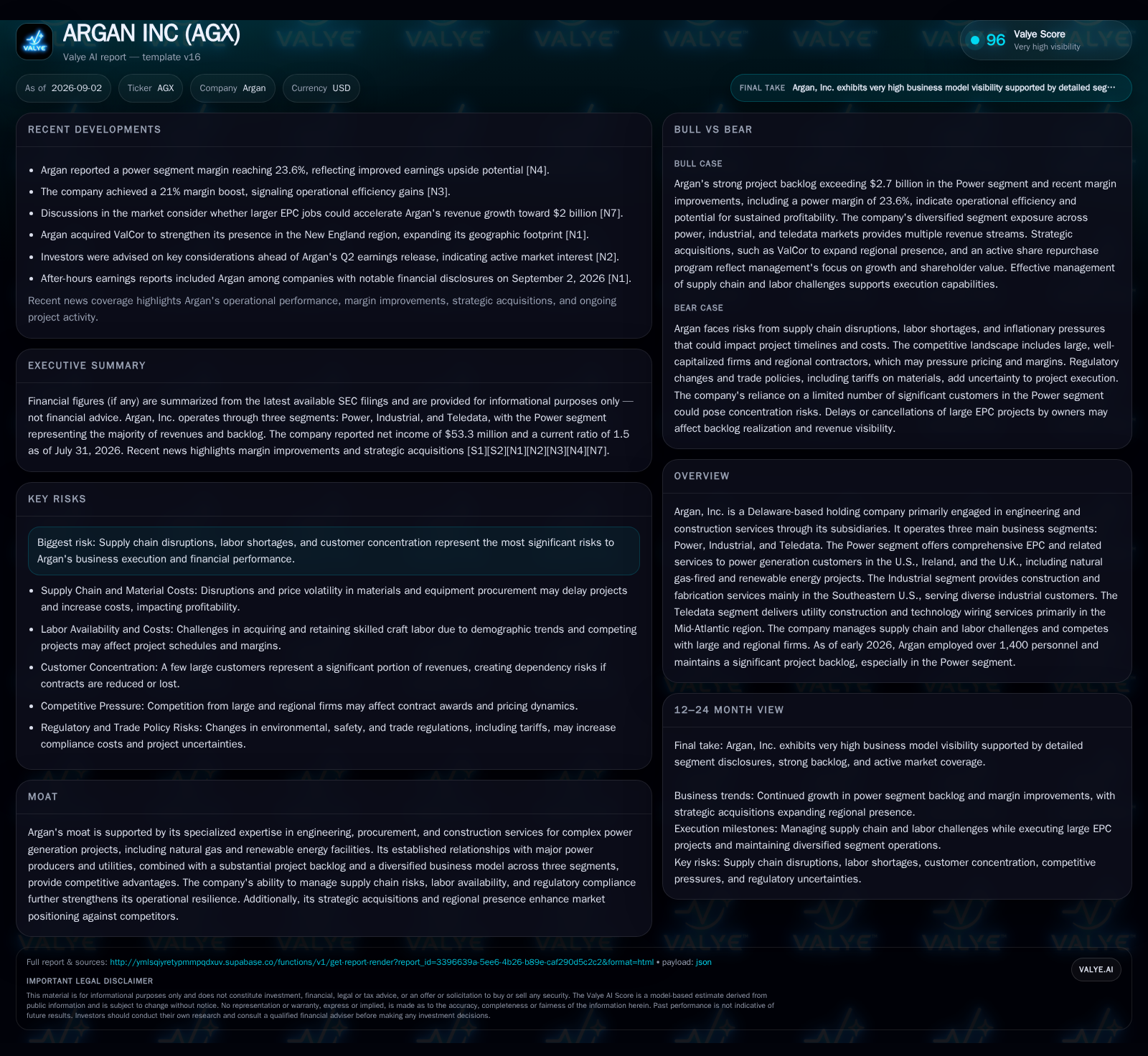
Argan, Inc. operates through three segments with a Power segment backlog exceeding $2.7 billion. Recent margin improvements reflect operational efficiency. Strategic acquisitions like ValCor enhance regional footholds. However, risks from supply chain volatility, labor scarcity, and competitive dynamics could pressure execution and margins. The company’s future hinges on execution of large EPC projects, managing inflationary pressures, and leveraging its backlog to grow revenues sustainably.
Argan, Inc. stands at an operational inflection point supported by a robust backlog primarily in its Power segment, which represents over 80% of revenues. With backlog growth doubling year-over-year to $2.7 billion and margin expansion reaching 23.6%, the company demonstrates enhanced execution capabilities and pricing discipline. Strategic moves like the acquisition of ValCor broaden its geographic reach, particularly in New England. However, navigating supply chain volatility, labor market tightness, and intense competition remains pivotal for realizing sustained growth and profitability. This analysis explores the underlying business economics, competitive positioning, and key catalysts shaping Argan’s trajectory into 2027.
Latest Operating Snapshot
Argan's Power segment generated $756.5 million in revenues for fiscal 2026, constituting 80.1% of consolidated revenues, with its backlog exceeding $2.7 billion as of January 31, 2026, more than doubling from the prior year [S1]. This backlog concentration underscores the segment's critical role as the primary revenue driver and growth engine. The company’s Industrial and Teledata segments contributed approximately 17.7% and 2.2% of revenues, respectively, highlighting a diversified albeit smaller footprint outside Power [S1].
Recent operational highlights include the Power segment achieving a margin of 23.6%, reflecting improved project execution efficiency and pricing leverage in a competitive market [N4]. The company also completed the acquisition of ValCor in August 2026, expanding its regional presence in New England, a strategic move to capture additional market share and diversify geographic risk [N1]. Financially, Argan reported net income of $53.3 million for Q2 2026 and maintained a current ratio of 1.5, indicating solid liquidity to support ongoing project activity [S2].
Business Model and Unit Economics
Argan monetizes its engineering and construction expertise primarily through comprehensive EPC contracts in the Power segment, alongside industrial construction and utility wiring services. Pricing typically reflects project scope, complexity, and risk allocation. The Power segment’s large-scale combined-cycle, renewable energy, and biofuel projects involve significant upfront fixed costs in engineering and procurement, with variable construction labor and materials costs. This mix suggests moderate operating leverage; fixed costs are substantial but can be scaled with backlog growth, enabling margin expansion if execution efficiencies and pricing power persist.
Capital intensity is moderate, with the company leveraging subcontractors and craft labor rather than owning heavy equipment fleets extensively. Supply chain management is critical, as material inflation and tariffs impact variable costs and project margins. The Industrial and Teledata segments likely have lower average contract sizes and margins but provide diversification and steady cash flow. The backlog-to-revenue conversion ratio and project duration affect cash flow timing, making working capital management and liquidity crucial to smooth operations.
Moat, Competition and Counterforces
Argan’s moat derives from specialized EPC capabilities in complex power generation projects, including renewable and natural gas-fired plants, where technical expertise and regulatory compliance are barriers to entry. Long-standing relationships with utilities, independent power producers, and equipment suppliers bolster its competitive positioning. The sizeable backlog acts as a revenue visibility buffer, reinforcing client trust and operational stability. Strategic acquisitions like ValCor enhance local market penetration, adding scale and reducing geographic concentration risk.
However, the competitive landscape features large, well-capitalized EPC firms and agile regional contractors who can pressure pricing and contract awards. Supply chain disruptions and labor shortages amplify execution risk and could erode margins if not managed deftly. Customer concentration risks arise from reliance on a limited number of key power producers, potentially exposing Argan to demand fluctuations. Regulatory changes and tariff policies further add uncertainty in project economics and timelines.
Bull Case
Argan capitalizes on a robust and growing Power segment backlog exceeding $2.7 billion, translating into sustained revenue growth toward and beyond $2 billion. Operational enhancements and scale efficiencies drive margin expansion, as evidenced by the recent 23.6% Power segment margin, suggesting improved pricing power and cost control. Strategic acquisitions like ValCor enhance geographic diversification and open new markets, reducing dependency on traditional regions. Effective management of supply chain and labor challenges enables on-schedule, within-budget project delivery, cementing customer relationships and fueling repeat business.
Confirming evidence would include continued backlog growth, consistent margin improvements across quarters, and successful integration of acquisitions leading to cross-selling or operational synergies. Falsification would be manifested by margin contraction despite backlog growth, material execution delays, or failure to secure new large EPC contracts, indicating operational or competitive weaknesses.
Base Case
Argan maintains stable revenue growth driven chiefly by its Power segment backlog, with margins fluctuating around recent highs due to competitive pricing pressures and manageable cost inflation. The company continues to expand its geographic footprint modestly via acquisitions like ValCor but faces headwinds from supply chain volatility and labor market constraints that modestly compress margins. Execution risk moderates revenue visibility, with some project delays or cost overruns offset by new contract awards and backlog replenishment.
Confirming evidence would be steady backlog replenishment offsetting project completions, margin stability within a 20-23% range, and operating cash flow supporting capital expenditures and share repurchases. Falsification would be sharp backlog declines, margin erosion below 18%, or liquidity stress from working capital mismatches.
Bear Case
Argan confronts escalating supply chain disruptions and labor shortages that delay major EPC projects, leading to cost overruns and margin compression below historical levels. Competitive intensity intensifies with large firms undercutting pricing, resulting in backlog stagnation or decline. Customer concentration risks materialize as significant clients reduce or cancel projects amid regulatory or economic headwinds. Tariff escalations and regulatory changes increase compliance costs and project uncertainty. These factors converge to impair cash flow, strain liquidity, and curtail capacity for strategic investments or share repurchases.
Confirming evidence includes shrinking backlog below prior-year levels, persistent margin declines below 15%, project cancellations, and negative cash flow trends. Falsification would be any reversal in backlog attrition or margin stabilization despite cost pressures.
What Matters Next
Key performance indicators to watch include quarterly backlog updates segmented by business unit and geography to gauge revenue visibility and diversification. Monitoring Power segment margins quarterly will reveal whether recent efficiency gains are sustainable or cyclical. Project execution metrics such as on-time and on-budget completion rates, while not always publicly disclosed, would be critical to assess operational risk. New contract awards, particularly large EPC projects, will signal market confidence and growth prospects.
Additional milestones include integration progress and revenue contribution from acquisitions like ValCor, as well as updates on supply chain and labor cost management strategies. Capital allocation decisions, including share repurchase activity and potential debt issuance, will inform potential financial flexibility. Finally, regulatory changes affecting power infrastructure investments and tariffs on key materials remain important external factors influencing Argan’s operating environment.
Disclaimer: This is research-only, informational analysis and not investment advice. It may include AI-generated interpretation and general industry context. Always verify important details using primary sources.

Comments