
Brown-Forman Corporation (BF-A) Equity Analysis: Navigating Brand Value and Market Pressures in Beverage Alcohol
Brown-Forman’s premium brand portfolio and operational discipline underpin its steady profitability amid commodity cost pressures and currency volatility, but intangible asset impairments and market uncertainties temper near-term outlook.
Brown-Forman operates a capital-light, brand-driven beverage alcohol business generating stable profit through premium pricing and global distribution. Its moat centers on strong brand equity, though impairment charges signal challenges in sustaining intangible asset value. Market risks from commodity input costs, currency swings, and economic demand shifts create earnings variability. The company’s liquidity and internal controls support resilience, but future value hinges on maintaining brand relevance and navigating cost pressures effectively.
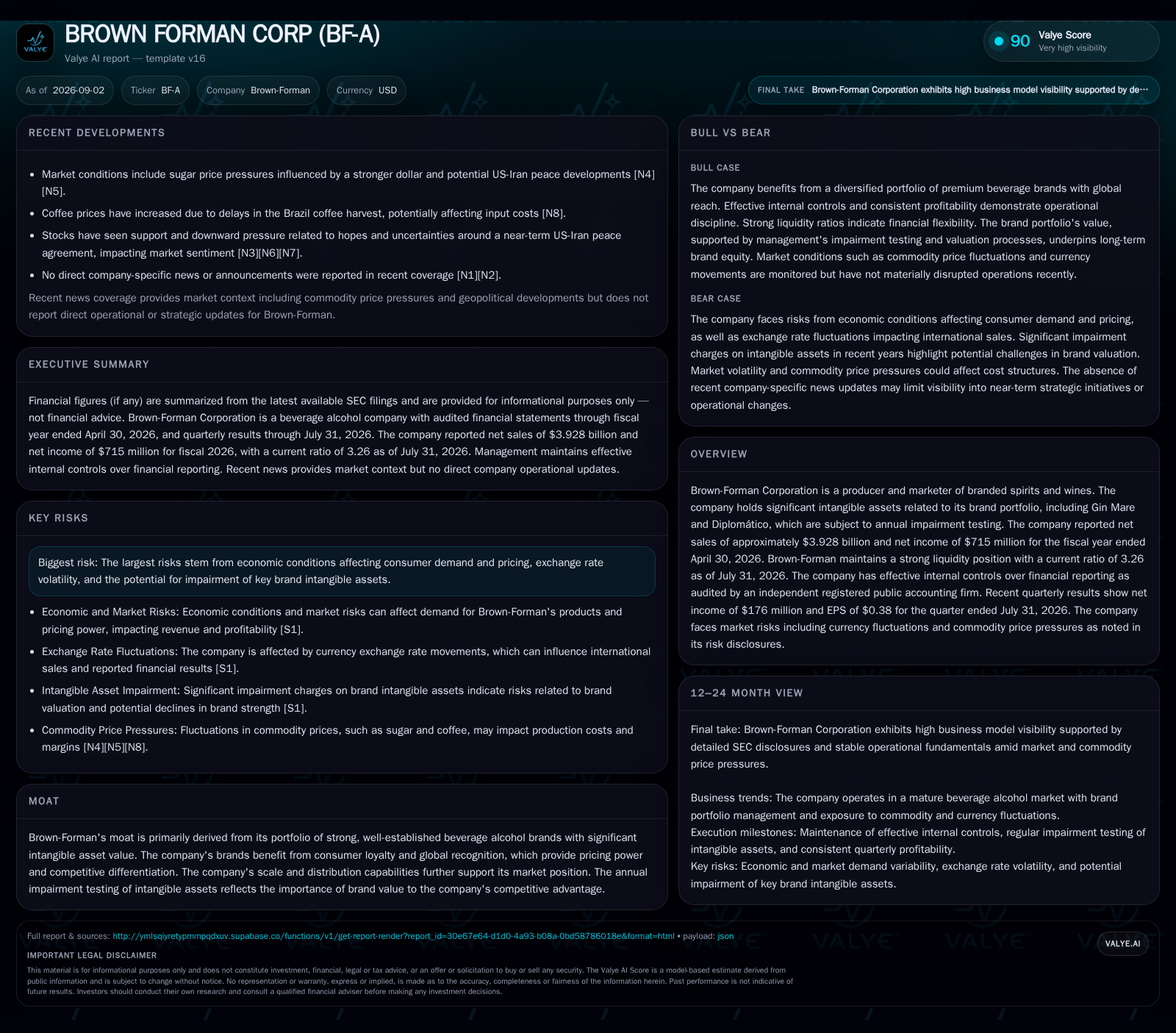
Brown-Forman Corporation, a major producer and marketer of premium spirits and wines, reported $3.928 billion in net sales and $715 million in net income for fiscal 2026, illustrating continued strength in branded alcohol demand [S1]. Despite stable earnings, the company recorded a sizeable $132 million impairment on intangible assets tied to its brand portfolio, highlighting challenges in maintaining brand valuation in a competitive and evolving market [S1]. With reported liquidity position (current ratio 3.26) and strong internal controls [S2][S1], Brown-Forman is positioned to manage operational risks, including commodity price pressures and currency fluctuations [N4][N5][N8]. The key question is whether the company can leverage its brand moat and global reach to sustain profitable growth amid these headwinds and intensifying market competition.
Latest Operating Snapshot
For the fiscal year ended April 30, 2026, Brown-Forman reported net sales of approximately $3.928 billion and net income of $715 million, reflecting steady demand for its portfolio of premium beverage alcohol brands [S1]. The quarterly update ending July 31, 2026, showed net income of $176 million and earnings per share of $0.38, underscoring consistent profitability [S2].
The company’s balance sheet remains solid, with a current ratio of 3.26 and cash and cash equivalents totaling $301 million as of July 31, 2026, signifying strong short-term liquidity and operational flexibility [S2]. However, Brown-Forman recognized $132 million in impairment charges on intangible assets during fiscal 2026, signaling notable challenges in brand valuation and the durability of certain brand equities [S1]. Recent market commentary indicates commodity cost pressures, such as rising sugar and coffee prices, alongside currency fluctuations, that could affect input costs and international sales dynamics [N4][N5][N8].
Business Model and Unit Economics
Brown-Forman’s business model centers on the production and marketing of branded spirits and wines, leveraging premium pricing power derived from strong brand equity. Revenue primarily arises from selling proprietary brands like Gin Mare and Diplomático, where pricing reflects consumer willingness to pay a premium for quality and heritage. Volume growth tends to be moderate in mature markets, placing greater emphasis on pricing and mix improvements to drive sales.
The company operates a capital-light model relative to manufacturing-intensive industries, with significant intangible assets representing brand value rather than physical production assets [S1]. Fixed costs include brand marketing and distribution infrastructure, while variable costs are influenced by commodity inputs such as sugar and packaging materials. Operating leverage emerges if revenue growth outpaces fixed marketing and overhead expenses, but margin compression can occur if commodity and currency pressures force cost increases that cannot be fully passed on to consumers. Maintaining brand relevance and premium positioning is therefore critical to sustaining favorable unit economics.
Moat, Competition and Counterforces
Brown-Forman’s moat rests on its portfolio of well-established, globally recognized beverage alcohol brands that command consumer loyalty and pricing power. This intangible asset base underpins competitive differentiation, enabling the company to maintain margins superior to less differentiated peers. The scale of Brown-Forman’s distribution network further enhances market access and shelf presence, reinforcing its competitive positioning [S1].
Counterforces that could weaken the moat include shifts in consumer preferences toward craft or local brands, intensifying competition from large multinational competitors and private-label products, and the risk of brand dilution or impairment as evidenced by recent $132 million intangible asset write-downs [S1]. Additionally, currency volatility and rising input costs can erode margins, while regulatory changes affecting alcohol marketing or distribution could raise barriers to sustaining competitive advantages. The competitive set includes other premium spirits producers with global reach, requiring ongoing innovation and brand investment.
Bull Case
In a bullish scenario, Brown-Forman successfully leverages its premium brand portfolio to capture growing global demand for high-quality spirits, particularly in emerging markets where consumer spending on luxury beverages is expanding. The company’s effective internal controls and disciplined cost management enable it to navigate commodity cost pressures and currency fluctuations without sacrificing margins. Continued brand innovation and targeted marketing reinforce consumer loyalty, allowing for steady pricing power.
Confirming evidence for this scenario would include stable or improving brand impairment metrics, consistent organic revenue growth outpacing category averages, and margin expansion despite external cost pressures. The company’s liquidity and balance sheet strength provide flexibility to invest in marketing and selective acquisitions to expand its global footprint. A falsification test would be sustained margin erosion or repeated intangible asset impairments reflecting declining brand strength or ineffective cost pass-through.
Base Case
The base case envisions Brown-Forman maintaining steady revenue and earnings with modest growth driven primarily by price increases and selective volume gains in core markets. Commodity price volatility and currency fluctuations create episodic margin pressures that are partially offset by cost efficiencies and pricing actions. Brand impairments stabilize as management calibrates portfolio investments and divestitures to maximize overall brand equity.
In this scenario, the company’s moat remains intact but requires ongoing investment to defend market share against competitive incursions and changing consumer trends. Financial discipline and liquidity management support steady dividends and moderate capital expenditures. Confirming evidence includes stable impairment charges, steady revenue growth aligned with industry benchmarks, and manageable margin fluctuations. Falsification would be a prolonged decline in brand health indicators or volatile earnings due to ineffective cost management.
Bear Case
The bear case involves adverse economic or market conditions curtailing consumer discretionary spending on premium alcohol, leading to volume declines and pricing pressure. Rising commodity and manufacturing costs, exacerbated by unfavorable currency moves, compress margins and squeeze profitability. The company may be forced to take further impairment charges on intangible assets if brand strength deteriorates amid intensifying competition and shifts in consumer tastes toward alternative beverage categories.
Confirming evidence would include repeated large impairments signaling sustained brand valuation deterioration, declining revenue and EPS, weakening liquidity ratios, and negative cash flow trends. A failure to adapt marketing strategy or product innovation to evolving consumer preferences would further pressure competitive positioning. Falsification would be stabilization or improvement in brand metrics, cost containment, and renewed top-line growth.
What Matters Next
Key metrics to monitor include quarterly net sales growth and volume trends, especially in emerging versus mature markets, which reveal demand momentum and pricing power effectiveness. Tracking impairment charges on intangible assets offers insight into underlying brand health and valuation risks. Margins and operating leverage dynamics should be analyzed closely to assess the impact of commodity prices and currency fluctuations on profitability.
Other important indicators are liquidity ratios and cash flow generation, signaling potential financial flexibility to invest in brand building and innovation. Tracking cost inflation on critical inputs like sugar and packaging is vital, as is monitoring changes in foreign exchange rates affecting international sales. Finally, observing management’s commentary on strategic initiatives, marketing investments, and competitive responses will provide clues on the company’s ability to sustain its moat and navigate market headwinds.
Disclaimer: This is research-only, informational analysis and not investment advice. It may include AI-generated interpretation and general industry context. Always verify important details using primary sources.

Comments