
Scribe Therapeutics, Inc. (SCTX) — Early Public Stage with Strategic Partnership Amid Financial Constraints
Scribe Therapeutics recently completed its IPO and secured a private placement with Sanofi, signaling strategic capital infusion and partnership potential. However, liquidity pressures, operating losses, and limited operational transparency present key challenges as the company advances its early-stage biotechnology platform.
Scribe Therapeutics has leveraged capital markets and a strategic pharma partnership to bolster its early development trajectory. Yet, the company faces significant liquidity constraints and ongoing net losses, with limited detail on its product pipeline or commercialization path. Its competitive moat and sustainable revenue model remain uncertain, making execution and financial discipline critical over the next 12-24 months.
Scribe Therapeutics, Inc. entered the public markets in mid-2026, raising capital through an IPO and a private placement with pharmaceutical giant Sanofi. These milestones position the company to advance its biotechnology platform amid early development stages. However, its financial statements reveal pressing liquidity constraints and continued operating losses typical for a pre-commercial biotech firm. The firm's stock performance and insider buying indicate investor and management optimism, yet limited transparency on product pipeline and commercialization strategy complicate evaluation of its long-term viability. Navigating capital efficiency and demonstrating clinical progress will be pivotal for Scribe’s growth trajectory over the coming years.
Latest Operating Snapshot
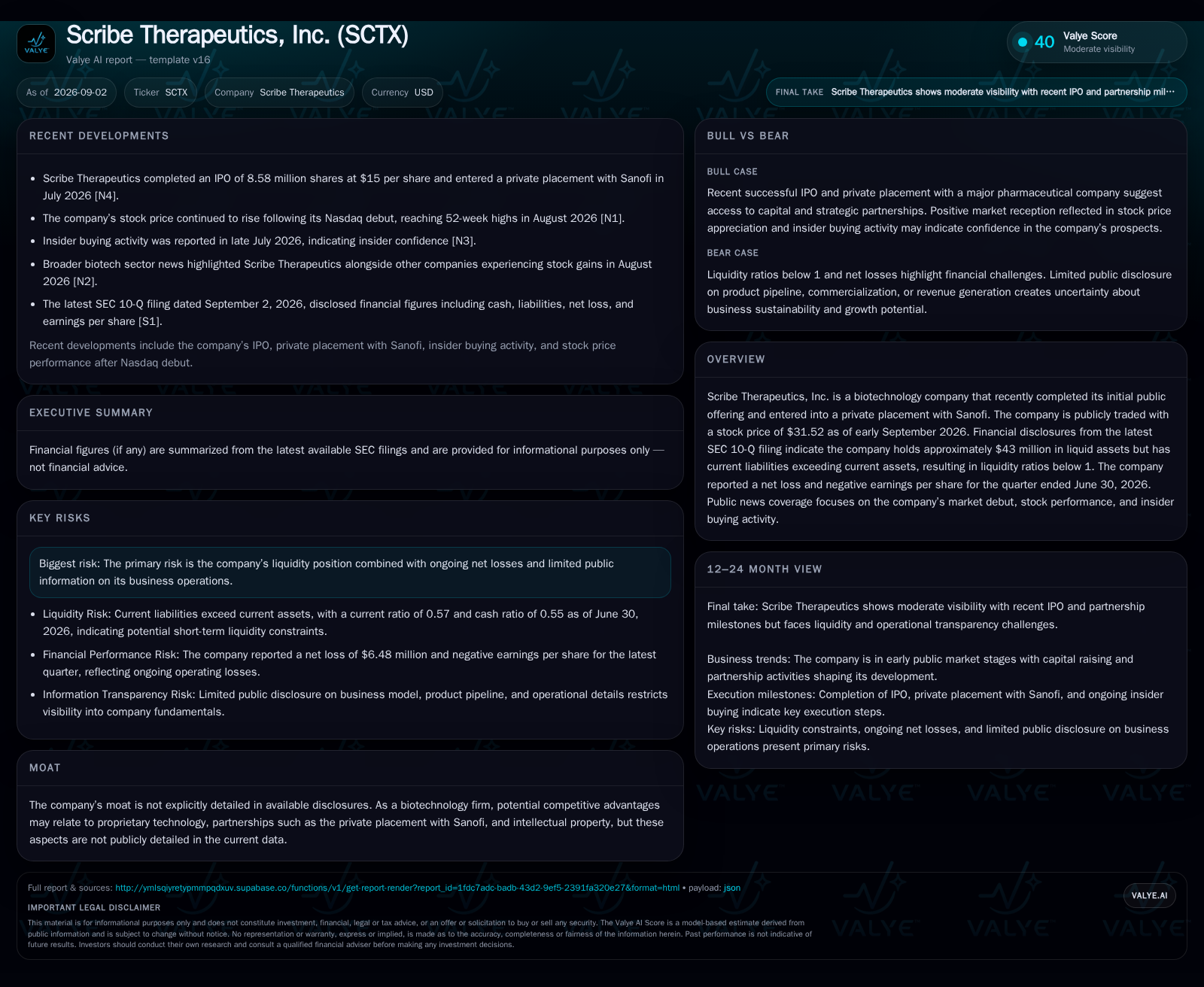
Scribe Therapeutics completed its IPO in July 2026, issuing 8.58 million shares at $15 each, coupled with a private placement agreement with Sanofi, a leading pharmaceutical company [N4]. This dual capital raise reflects a strategic effort to secure financial resources and a potential collaborative partner for development or commercialization. Following the IPO, Scribe’s stock price appreciated, reaching $31.52 by early September 2026, marking a strong market reception and investor interest [N1].
Despite this positive market momentum, the company’s financial position shows constraints. As of June 30, 2026, cash and short-term investments totaled about $43 million, but current liabilities of $78.7 million exceeded current assets of $45.1 million, resulting in a current ratio of 0.57 and a cash ratio of 0.55 [S1]. Such liquidity ratios below 1 signal potential short-term funding pressures, particularly given ongoing net losses of $6.48 million and negative EPS in the latest quarter. Insider buying reported in late July 2026 adds a layer of management confidence despite these financial challenges [N3].
Business Model and Unit Economics
As a biotechnology company in an early public stage, Scribe Therapeutics’ business model likely revolves around developing proprietary gene-editing or therapeutic technologies, typical for firms in this sector. Revenues are probably minimal or non-existent at this point, with operating losses reflecting heavy R&D investments and clinical trial expenses. Pricing and volume metrics remain undeveloped, pending regulatory approvals and commercialization pathways.
The economics of early-stage biotech are characterized by high fixed costs in R&D infrastructure and clinical development, with relatively low variable costs per incremental trial participant or product batch. Operating leverage could emerge materializing upon successful product commercialization, enabling incremental revenue to scale disproportionately to costs. However, the capital intensity of biotech development and long lead times create significant cash burn and necessitate periodic external capital raises, as evidenced by Scribe’s IPO and private placement. Without clear milestones or recurring revenue streams, managing liquidity and extending runway remain key challenges to realizing operating leverage.
Moat, Competition and Counterforces
Scribe Therapeutics’ competitive advantage likely depends on proprietary gene-editing technology, intellectual property rights, and strategic partnerships such as the Sanofi private placement. However, public disclosures lack detailed information on patented platforms, pipeline candidates, or differentiation factors, making it difficult to assess the durability of its moat. In a rapidly evolving biotech landscape, first-mover advantages, technological innovation, and regulatory approvals generally define competitive positioning.
Competitors include established biotech firms specializing in gene editing and CRISPR-based therapies, as well as pharmaceutical companies developing alternative gene therapies or biologics. The presence of large incumbents with deep pockets and established pipelines could exert competitive pressure. Additionally, counterforces such as regulatory hurdles, technological obsolescence, and capital access risks could erode potential advantages. Scribe’s partnership with Sanofi may provide validation and resource access but does not guarantee long-term moat sustainability without continuous innovation and successful clinical outcomes.
Bull Case
In the bullish scenario, Scribe Therapeutics leverages its IPO proceeds and Sanofi partnership to accelerate clinical development and obtain regulatory approvals, translating to early commercialization and revenue generation. Insider buying and rising stock prices signal strong management confidence and investor support, suggesting successful execution of milestones. The company’s proprietary technology, once validated, could attract additional partnerships, licensing deals, or acquisition interest, creating multiple value inflection points.
Confirmation of this pathway would include clinical trial data demonstrating safety and efficacy, expanded collaboration agreements with Sanofi or other pharma partners, and improved liquidity ratios through milestone payments or further financing. Falsification would occur if clinical setbacks arise, capital markets reactions weaken, or partnerships dissolve, undermining confidence and raising capital access costs. Sustained insider selling or declining share prices would also counter the bull narrative.
Base Case
The base case envisions Scribe continuing as a pre-commercial biotech company, progressing through clinical trials but facing typical developmental timelines and capital needs. The company manages liquidity through capital raises and partnership funding but remains loss-making for the foreseeable future. Stock price may stabilize, reflecting the sector’s volatility and the company’s early-stage risk profile.
Operational transparency improves modestly as the company provides incremental pipeline updates and clarifies strategic objectives. The Sanofi partnership remains intact without major expansion or disruption. The firm’s moat is nascent, with competitive differentiation hinging on future data. Financial metrics improve only slowly, with liquidity tight but manageable through prudent capital allocation. Failure to meet clinical or financial milestones could shift this outlook downward.
Bear Case
In a downside scenario, Scribe Therapeutics experiences clinical trial failures or regulatory delays, undermining investor confidence and straining liquidity. The company’s cash burn outpaces capital raises, and current liabilities pressures intensify, risking operational disruptions or dilution through emergency financing. The Sanofi partnership could weaken or terminate, removing strategic support and exacerbating funding challenges.
Limited disclosure and ongoing losses fuel market skepticism, potentially leading to share price declines and insider selling. A bear case would be confirmed by missed clinical endpoints, deteriorating liquidity ratios, and partnership setbacks. Conversely, signs of renewed capital support, clinical progress, or improved financial discipline could falsify this pessimistic scenario.
What Matters Next
Key performance indicators to watch include clinical trial progress and data releases, which will drive validation of the company’s technology and pipeline viability. Updates on the status and scope of the Sanofi partnership will provide insights into strategic support and potential future funding.
Financial metrics such as quarterly cash burn, liquidity ratios, and capital raise announcements will be critical to assess sustainability. Monitoring insider transaction patterns offers signals of management confidence or concerns. Finally, disclosures on regulatory interactions, patent filings, and commercialization plans will enhance visibility into Scribe’s path to revenue and competitive positioning.
Disclaimer: This is research-only, informational analysis and not investment advice. It may include AI-generated interpretation and general industry context. Always verify important details using primary sources.

Comments