
Attovia Therapeutics, Inc. (ATTO) Equity Analysis: Early-Stage Biotech with Strong Capital Base Amid Sector Risks
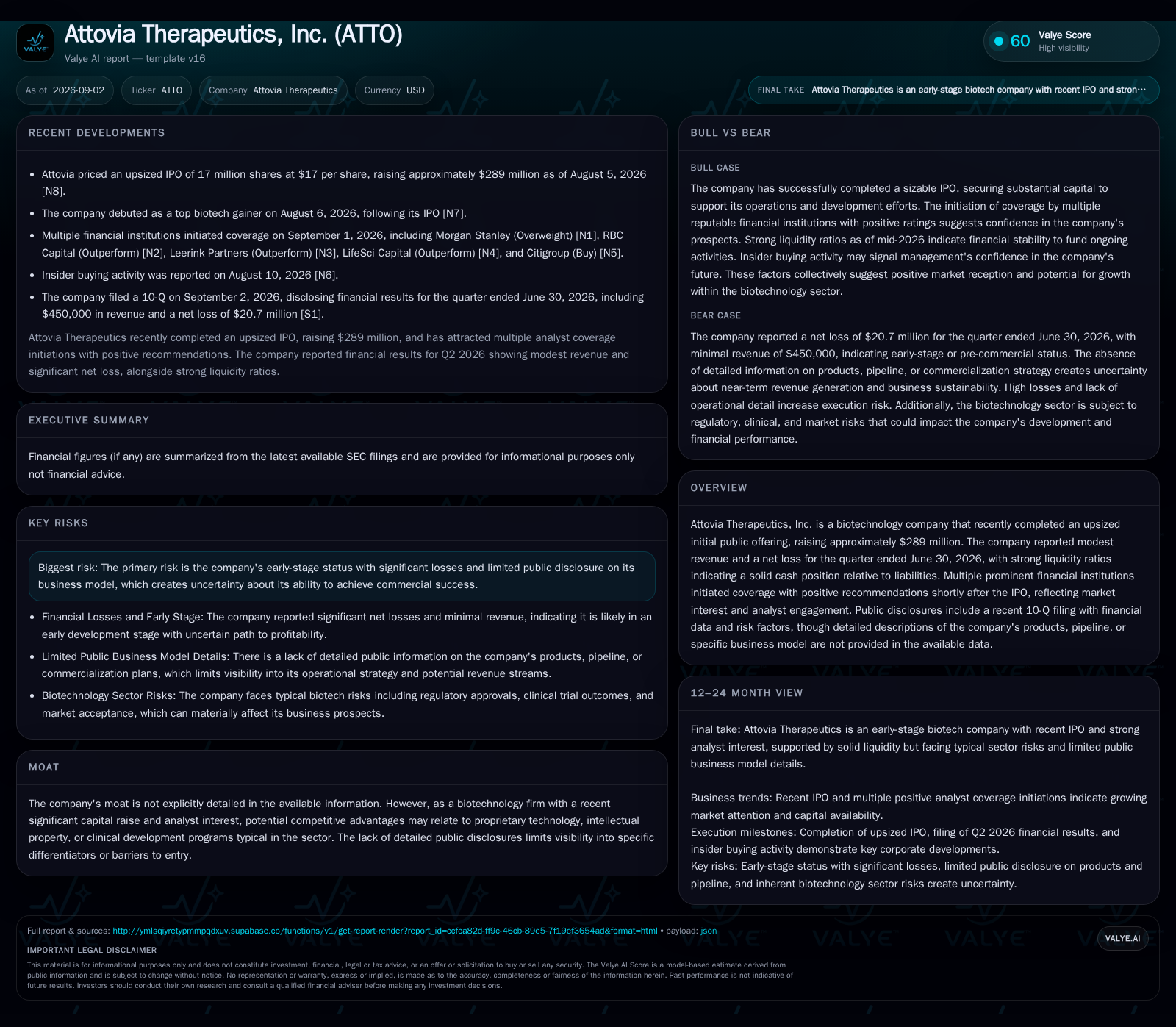
Attovia Therapeutics recently completed a substantial IPO, attracting positive analyst coverage and demonstrating reported liquidity position. However, the company remains in early development with minimal revenue and significant losses, facing typical biotechnology sector hurdles and opaque business model details.
Attovia Therapeutics, Inc. is an emerging biotech firm that raised $289 million through an upsized IPO in mid-2026, signaling strong capital support. Despite modest initial revenue and a sizable net loss, multiple top-tier financial institutions initiated coverage with optimistic ratings, bolstered by insider buying activity. The company’s operating model and product pipeline remain undisclosed, leaving uncertainties about commercialization and profitability timelines. Attovia’s future hinges on successful clinical and regulatory milestones, prudent capital deployment, and competitive positioning in a challenging biotech landscape.
Attovia Therapeutics, Inc. emerged from its August 2026 upsized IPO with approximately $289 million in proceeds, providing a strong capital foundation for its drug development ambitions. Despite reporting only nominal revenue of $450,000 in Q2 2026 and a net loss exceeding $20 million, the company attracted favorable analyst coverage from top-tier financial firms, reflecting market optimism about its potential. Insider buying following the IPO further underscores internal confidence. However, the absence of detailed disclosures on product candidates or commercialization strategy leaves fundamental questions unanswered. Attovia’s path forward depends on translating its financial strength into clinical progress and eventual marketable therapies within a highly competitive and regulated biotech environment.
Latest Operating Snapshot
Attovia Therapeutics completed an upsized initial public offering on August 5, 2026, issuing 17 million shares at $17 each and raising roughly $289 million [N8]. This capital influx positions the company well to fund its early-stage development activities. The IPO debut was well received, with the stock registering as a top biotech gainer the following day [N7].
For the quarter ended June 30, 2026, Attovia reported $450,000 in revenue and a net loss of $20.7 million, reflecting its pre-commercial status and heavy R&D spending [S1]. Liquidity remains strong with a current ratio of 9.39 and a cash ratio of 2.6, indicating ample short-term resources relative to liabilities [S1]. Notably, insider buying was recorded shortly after the IPO, implying management’s belief in the company’s prospects [N6]. Multiple prominent financial institutions including Morgan Stanley, RBC Capital, Leerink Partners, LifeSci Capital, and Citigroup initiated coverage with positive recommendations on September 1, 2026, signaling broad market interest [N1][N2][N3][N4][N5].
Business Model and Unit Economics
As an early-stage biotechnology company, Attovia’s current business model is centered on drug discovery and clinical development rather than revenue generation from marketed products. The nominal revenue reported likely reflects milestone payments, licensing fees, or collaborative agreements rather than product sales, underscoring the pre-commercial phase. The economics at this stage are characterized by high fixed costs in R&D and clinical trials, with limited variable costs tied to production or sales volumes. Consequently, operating leverage is minimal until product commercialization.
Capital intensity is elevated due to expensive clinical trial phases and regulatory compliance. The large IPO proceeds provide a runway to progress through clinical milestones before potential commercialization. Pricing power and revenue mix will become relevant only upon successful product approvals. The company’s ability to translate clinical success into pricing and sales volume growth will be critical for future unit economics. Early-stage biotech firms typically face steep operating losses until achieving regulatory and market validation, at which point operating leverage may emerge if the company scales production and sales efficiently.
Moat, Competition and Counterforces
Attovia’s moat is not explicitly articulated in the available data, but in biotechnology, competitive advantage generally derives from proprietary intellectual property, novel mechanisms of action, and clinical efficacy differentiators. The absence of detailed pipeline information obscures assessment of such advantages. Potential moats would depend on patent protection, clinical trial success, regulatory exclusivity, and barriers to entry created by complex scientific innovation.
Competitive pressures arise from established pharmaceutical companies, other biotech firms targeting similar therapeutic areas, and emerging technologies. Counterforces include regulatory uncertainty, rapid scientific evolution, and capital market volatility. Given the typical biotech risk profile, the company must demonstrate clinical milestones and differentiation to fend off competitors and attract partnerships or licensing deals. Without observable switching friction or platform ecosystems, the moat likely hinges on the uniqueness and efficacy of its product candidates once disclosed.
Bull Case
In an optimistic scenario, Attovia leverages its $289 million IPO proceeds to advance its clinical programs efficiently, achieving key regulatory milestones that validate its drug candidates’ safety and efficacy. Positive trial outcomes attract partnerships or licensing agreements, generating milestone-related revenue and de-risking development. The multiple positive analyst initiations and insider purchasing reflect growing confidence that the company’s technology addresses unmet medical needs in a lucrative market.
Confirming evidence would include subsequent clinical data releases, regulatory designations such as Fast Track or Breakthrough Therapy, and expanded analyst coverage with target price upgrades. Insider buying continuing would reinforce management’s conviction. Falsification would occur if clinical trials fail, the company faces regulatory setbacks, or capital depletion forces dilutive financing before achieving proof-of-concept.
Base Case
The base case assumes Attovia remains in the early development stage for the near term, using IPO capital to fund clinical trials but not generating significant commercial revenue. The company progresses steadily but cautiously, with incremental trial data that neither significantly exceeds nor falls short of expectations. Analyst coverage stays positive but tempered, reflecting the typical biotech development risk.
In this scenario, operating losses persist, and liquidity remains adequate for 12-24 months, with financing needed thereafter depending on clinical progress. Market acceptance and competitive positioning remain uncertain until product candidates enter late-stage development. The company’s valuation will hinge on pipeline data and potential partnerships. Failure to disclose detailed product or strategy information limits near-term visibility but does not preclude long-term value creation.
Bear Case
On the downside, Attovia fails to demonstrate meaningful clinical progress, encountering trial failures, safety issues, or regulatory delays that undermine investor confidence. The significant net loss and minimal revenue reported highlight the company’s current reliance on external capital. Should the company exhaust its cash resources without tangible milestones, it may need dilutive financing on unfavorable terms or face operational cutbacks.
Confirming evidence for this scenario includes clinical trial terminations, negative regulatory feedback, insider selling, or downgrades by analysts. The biotechnology sector’s inherent uncertainties amplify these risks, with commercial viability contingent on successful development. Lack of transparency about the pipeline exacerbates uncertainty, potentially eroding valuation and increasing volatility. The company’s reported liquidity position cushion provides some buffer, but prolonged setbacks could threaten sustainability.
What Matters Next
Key performance indicators and milestones to monitor include: (1) clinical trial progress updates and data readouts, which will signal development trajectory; (2) regulatory interactions and designations indicating accelerated pathways; (3) changes in cash burn rate and runway estimates reflecting capital efficiency; (4) partnership or licensing deals that could provide non-dilutive funding and validation; (5) insider trading activity as a proxy for management’s confidence; (6) analyst coverage revisions and target price adjustments offering market sentiment insights; (7) disclosures regarding pipeline composition and commercialization strategy to improve visibility; and (8) broader biotechnology market conditions and funding environment influencing valuation and access to capital.
Greater transparency around product candidates and commercialization timelines would reduce uncertainty and allow for more precise valuation modeling. Successful clinical milestones would catalyze operating leverage potential and transition the company from a capital-intensive R&D phase toward revenue generation. Conversely, failure to meet these milestones or capital constraints would increase execution risk substantially.
Disclaimer: This is research-only, informational analysis and not investment advice. It may include AI-generated interpretation and general industry context. Always verify important details using primary sources.

Comments