
Methode Electronics Inc (MEI) Deep Equity Analysis: Navigating Complexity in Engineered Mechatronics
Methode Electronics operates at the intersection of mobility, industrial, and commercial markets with custom engineered mechatronic products. Its diversified portfolio and global footprint offer resilience but require ongoing innovation and operational execution amid competitive and market pressures.
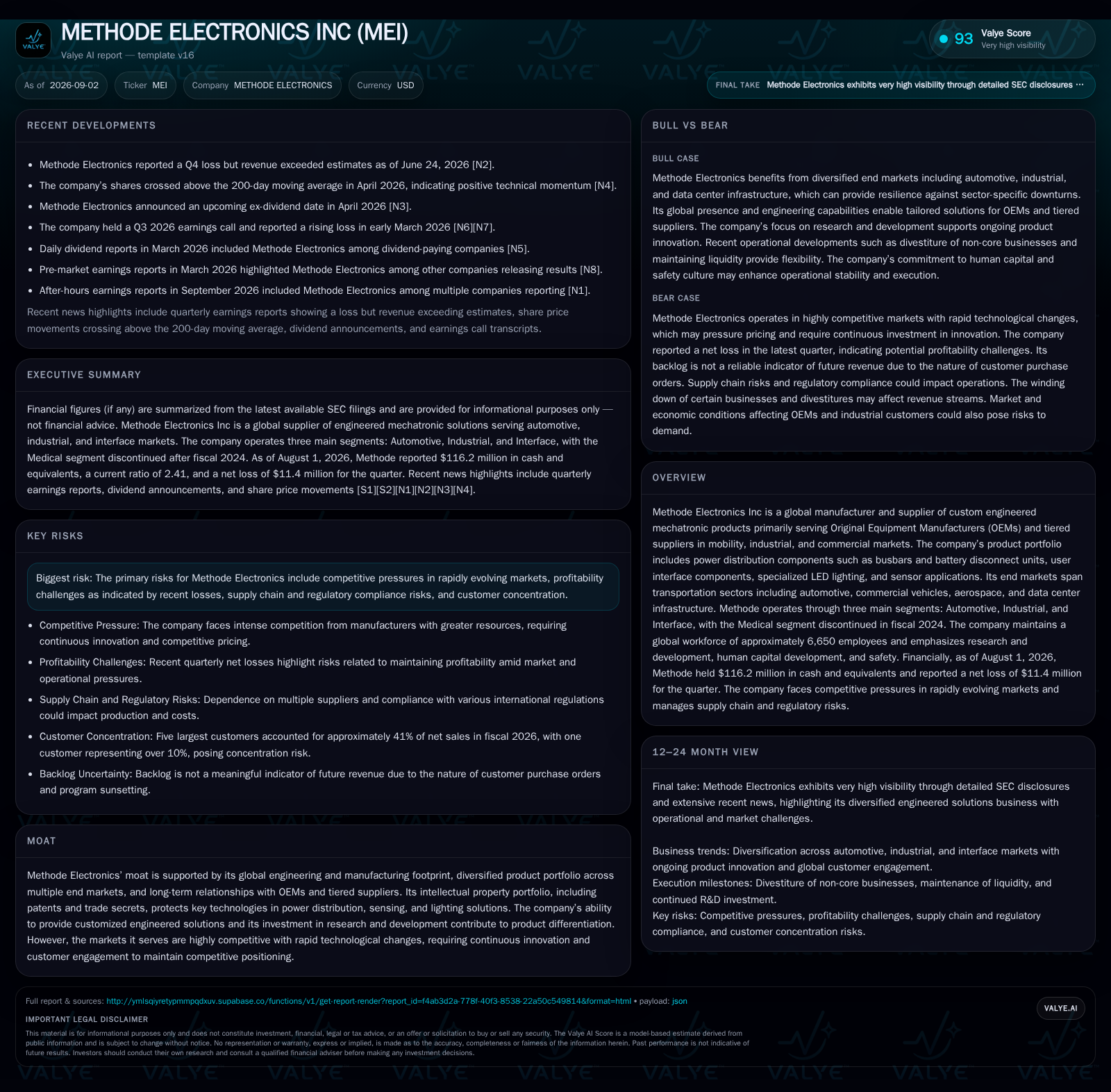
Methode Electronics is a global supplier of engineered mechatronic solutions serving diverse end markets including automotive, industrial, and infrastructure. Despite recent quarterly losses, the company’s broad segment exposure, global manufacturing, and R&D focus underpin a potential recovery path. Sustained profitability depends on managing competitive pressures, technology evolution, supply chain risks, and customer concentration. Key uncertainties revolve around revenue visibility and margin expansion, while a disciplined capital structure and workforce investments provide operational stability.
Methode Electronics (MEI) stands as a global provider of engineered mechatronic components, supplying OEMs and tiered suppliers primarily in automotive, industrial, and commercial transportation markets. Its product portfolio spans power distribution devices, user interface components, LED lighting, and sensors. Despite a recent quarterly net loss of $11.4 million, revenues exceeded expectations, reflecting operational resilience in a highly competitive market characterized by rapid technological change and intense price competition. Methode’s broad diversification across end markets and geographies, combined with sustained R&D investments, provide a foundation for strategic adaptation, although profitability recovery remains uncertain as the company navigates supply chain and customer concentration risks.
Latest Operating Snapshot
As of August 1, 2026, Methode Electronics reported a quarterly net loss of $11.4 million while surpassing revenue estimates, highlighting ongoing margin pressures despite healthy top-line demand [S2][N2]. The company’s cash and equivalents stood at $116.2 million with a current ratio of 2.41, indicating a solid short-term liquidity position to support operational commitments [S2].
Segmentally, Automotive accounted for 45.9% of net sales, Industrial for 51.4%, and Interface 2.7%, reflecting diversified exposure after discontinuing the Medical segment post-fiscal 2024 [S1]. The company’s workforce comprises approximately 6,650 employees globally, with a substantial 93.9% located outside the U.S., underscoring its global manufacturing and engineering footprint [S1]. These factors are material as they frame the company’s operational scale, geographic risk profile, and the diversity of end-market drivers impacting revenue and cost structure.
Business Model and Unit Economics
Methode Electronics generates revenue by designing, engineering, and manufacturing custom mechatronic components sold primarily to OEMs and tiered suppliers across mobility, industrial, and commercial markets [S1]. The pricing dynamics depend on contract terms with OEMs, which are typically competitive and sensitive to product performance and cost efficiency. Volume growth is linked to OEM production cycles and broader end-market demand, while product mix influences profitability given differing margin profiles across power distribution, user interface, lighting, and sensor products.
The business is capital intensive given the need for manufacturing facilities, specialized equipment, and engineering R&D embedded as cost of goods sold [S1]. Fixed costs related to production capacity and R&D investments limit operating leverage, especially in periods of revenue volatility. Operating leverage may emerge if scale expands in high-margin product lines or if cost efficiencies in manufacturing and supply chain are realized. Conversely, margin expansion could fail if competitive pressures force pricing concessions or if product mix shifts toward lower-margin components. The discontinuation of the Medical segment indicates strategic capital reallocation towards core segments.
Moat, Competition and Counterforces
Methode’s moat primarily stems from its ability to provide customized engineered solutions integrating power distribution, sensing, and interface technologies tailored to OEM specifications. Its global manufacturing and engineering presence allows proximity to key customers and supply chain flexibility [S1]. A portfolio of patents and trade secrets extending through 2045 offers some protection of proprietary innovations, particularly in specialized busbars, battery disconnect units, and sensor applications.
However, the highly competitive markets it serves are marked by rapid technological change, aggressive pricing, and the presence of well-capitalized competitors. Customer concentration risk is notable, with the top five customers representing roughly 41% of net sales and the largest accounting for over 10% [S1]. These factors create counterforces to moat durability, requiring continuous innovation, cost management, and customer relationship depth to maintain competitive positioning. The lack of meaningful backlog visibility further amplifies revenue uncertainty.
Bull Case
In a positive scenario, Methode leverages its diversified end-market exposure to weather sector-specific downturns, with strength in industrial and data center infrastructure offsetting automotive cyclicality. The company’s sustained R&D investments yield differentiated products that improve pricing power and deepen OEM partnerships, enabling a gradual recovery in profitability. Operational improvements in manufacturing efficiency and supply chain management enhance margins, while disciplined capital allocation supports innovation without excessive cost inflation.
Confirmation would come from sequential margin expansion, conversion of revenue beats into sustainable top-line growth, and stabilization or reduction in losses. Evidence of new multi-year OEM awards or design wins with tiered suppliers would support the thesis. Conversely, failure to improve operating profitability or sustained revenue volatility would falsify the bull case, as would loss of key customers or erosion of technological relevance.
Base Case
The base case envisions Methode maintaining its current diversified product mix and global footprint, generating stable but modest growth aligned with end-market trends. The company continues to face competitive pricing pressures and uneven demand, resulting in modest or breakeven profitability over the medium term. R&D spending remains steady, supporting incremental product improvements without disruptive innovation breakthroughs. Supply chain challenges persist but are managed without major disruption.
Revenue fluctuates with OEM production cycles and industrial activity without significant backlog visibility. Liquidity remains adequate to fund operations and capital expenditures, but the company does not generate significant free cash flow growth. Customer concentration risks are monitored but do not materialize into major contract losses. This scenario assumes balanced execution without material improvement or deterioration in financial performance.
Bear Case
Downside risks include intensified competitive pressures forcing price concessions and accelerating margin erosion. Rapid technological shifts could render some existing product lines obsolete, requiring costly reinvestment or write-offs. Supply chain disruptions or regulatory compliance failures could increase costs or delay shipments. The company’s loss of key customers or failure to diversify its customer base may lead to revenue declines. The absence of meaningful backlog visibility exacerbates earnings volatility.
Confirming evidence for the bear case would be continued or increasing quarterly losses, declining revenues, and negative free cash flow. Material customer attrition or adverse regulatory actions would reinforce downside risks. Conversely, signs of margin stabilization, successful new product launches, or improved order visibility would challenge the bear case.
What Matters Next
Key performance indicators for Methode include segment revenue growth and margin trends, particularly in Automotive and Industrial segments, which drive the majority of sales. Monitoring R&D spending as a percentage of sales provides insight into innovation investment levels. Customer concentration metrics and any disclosures on order book or backlog changes would help assess revenue visibility.
Operational KPIs such as manufacturing utilization rates, supply chain lead times, and cost of goods sold trends are important to gauge margin trajectory. Workforce metrics related to human capital development and safety culture may indirectly influence operational stability. Finally, tracking any patent filings or technology announcements can signal the company’s ability to sustain its competitive moat.
Disclaimer: This is research-only, informational analysis and not investment advice. It may include AI-generated interpretation and general industry context. Always verify important details using primary sources.

Comments