
REGIS CORP (RGS) 2026 Company Analysis: Navigating Growth, Liquidity Constraints, and Competitive Dynamics in Salon Services
REGIS CORP operates a diversified portfolio of salon brands across franchised and company-owned models in North America, expanding through acquisitions and leadership shifts. Financial and operational challenges coexist with strategic growth opportunities amid competitive industry pressures.
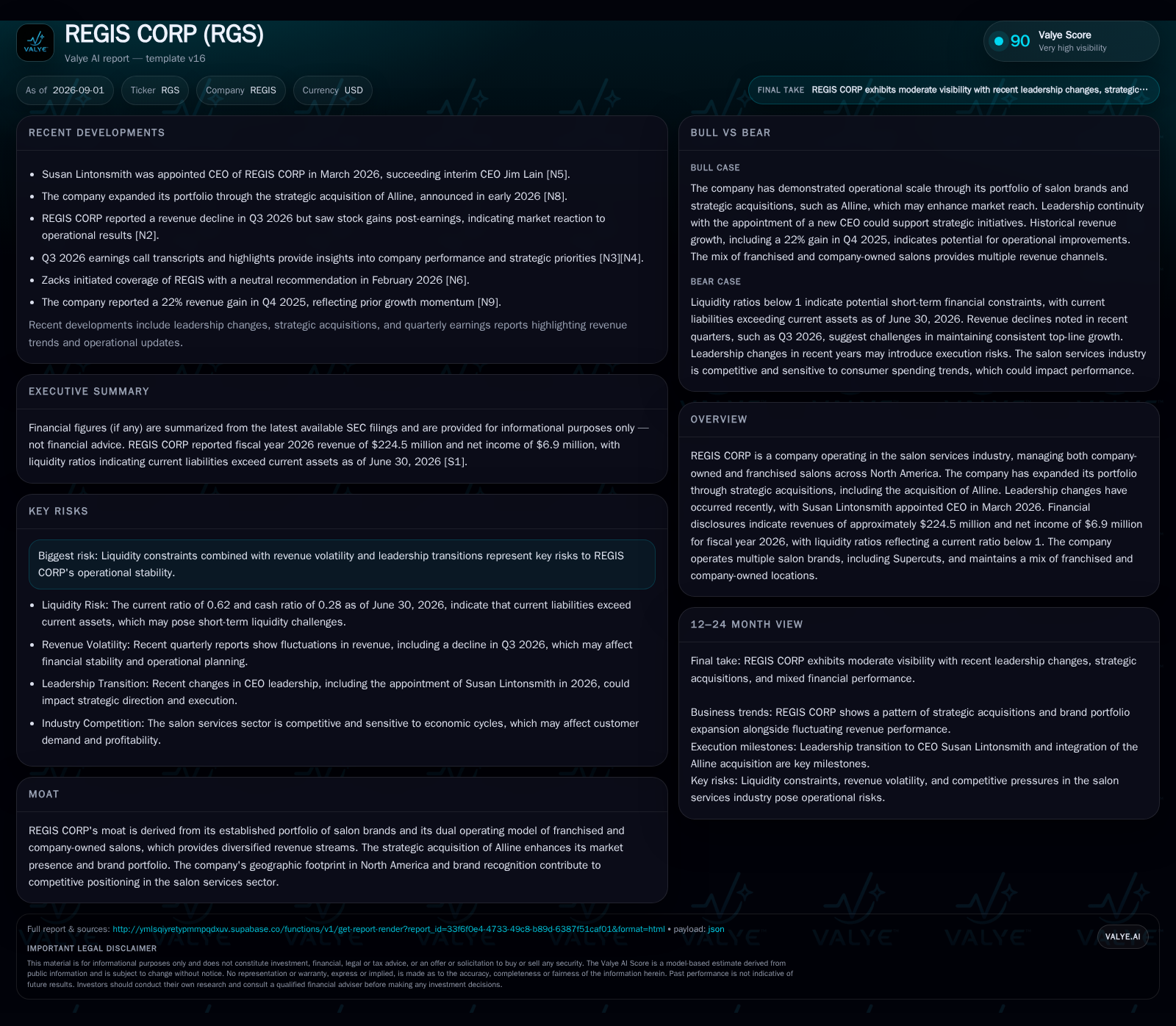
REGIS CORP’s latest fiscal year shows $224.5 million in revenues and net income near $7 million, alongside liquidity pressures and a recent CEO transition. Its dual franchised and company-owned salon model, enhanced by the Alline acquisition, offers multi-channel growth potential, but recent revenue volatility and industry competition pose risks. The company’s future depends on stabilizing operations, integrating acquisitions, and leveraging brand scale to improve profitability and cash flow.
REGIS CORP (RGS) stands at a critical inflection point with its fiscal 2026 results revealing moderate profitability but underlying liquidity pressures. The company’s strategic acquisition of Alline complements its established salon brands, creating scale advantages in a fragmented industry. However, recent leadership changes and uneven quarterly revenue performance introduce execution risks. Understanding REGIS’s business model economics and competitive positioning is essential to assess its trajectory as it seeks to stabilize cash flow, optimize its portfolio mix, and confront competitive and consumer demand fluctuations in the salon services sector.
Latest Operating Snapshot
REGIS CORP reported approximately $224.5 million in revenue and $6.9 million net income for fiscal year 2026, reflecting modest profitability amid operational challenges [S1]. The company’s liquidity position is strained, with a current ratio of 0.62 and cash ratio of 0.28 as of June 30, 2026, indicating that current liabilities exceed current assets and potential near-term cash flow constraints [S1].
Strategically, REGIS expanded its brand portfolio through the acquisition of Alline in early 2026, broadening its market coverage and service offerings [N8]. Leadership changes culminated in the appointment of Susan Lintonsmith as CEO in March 2026, following interim leadership, signaling a renewed strategic focus [N5]. Quarterly revenue trends remain uneven, with a notable 22% revenue increase in Q4 2025 contrasted by a revenue decline in Q3 2026, underscoring volatility in consumer demand or operational execution [N2].
Business Model and Unit Economics
REGIS generates revenue primarily through providing salon services via a mix of company-owned and franchised salons across North America. Revenue stems from retail services, product sales, and franchise fees. The franchised segment offers a recurring revenue component through royalties and fees, while company-owned salons contribute direct service revenue but require higher operational capital and labor costs [S1]. Pricing is influenced by service mix, geographic location, and brand positioning, with volume tied to consumer traffic and retention.
Unit economics hinge on balancing fixed costs like salon leases and staff salaries against variable revenues from client visits. Company-owned salons carry higher fixed costs and capital intensity, exposing REGIS to operating leverage risks if volumes decline. The franchised model reduces capital burden and improves margin stability but depends on franchisee performance and retention. The Alline acquisition may improve scale and cross-brand marketing, potentially enhancing pricing power and reducing per-unit costs if integration succeeds. However, liquidity constraints could limit capital deployment needed for growth or turnaround investments.
Moat, Competition and Counterforces
REGIS’s moat is anchored in its multi-brand portfolio, including Supercuts and Alline, combined with a dual franchised and company-owned salon model. This structure provides diversified revenue streams and geographic coverage across the U.S. and Canada, enabling cross-selling and operational synergies. Brand recognition and scale can support supplier negotiation and marketing efficiency, key for a fragmented salon market.
However, the salon services industry is highly competitive and sensitive to discretionary consumer spending, which is cyclical and influenced by macroeconomic factors. Competitors include regional salon chains, independent salons, and emerging boutique or technology-enabled service providers. Switching costs for consumers are generally low, emphasizing the importance of brand loyalty and service quality. The company’s recent leadership transitions and liquidity pressures may hamper the ability to invest in differentiation or digital enhancements, eroding competitive positioning over time.
Bull Case
In a favorable scenario, REGIS leverages its Alline acquisition to broaden its service offerings and geographic reach, capturing incremental market share in North America. The new CEO, Susan Lintonsmith, successfully stabilizes operational execution and enhances franchisee engagement, leading to improved revenue consistency and margin expansion. The dual model platform allows the company to optimize the portfolio by scaling profitable franchised locations while selectively investing in company-owned salons with high returns.
This scenario would be confirmed by steady revenue growth beyond recent volatility, margin improvement from operational efficiencies, and positive cash flow generation easing liquidity constraints. Successful integration of Alline with cross-brand promotions and loyalty programs would validate the strategic rationale. Conversely, failure to stabilize revenues or integrate acquisitions would falsify this outcome.
Base Case
REGIS maintains its current scale with moderate revenue growth driven by steady franchised salon performance but experiences ongoing volatility in company-owned operations. Liquidity remains tight but manageable through working capital optimization and limited capital expenditure. Leadership under Lintonsmith achieves incremental operational improvements but faces industry headwinds from competition and shifting consumer preferences.
Revenue oscillates around current levels with occasional quarter-to-quarter variability, and acquisition synergies from Alline materialize gradually without dramatic profit impact. The company sustains its brand portfolio and geographic footprint but does not meaningfully expand market share or pricing power. This outcome would be supported by stable but unspectacular quarterly results and marginal margin progression, with liquidity ratios improving only slightly.
Bear Case
In a downside scenario, REGIS struggles to manage liquidity constraints, leading to operational cutbacks and potential salon closures, especially among capital-intensive company-owned locations. Revenue declines persist or accelerate as consumer spending softens, and competitive pressures intensify from boutique salons and emerging service delivery models. Leadership transitions exacerbate execution risk, delaying strategic initiatives and integration of Alline.
This scenario would see worsening current and cash ratios, sustained revenue contraction, and negative cash flows necessitating asset sales or capital raises. Franchisee dissatisfaction could increase, triggering contract terminations or downward pressure on franchise fees. Failure to reverse these trends would confirm the bear case, while any signs of liquidity relief or revenue stabilization would argue against it.
What Matters Next
Key performance indicators to monitor include quarterly revenue growth rates segmented by franchised versus company-owned salons, to assess operational stability and growth drivers. Tracking gross and operating margin trends will indicate progress on cost management and pricing power. Liquidity metrics, especially current and cash ratios, are critical to evaluating potential financial flexibility and runway.
Further milestones include successful integration of Alline measured by incremental revenue contributions and cost synergies, and franchisee retention or expansion rates reflecting franchise system health. Leadership execution can be assessed through operating cash flow trends and capital expenditure efficiency. External factors like consumer discretionary spending patterns and competitive dynamics in the salon industry also materially impact outlook.
Disclaimer: This is research-only, informational analysis and not investment advice. It may include AI-generated interpretation and general industry context. Always verify important details using primary sources.

Comments