
GitLab Inc. (GTLB) Deep Dive: AI-Orchestrated DevSecOps Platform with Growth and Profitability Challenges
GitLab’s unified DevSecOps platform leverages AI to accelerate software delivery and embed security, serving a diverse global customer base with flexible deployment and pricing models. While revenue growth and product innovation highlight its strategic positioning, operational scale and cybersecurity risks underscore the path to sustained profitability.
GitLab integrates AI-driven orchestration into a single-codebase DevSecOps platform widely adopted across industries, including regulated sectors. Its open-core model and flexible deployment foster innovation and customer expansion, yet profitability is challenged by rising expenses and competitive pressures. The company’s future hinges on scaling operations effectively, advancing AI capabilities, and mitigating security risks amid evolving market dynamics.
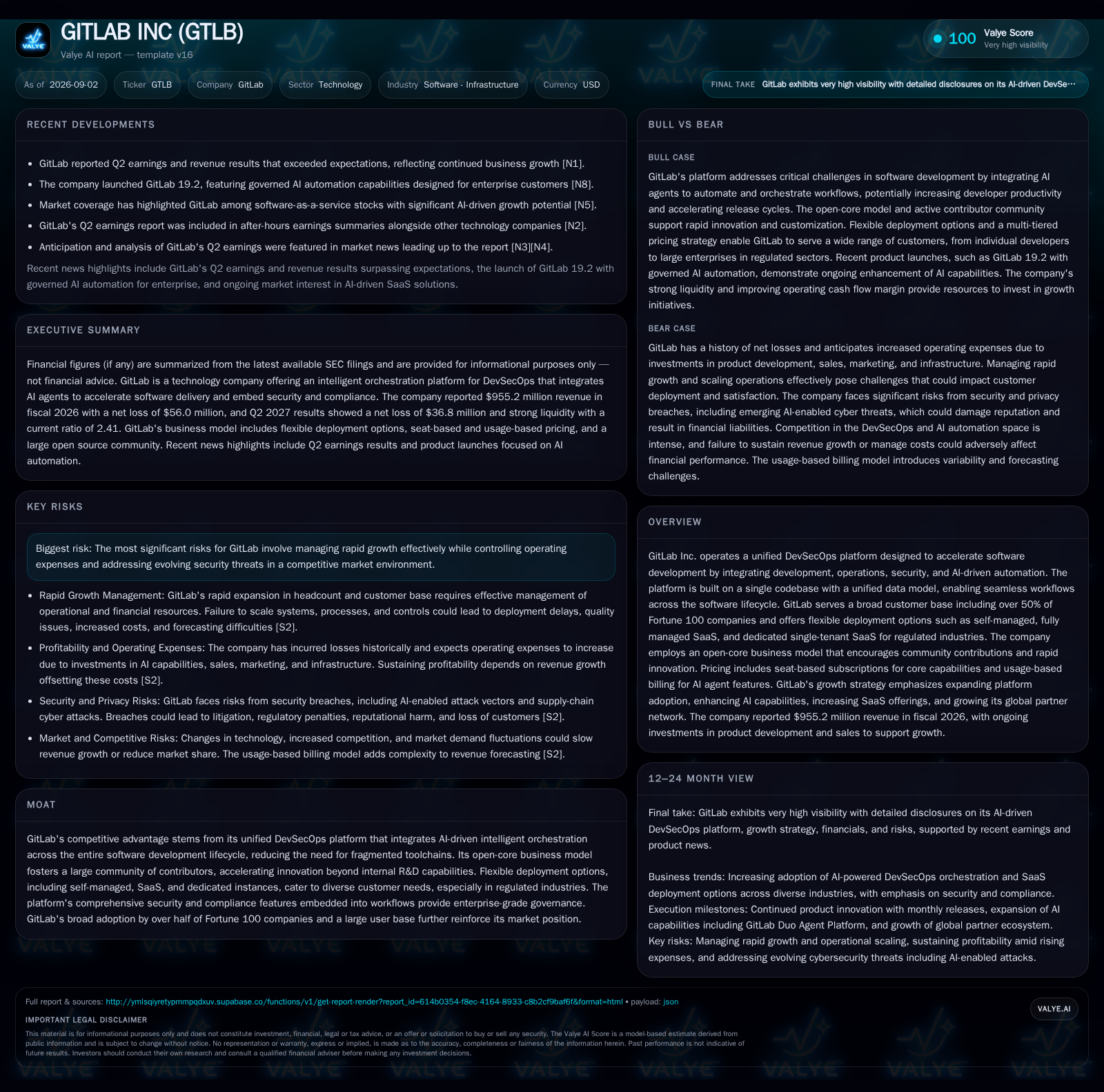
GitLab Inc. operates a unified DevSecOps platform that integrates AI agents to automate and accelerate software development, security, and compliance workflows. Serving over half of Fortune 100 companies, GitLab’s open-core model and flexible deployment options support broad adoption across industries, including regulated sectors. The company generated $955.2 million in revenue in fiscal 2026, growing 26% year-over-year, with improving operating cash flow but persistent net losses. Its hybrid pricing—seat-based for core capabilities and usage-based for AI features—reflects the evolving monetization of AI automation. While GitLab’s platform innovation and enterprise footprint underpin a strong competitive position, challenges remain in scaling operations profitably and mitigating emerging AI-driven security risks.
Latest Operating Snapshot
In fiscal 2026, GitLab reported $955.2 million in revenue, representing a 26% increase over the prior year, alongside a net loss of $56.0 million, indicating ongoing investments in growth and product development [S1]. Operating cash flow margin improved substantially to 24%, a marked turnaround from negative 8% in fiscal 2025, signaling better cash conversion despite net losses. Gross profit margin remains high at 87%, reflecting scalable SaaS economics and efficient cost of revenue management [S1].
Q2 2027 results (period ended July 31, 2026) showed cash and equivalents of $226.5 million and a current ratio of 2.41, demonstrating adequate liquidity to fund ongoing expansion initiatives. However, the company recorded a net loss of $36.8 million for the quarter and EPS of negative $0.22 per share, consistent with historical profitability pressures [S2]. GitLab launched version 19.2 featuring governed AI automation, reinforcing its innovation cadence and focus on enterprise-grade AI capabilities [N8].
Business Model and Unit Economics
GitLab monetizes its platform primarily through seat-based subscriptions for core DevSecOps capabilities, which provide predictable recurring revenue linked to user counts, and usage-based billing (GitLab Credits) for AI agent features, introducing variable revenue streams tied to customer consumption [S1]. This hybrid pricing model aligns incentives with customer expansion but complicates revenue forecasting due to usage variability.
The unified software platform is deployed flexibly: customers can choose self-managed on-premises, hybrid cloud, fully managed SaaS, or single-tenant SaaS (GitLab Dedicated) for regulated industries, allowing GitLab to serve a wide spectrum of enterprise needs. This flexibility supports higher gross margins through scalable SaaS delivery while also incurring variable infrastructure and support costs for self-managed deployments. The platform’s open-core architecture leverages external contributors to accelerate feature development, effectively reducing internal R&D burden and enhancing innovation velocity. Operating leverage is achievable if revenue growth outpaces incremental sales, marketing, and infrastructure expenses, but ongoing investments in AI capabilities and enterprise sales may constrain margin expansion in the near term.
Moat, Competition and Counterforces
GitLab’s moat is anchored by its integrated DevSecOps platform that consolidates fragmented toolchains into a unified workflow enhanced by AI-driven orchestration. This reduces complexity and switching friction for customers, especially large enterprises seeking end-to-end security and compliance embedded within software delivery. Its open-core model fosters a vast global community contributing to continuous product innovation, supplementing internal R&D and enabling rapid feature iteration.
Competition is intense from other DevOps platforms, cloud-native tool providers, and emerging AI automation vendors. GitLab’s broad adoption by over 50% of Fortune 100 companies and support for regulated industries provide some differentiation. However, competitors with deeper cloud integration, specialized AI capabilities, or greater financial resources could capture share. Security and privacy risks, particularly AI-enabled cyber threats, pose reputational risks that could weaken customer trust and act as counterforces against the platform’s perceived reliability.
Bull Case
In a bull scenario, GitLab’s AI-powered orchestration platform becomes a critical enabler for enterprises to accelerate software delivery, improve developer productivity, and embed security compliance seamlessly. The open-core model continues to attract a vibrant contributor community, enhancing innovation velocity and reducing time-to-market for new features. Flexible deployment options expand total addressable market penetration across industries, particularly in regulated sectors where compliance is paramount.
Strong SaaS growth driven by AI agent usage-based monetization lifts revenue and margins. Continued monthly product releases and launches such as GitLab 19.2 with governed AI automation validate technological leadership. Operating cash flow margins improve further, enabling reinvestment in sales and global partnerships, accelerating platform adoption. Evidence confirming this path includes sustained double-digit revenue growth, expanding AI usage metrics, improving net income trends, and high customer retention. Falsification would occur if AI adoption stagnates, competitors outpace innovation, or operating expenses escalate disproportionately.
Base Case
The base case envisions steady revenue growth in the mid-to-high twenties percentage range, supported by continued adoption of GitLab’s DevSecOps platform and gradual expansion of AI-driven features. Operating losses persist but narrow as revenue growth begins to offset incremental R&D, sales, and infrastructure investments. The company maintains strong gross margins and positive operating cash flow, but profitability remains elusive in the near term.
The open-core community remains active but incremental innovation slows as the platform matures. Usage-based AI monetization grows moderately, contributing to revenue diversification but adding forecasting complexity. Competitive pressures limit pricing power, and security incidents are managed without material customer attrition. This path is confirmed by consistent growth metrics, stable gross margins, and manageable expense ratios. It would be falsified if growth falters materially, operating losses widen, or significant security breaches occur.
Bear Case
In a downside scenario, GitLab struggles to manage the complexity of rapid headcount and customer base expansion, leading to operational inefficiencies, deployment delays, and deteriorating customer satisfaction. Rising operating expenses outpace revenue growth, compressing margins and elevating net losses. The hybrid pricing model’s variability exacerbates revenue forecasting challenges, undermining financial predictability.
More critically, emerging AI-enabled cyber attacks or supply-chain breaches compromise GitLab’s platform security, damaging reputation and triggering customer churn, litigation, or regulatory penalties. Competitive intensity from cloud-native DevSecOps providers and AI automation startups erodes market share. Confirmation would include widening operating losses, flat or declining revenue, customer attrition, and publicized security incidents. Falsification requires evidence of operational improvements, stable or growing customer base, and absence of significant security breaches.
What Matters Next
Key performance indicators to monitor include: (1) Monthly Recurring Revenue (MRR) growth and composition between seat-based and usage-based AI credits, providing insight into monetization trends; (2) Customer retention and net expansion rates, particularly among regulated industries to gauge platform stickiness; (3) Operating expense growth relative to revenue to assess progress toward profitability; (4) Adoption rates and usage intensity of AI agent capabilities as a leading indicator of future revenue diversification; (5) Frequency and impact of security incidents or breaches influencing reputation and customer trust; (6) Product release cadence and customer feedback on new AI automation features to evaluate innovation pace; (7) Expansion of global partner ecosystem reflecting go-to-market scalability; and (8) Cash flow generation and liquidity position to ensure runway for investments.
While some KPIs like MRR split and AI usage intensity may not be fully disclosed, their tracking would provide valuable insight into business trajectory. Regulatory developments or cybersecurity threat landscape shifts also warrant attention given their potential material impact on GitLab’s operations and market perception.
Disclaimer: This is research-only, informational analysis and not investment advice. It may include AI-generated interpretation and general industry context. Always verify important details using primary sources.

Comments