
FuelCell Energy Inc (FCEL) — Navigating the Transition to Commercial Hydrogen Power Amid Persistent Losses
FuelCell Energy operates in the evolving clean energy sector, leveraging proprietary carbonate fuel cell technology and global government incentives. The company’s business model hinges on commercializing hydrogen-based power generation, but sustained losses and market volatility challenge its path to profitability. Strategic restructuring and reported liquidity position provide a platform for scaling, yet competitive dynamics and policy dependencies warrant close monitoring.
FuelCell Energy is transitioning from R&D to commercial-scale fuel cell manufacturing and services, supported by government incentives in key markets like South Korea and the EU. Despite ongoing net losses and cash burn, recent restructuring has improved cost efficiency and reduced losses. The company’s moat derives from proprietary carbonate technology and geographic diversification, but competition and policy risks remain significant. Future success depends on expanding hydrogen adoption, operational execution, and managing capital deployment effectively.
FuelCell Energy Inc is a key player in the niche yet rapidly evolving clean energy segment focused on carbonate fuel cell technology and hydrogen power generation. Transitioning from a predominantly research-driven firm to a commercial manufacturer and service provider, FCEL faces the dual challenge of scaling its technology while managing persistent net losses and cash flow deficits. Its strategic presence across multiple international markets, bolstered by supportive government policies, provides a promising backdrop. However, competitive tensions and execution risks necessitate prudent capital allocation and operational discipline as the company seeks sustainable profitability amid a volatile clean energy investment landscape.
Latest Operating Snapshot
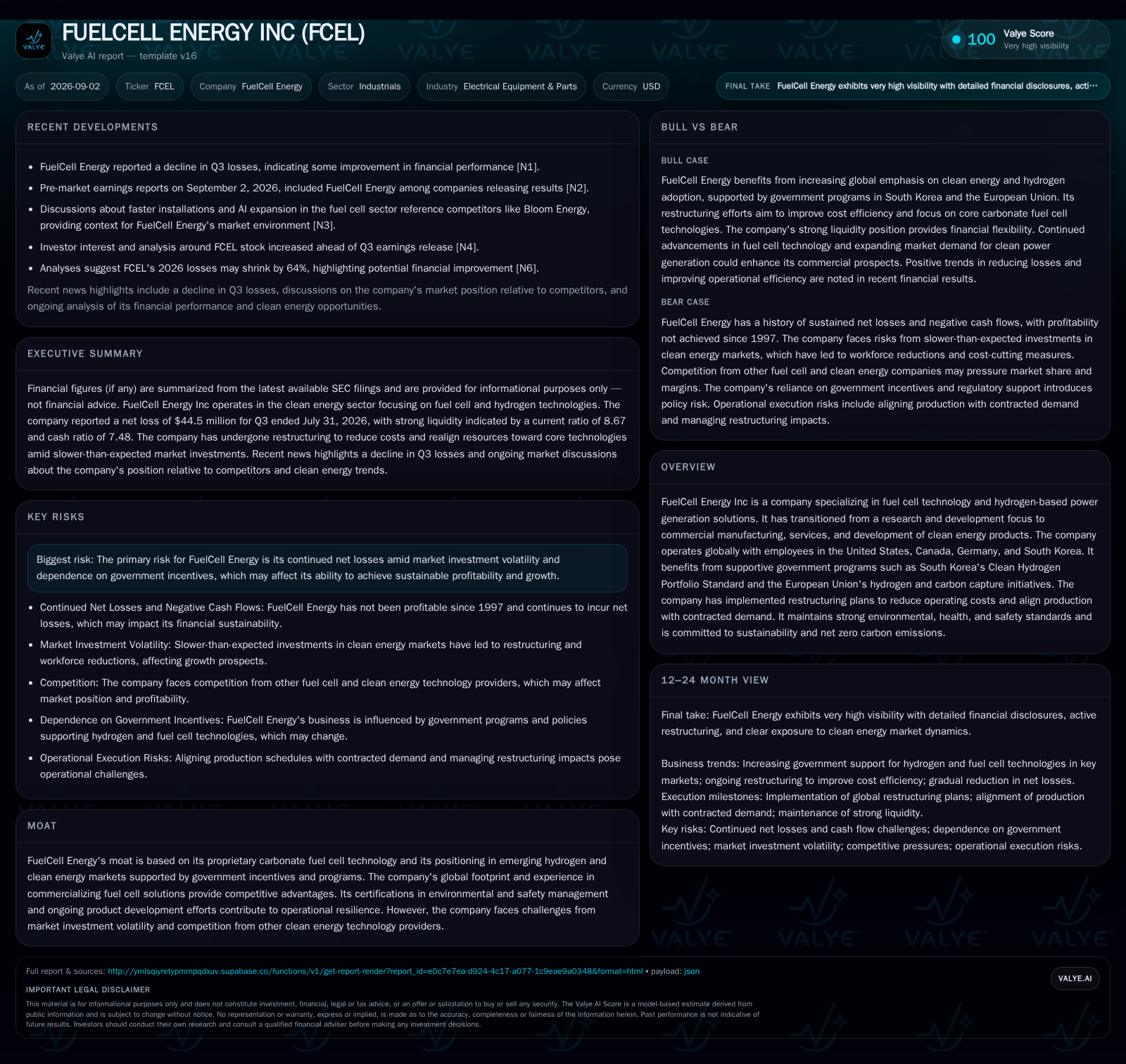
As of the quarter ended July 31, 2026, FuelCell Energy reported a net loss of $44.5 million with basic and diluted EPS of -$0.64, marking a reduction in losses compared to prior periods, signaling some improvement in operational efficiency and cost management [N1] [S2]. The company’s liquidity remains robust, with cash and equivalents of $658 million and a current ratio of 8.67, positioning it well to navigate ongoing investments and restructuring initiatives [S2].
FuelCell Energy has realigned its global workforce and cost structure through restructuring completed in late 2024 and mid-2025, focusing on core carbonate fuel cell technologies, which are central to its commercial strategy. Its international operations span the US, Canada, Germany, and South Korea, enabling access to key markets supported by government incentives such as South Korea's Clean Hydrogen Portfolio Standard and the European Union's hydrogen and carbon capture programs [S1]. These developments matter because they set the stage for scaling operations while attempting to reduce losses and capitalize on policy-driven demand.
Business Model and Unit Economics
FuelCell Energy generates revenue primarily through the sale and servicing of carbonate fuel cell power plants and related hydrogen generation systems. Pricing is likely influenced by project scale, technology customization, and service contracts, with volume growth tethered to adoption rates in key regulated and incentivized markets. The transition from R&D to commercial manufacturing introduces fixed costs related to plant operations, manufacturing facilities, and engineering, while variable costs scale with production volumes and service requirements. This mix suggests potential operating leverage if market demand expands sufficiently to absorb fixed costs.
However, historically negative cash flows and sustained net losses indicate that current volumes remain insufficient to cover fixed costs fully, reflecting challenges in demand acceleration and pricing power. Capital intensity is high given the specialized manufacturing equipment and ongoing R&D investments to improve efficiency and reduce costs. Operating leverage could emerge if government programs and corporate decarbonization efforts drive sizable contract pipelines, enabling better absorption of fixed costs and margin expansion. Conversely, if market adoption stalls or competitors capture market share, fixed costs could weigh more heavily, limiting profitability.
Moat, Competition and Counterforces
FuelCell Energy’s moat is anchored in its proprietary carbonate fuel cell technology, which offers distinct advantages in efficiency and scalability for clean hydrogen and power generation. Geographic diversification across North America, Europe, and Asia provides exposure to multiple regulatory frameworks and incentive programs, reducing dependence on any single market. Its certifications in environmental management and safety reinforce operational credibility, supporting customer trust and compliance in sensitive markets.
Countervailing forces include intense competition from other fuel cell technology providers such as Bloom Energy, which operates with different fuel cell chemistries and has pushed innovations like AI-enabled installations. The competitive landscape pressures pricing, margin, and customer acquisition. Moreover, government incentives, while supportive, add policy risk as changes in regulation or subsidy structures could materially impact demand. Market investment volatility and slower-than-expected adoption rates may further limit scale economies. The key competitive challenge is sustaining technological leadership and cost efficiency while navigating these external risks.
Bull Case
In the bull case, accelerating global decarbonization efforts and the rising adoption of hydrogen as a clean energy vector catalyze rapid market expansion. FuelCell Energy leverages its carbonate fuel cell technology to secure large-scale contracts supported by government programs in South Korea and the European Union. Successful execution of restructuring initiatives leads to sustained cost reductions, improved operating margins, and narrowing losses, evidenced by recent quarterly improvements [N1] [N6]. reported liquidity position provides the runway for targeted investments in manufacturing capacity and service infrastructure, establishing FCEL as a go-to supplier in emerging hydrogen markets.
Confirming evidence would include steady revenue growth driven by multi-year contracts, expanding installed base, and improved gross margins reflecting operating leverage. Falsification would come from prolonged lack of market uptake, continued deteriorating losses, or loss of key incentives. Additionally, inability to fend off competitive advances or failure to scale operations efficiently would undermine this optimistic scenario.
Base Case
The base case envisions moderate expansion in hydrogen adoption, with FuelCell Energy maintaining a stable share of a gradually growing market. Continued government incentives provide steady but cautious tailwinds, offset by competitive pressures that keep pricing and margins in check. The company’s restructuring efforts succeed in improving cost discipline but do not fully eliminate net losses in the near term. Liquidity remains ample, allowing measured capital deployment focused on core carbonate technologies without aggressive scaling.
In this scenario, operational execution is steady, with production aligned to contracted demand and manageable workforce levels. Revenue growth and margin improvement are incremental rather than exponential. Confirming signals would be consistent but moderate revenue increases, stable gross margins, and ongoing reduction in quarterly losses. Falsifiers include sharp declines in government support, sudden competitive disruptions, or operational setbacks such as missed production targets or supply chain issues.
Bear Case
The bear case centers on continued market volatility and slower-than-expected adoption of fuel cell technology, leading to persistent net losses and negative cash flows. Government incentives may wane or become less predictable, undermining demand visibility. Competitive pressures from alternative clean energy technologies intensify, eroding FuelCell Energy’s market share and pricing power. Restructuring fails to yield sustainable cost advantages, and operational execution problems arise in scaling or aligning production with demand.
Confirming evidence would include widening losses, cash depletion despite reported liquidity position buffers, workforce instability, and delays or cancellations of key projects. Additionally, loss of key customers or inability to secure new contracts would signal weakening fundamentals. Conversely, falsifying indicators would be timely contract wins, operational improvements, or renewed investor confidence reflected in share price stability or appreciation.
What Matters Next
Key metrics to monitor include quarterly revenue growth and gross margin trends, which indicate market adoption and operational efficiency. Tracking net loss trajectory and cash burn rates will provide insight into financial sustainability and capital runway. The cadence and scale of new contract awards, especially multi-year agreements, are crucial for revenue visibility and announced awards quality.
Additional milestones encompass successful completion of ongoing restructuring phases and workforce stability, as these influence cost structure and execution capability. External factors such as government policy developments in South Korea, the EU, and other key markets should be watched closely given their impact on demand. Finally, competitive dynamics, including technology advancements by peers like Bloom Energy and their effect on FCEL’s market positioning, remain critical.
Disclaimer: This is research-only, informational analysis and not investment advice. It may include AI-generated interpretation and general industry context. Always verify important details using primary sources.

Comments