
VIRCO MFG CORPORATION Faces Margin Pressure and Demand Fluctuations in Education Furniture Market
Amid macroeconomic headwinds and state budget uncertainty, VIRCO’s operational adjustments and financial positioning illustrate both resilience and exposure in a highly seasonal, cost-sensitive niche.
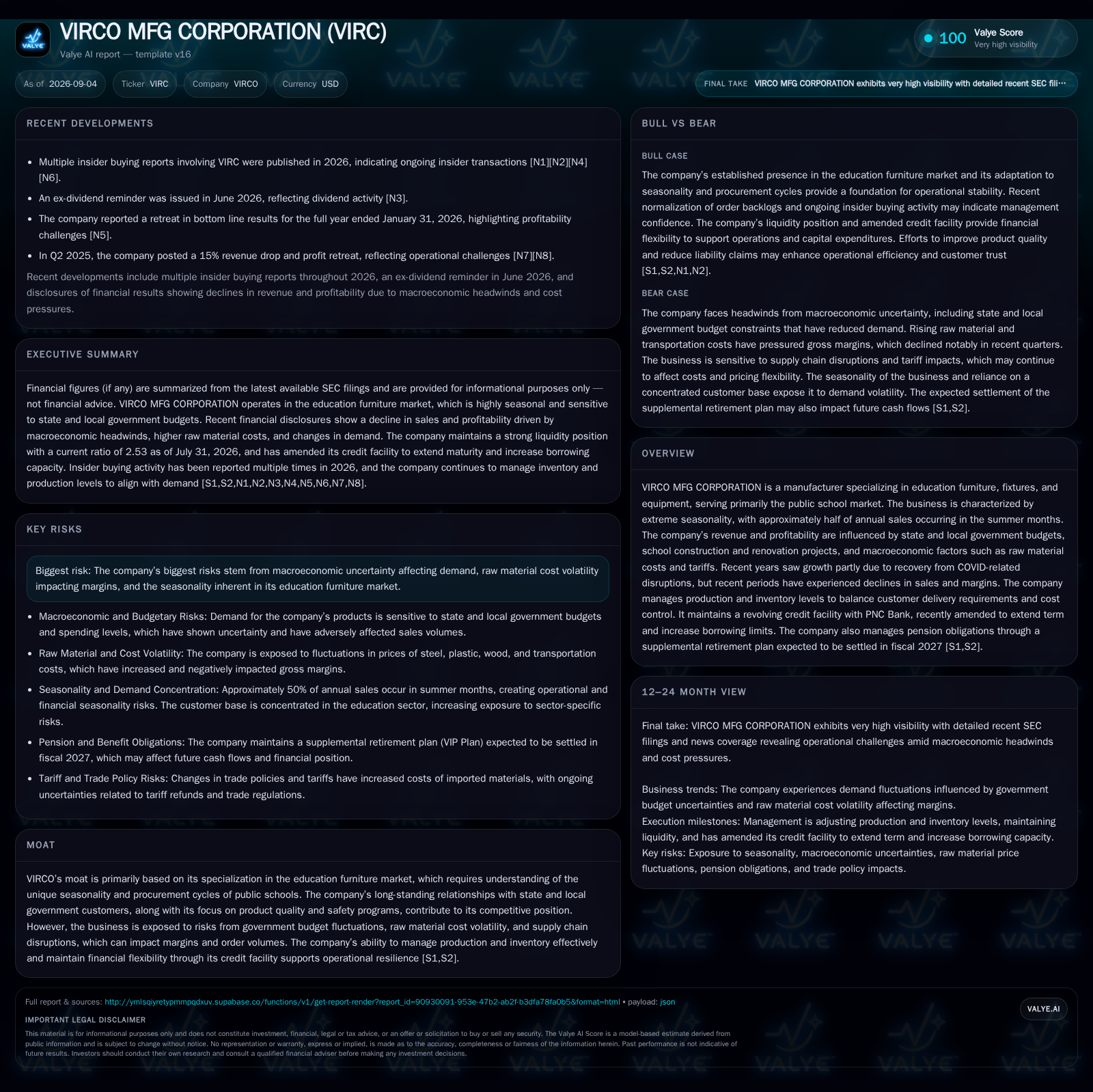
VIRCO MFG CORPORATION faces headwinds from government budget uncertainty and raw material cost inflation impacting demand and margins in its education furniture business. The company’s seasonal sales concentration and reliance on public-sector budgets create inherent volatility, while operational moves to moderate production and reduce inventory aim to preserve cash flow and delivery reliability. Its liquidity and amended credit facility provide potential financial flexibility, but margin pressures and pension settlement risks remain key challenges. Insider buying activity signals management confidence, yet demand and cost dynamics warrant close monitoring to assess recovery prospects and margin stabilization.
VIRCO MFG CORPORATION operates within the niche education furniture sector, characterized by pronounced seasonality and dependency on state and local government budgets. Recent financial disclosures through mid-2026 reveal a decline in sales and gross margins, linked to macroeconomic challenges including raw material cost inflation and public-sector budget uncertainties. The company has responded by moderating production and reducing inventory to align supply with softened demand and maintain customer service levels. While liquidity remains at a reported level consistent with operational needs and the credit facility was extended, margin pressures and the anticipated settlement of a supplemental retirement plan underscore the fragility of near-term profitability. Insider transactions suggest an internal belief in recovery potential, but the path forward hinges on navigating cost dynamics and demand fluctuations.
Demand Decline and Margin Pressure Shape Recent Performance
VIRCO experienced a 5.0% and 6.1% decline in net sales for the three and six months ended July 31, 2026, respectively, compared with the prior year, primarily due to macroeconomic headwinds and uncertain state and local government budgets impacting demand [S2]. This contraction follows a broader trend of revenue and profitability challenges evident since 2025, when the company posted a 15% revenue drop in Q2 and a retreat in profits [N7][N8].
Gross margin deteriorated from 44.4% in Q2 2025 to 40.0% in Q2 2026, reflecting the combined impact of lower sales volume and increased raw material and overhead costs, including steel, plastic, wood, and transportation expenses [S2][S1]. To mitigate inventory risks and support on-time deliveries, management moderated production, reducing inventory by $6.8 million year-over-year [S2]. These operational adjustments reveal active management of working capital amid demand volatility.
Seasonality and Cost Structure Define Operating Leverage Dynamics
VIRCO’s revenue generation is tightly linked to the public education sector’s capital expenditure and renovation cycles, which are concentrated in summer months, with about 50% of annual sales occurring from June through August [S2]. This seasonality creates a pronounced demand spike followed by a prolonged off-season, necessitating precise production scheduling and inventory management to avoid excess carrying costs or stockouts.
The company’s cost structure includes significant fixed overhead related to manufacturing facilities, alongside variable raw material and transportation costs. Rising input prices have compressed gross margins, and lower sales volumes limit absorption of fixed costs, causing operating leverage to work against profitability in downturns. Efforts to moderate production help curtail inventory holding costs but risk underutilizing capacity. Selling, general and administrative expenses decreased in absolute terms but rose as a percentage of sales due to higher delivery costs and product mix changes [S2], indicating limited expense flexibility.
Niche Public-Sector Focus Offers Stability but Limits Pricing Power
VIRCO’s specialization in education furniture provides a moat grounded in deep understanding of public-sector procurement cycles and product safety requirements, along with established relationships with school districts and governmental buyers [S1]. This focus supports some demand visibility and repeat business given the predictable nature of school renovation and new construction budgets, albeit subject to political and fiscal uncertainties.
However, the company faces competitive pressures from other manufacturers competing on price, quality, and delivery reliability. Rising raw material costs and tariffs constrain pricing flexibility, especially in a market sensitive to budget allocations. Switching frictions may be moderate given the commoditized nature of some furniture products, although quality and compliance improvements under the company’s product quality enhancement program could strengthen customer retention and reduce liability claims [S1]. These factors collectively shape a competitive environment with modest pricing power and margin vulnerability.
Recovery in Government Spending and Margin Stabilization Drive Growth
A favorable scenario unfolds if state and local government budgets stabilize or improve, restoring demand for education furniture through increased school renovation and construction projects. This would drive higher order volumes, enabling better absorption of fixed costs and margin recovery. Confirmation would come from sequential order backlog growth beyond the current 13% year-over-year increase and improved shipment rates surpassing prior-year levels [S2].
Additionally, successful cost management, including negotiated raw material contracts or tariff relief, combined with operational efficiencies from product quality initiatives, could reduce overhead and material cost inflation. Evidence of improved gross margins approaching historical levels (mid-40% range) would validate this. A falsification would be persistent margin compression despite demand improvement or continued backlog stagnation, suggesting structural cost pressures or competitive erosion.
Demand Normalization with Ongoing Cost Challenges Restricts Earnings Potential
The most plausible near-term outcome involves gradual normalization of incoming orders and backlog, reflecting cautious budget outlooks from public-sector buyers. While order backlog is currently 13% higher year-over-year, shipments plus backlog remain about 2% lower, indicating incomplete recovery [S2]. Demand may remain uneven due to macroeconomic uncertainties and political fiscal constraints.
Cost pressures from raw materials and transportation may persist, restraining margin expansion despite operational efforts. Production and inventory moderation continue to balance delivery and cost control, limiting working capital strain but capping sales growth. Gross margins might stabilize near current levels (~40%), while SG&A as a percentage of sales remains slightly elevated. Confirmation would include stable backlog growth without significant margin improvement, while falsification would be either a sharper-than-expected demand rebound or deeper margin deterioration.
Extended Budget Constraints and Cost Inflation Undermine Profitability and Liquidity
A downside path emerges if state and local governments enact deeper spending cuts or delays in education capital projects, driven by economic downturn or political priorities. This would depress order volumes and backlog, intensifying revenue declines beyond recent 5-6% drops [S2]. Lower utilization of production capacity amid fixed overhead could severely compress margins.
Concurrently, sustained or escalating raw material and transportation costs would further erode profitability, potentially forcing aggressive price concessions or reduced product quality investment. Inventory valuation risks, including slow-moving or obsolete stock, could increase, requiring write-downs [S1]. The anticipated supplemental retirement plan settlement in fiscal 2027 could strain cash flows, exacerbating liquidity pressures despite the reported current ratio and credit facility [S2]. Signs confirming this downside would include shrinking backlog, widening margin losses, and cash flow constraints; falsification would be stable or improving demand and cost control.
Demand and Cost Trends Plus Pension Settlement Timing Will Shape Future Outlook
Key metrics to monitor include order backlog growth rates and shipment volumes relative to prior periods, which would indicate demand trajectory given the company’s seasonality and government budget dependence. If disclosed, metrics on customer continued-adoption indicators or purchasing patterns would help test revenue visibility assumptions.
Gross margin trends and raw material cost pass-through effectiveness are critical to assess pricing power and cost management amid inflationary pressures. Tracking changes in product mix and delivery costs can reveal margin drivers or pressures.
Inventory levels and valuation practices, especially regarding slow-moving or obsolete stock, will shed light on working capital risks and operational efficiency. Monitoring SG&A expenses as a percentage of sales can indicate cost discipline amid revenue fluctuations.
Liquidity measures including cash and cash equivalents of $14.4 million, current assets of $122.6 million against current liabilities of $48.5 million resulting in a current ratio of 2.53, and availability under the revolving credit facility will illustrate potential financial flexibility, particularly as the supplemental retirement plan settlement approaches in fiscal 2027. These liquidity metrics alone do not establish capacity for acquisitions or investments [S2]. Insider buying activity trends provide a qualitative gauge of management’s confidence in strategic execution and outlook.
Disclaimer: This is research-only, informational analysis and not investment advice. It may include AI-generated interpretation and general industry context. Always verify important details using primary sources.

Comments