
Wiley’s Digital and AI Strategies Tested by Industry Disruption
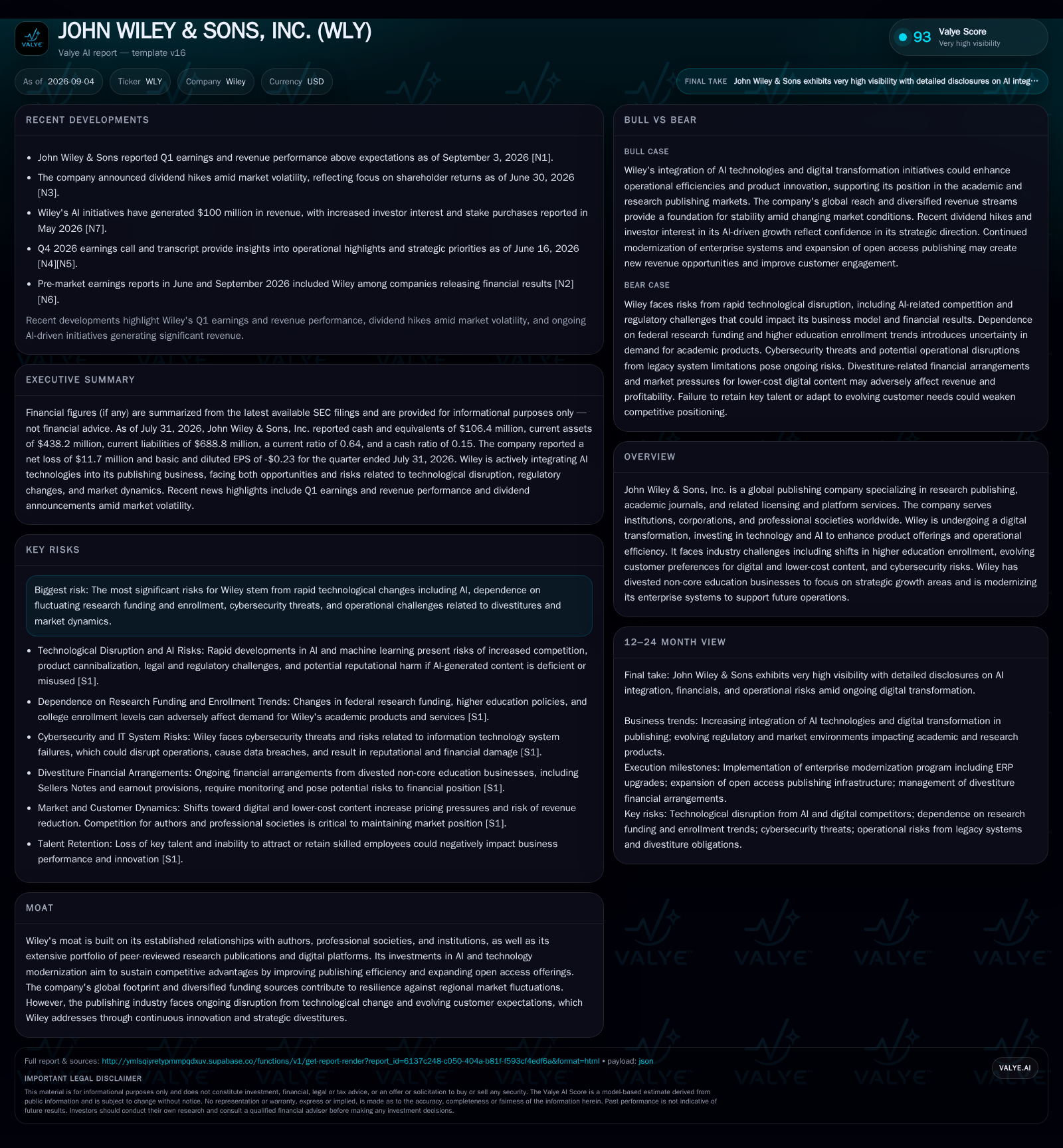
John Wiley & Sons is advancing AI integration and enterprise modernization to reshape its academic publishing model, but execution complexity, funding dependencies, and evolving market dynamics pose significant inflection points for sustainable growth.
Wiley’s strategic pivot to AI-driven publishing and digital platforms positions it to capitalize on emerging efficiencies and new revenue streams in research publishing. However, its model remains vulnerable to higher education enrollment trends, federal research funding variability, and regulatory scrutiny around AI content. Operational risks from legacy systems and cybersecurity also challenge margins amid competitive pressures for lower-cost digital content. Wiley’s near-term results show revenue resilience and investor interest in AI initiatives, but maintaining competitive advantage depends on navigating technological disruption, regulatory environments, and adoption of open access models.
John Wiley & Sons, a stalwart in academic and research publishing, is aggressively reengineering its business model through AI integration and digital transformation amid a shifting scholarly landscape. Recent quarterly results show progress with AI-driven revenue surpassing $100 million, underscoring the potential of technology to enhance publishing efficiency and open access adoption. Yet, Wiley confronts a complex interplay of external and internal challenges—volatile federal research budgets, fluctuating university enrollments, cybersecurity risks, and legacy IT infrastructure—that collectively test the durability of its strategic pivot. Investors and stakeholders will keenly watch how Wiley balances innovation with operational resilience to maintain its foothold in an evolving global publishing market.
AI Revenue Milestone and Digital Shift Underpin Wiley’s Recent Financial Beat
Wiley’s Q1 2026 results outperformed market expectations with revenue and earnings surpassing estimates, driven notably by its AI initiatives that generated approximately $100 million in revenue. This milestone reflects meaningful monetization of AI integration into research publishing workflows, including faster article processing and expanded open access payment infrastructure. The improved top-line was accompanied by increased investor interest, as evidenced by notable stake purchases following the AI revenue announcement.
Simultaneously, Wiley announced dividend hikes despite reporting a net loss of $11.7 million for the quarter and liquidity ratios below 1.0, indicating ongoing financial pressures. The company is undertaking a multiyear enterprise modernization program, including ERP system upgrades, to improve operational efficiency and support future digital product offerings. These developments highlight Wiley’s dual focus on leveraging technology for growth while managing the legacy cost structure and market volatility.
Transforming Publishing Economics Through AI and Platform Modernization
Wiley’s core revenue derives from publishing academic journals, research articles, and licensing content to institutions and corporations globally. Pricing dynamics depend on subscriptions, article processing charges especially in open access, and licensing deals with professional societies. The integration of AI aims to reduce publication cycle times, improve editorial efficiencies, and enable scalable open access payment models, which could shift the revenue mix toward faster, higher-margin digital services.
Operating leverage is constrained by legacy IT infrastructure and the capital intensity of platform modernization and cybersecurity investments. Fixed costs remain significant, particularly in content acquisition, editorial staffing, and technology development. However, successful digital transformation may unlock operating leverage by automating workflows and expanding scalable service offerings. Volume growth is tied to research funding and academic enrollment trends, while pricing power faces pressure from the growing demand for lower-cost or free access to scholarly content.
A critical aspect of Wiley’s digital transformation lies in the balance between upfront capital expenditures and the anticipated long-term payoff from AI-driven efficiencies. While platform modernization demands significant investment in technology and talent, the potential to automate labor-intensive editorial tasks and reduce time-to-publication could materially improve unit economics. However, this payoff is conditional on achieving sufficient scale and adoption among authors and institutions, as partial or fragmented uptake may result in suboptimal returns. Investors should therefore monitor the marginal cost reductions per article processed and the elasticity of demand for faster, AI-enabled publication services to assess whether the technology investments translate into sustainable margin expansion.
Author and Institution Relationships Anchor Wiley’s Moat Amid Rising Disruption
Wiley’s competitive advantage rests on its extensive portfolio of peer-reviewed journals and longstanding relationships with authors, academic societies, and research institutions worldwide. These relationships create switching frictions and content exclusivity that are difficult for new entrants to replicate. The company’s global footprint and diversified funding sources provide resilience against regional market fluctuations.
Nevertheless, rapid advances in AI content generation and editorial automation pose competitive threats, potentially enabling new entrants or platform aggregators to disrupt traditional publishing economics. Regulatory scrutiny around AI-generated content quality and ethical standards further complicates the landscape. Wiley’s investments in AI and platform modernization seek to bolster its moat by enhancing service quality and operational efficiency, but its ability to sustain pricing power and author loyalty under evolving customer expectations remains uncertain.
The company’s moat, anchored in author and institution relationships, faces nuanced challenges beyond direct competition. The rise of AI-generated content and alternative publishing platforms could erode customer loyalty if Wiley’s offerings do not evolve to meet changing expectations for speed, cost, and transparency. Moreover, the regulatory environment around AI content quality and ethical standards introduces uncertainty that could either reinforce Wiley’s position as a trusted publisher or impose compliance costs that narrow its competitive advantage. A key falsification test for the moat’s resilience will be the company’s ability to maintain or grow submission volumes and society partnerships amid increasing pressure from novel publishing models and regulatory shifts.
AI-Driven Publishing Efficiency Spurs Growth and Margins in a Favorable Funding Environment
In a favorable scenario, Wiley successfully scales AI integration to accelerate article submissions, shorten publication timelines, and expand open access uptake, increasing revenue and improving margins. The company’s modernization of legacy order management and ERP systems enhances operational efficiency, reducing fixed cost burdens and enabling faster innovation cycles. Robust federal research funding and stable higher education enrollment sustain volume growth, while regulatory clarity around AI content minimizes compliance risks.
Confirming evidence would include consistent sequential growth in AI-generated revenue beyond $100 million, rising open access article volumes, margin expansion due to lower editorial costs, and positive feedback from institutional customers on platform usability. Conversely, failure to maintain author and society relationships or regulatory setbacks on AI use would challenge this upside thesis.
Digital Adoption Balances Investment Costs Against Mixed Market Headwinds
The most plausible path sees Wiley advancing AI and digital transformation at a measured pace, offsetting ongoing investments with incremental improvements in operational efficiency. Growth in AI-enabled revenue moderates as adoption curves flatten and competitive pressures limit pricing flexibility. Federal research funding and enrollment trends fluctuate, producing uneven volume growth. Legacy systems continue to impose operational constraints, while cybersecurity investments absorb capital without materially improving profitability.
Evidence confirming this scenario would be stable but modest AI revenue growth, persistent net losses or narrow margins, and incremental progress on ERP modernization without a step-change in cost structure. Market volatility and regulatory developments related to AI use could intermittently weigh on customer sentiment and demand. A falsification test would be either sharply accelerating AI revenue growth or a substantial deterioration in research funding or enrollment.
The upside scenario also depends heavily on external market dynamics aligning favorably. Stable or growing federal research budgets and higher education enrollments provide the volume base necessary to leverage AI efficiencies and justify upfront technology investments. Conversely, if these funding sources contract or shift toward open science mandates without commensurate compensation models, Wiley’s revenue growth and margin improvement could stall despite technological advances. Therefore, the interplay between public funding policies, open access mandates, and Wiley’s pricing strategies will be a critical driver of the company’s ability to capitalize on its digital transformation.
Technological Disruption and Funding Volatility Erode Revenue and Competitive Position
In a downside case, rapid AI-driven disruption enables new competitors to bypass Wiley’s traditional author and society relationships by offering lower-cost, AI-augmented publishing platforms. Regulatory crackdowns on AI content or reputational damage from AI-generated errors diminish customer trust. Concurrently, reductions in federal research grants and shrinking higher education enrollment lead to volume declines, compressing revenue and fixed cost absorption. Legacy IT system failures or cybersecurity breaches exacerbate operational risks and increase expenses.
This scenario would be confirmed by declining article submissions, persistent net losses beyond current levels, customer attrition to newer platforms, and adverse regulatory actions related to AI-generated content. Conversely, stable or growing AI revenue and research funding would falsify this downside path.
Key Factors in Wiley’s Transition Success and Market Resilience
Key performance indicators include the growth rate of AI-generated revenue and open access article volumes, which directly reflect adoption of new publishing models. Monitoring gross and operating margins will reveal if digital transformation is unlocking operating leverage or if investment costs are suppressing profitability. Tracking federal research funding trends and higher education enrollment statistics is essential to anticipate demand shifts for Wiley’s academic products.
Additional milestones include progress and deployment speed of ERP and order management system upgrades, incident frequency and severity in cybersecurity, and customer retention or attrition rates among institutional clients and professional societies. Disclosure of author submission growth rates and average article processing times would be valuable metrics to assess publishing efficiency improvements. Regulatory developments and legal challenges related to AI content quality and compliance warrant close observation.
In addition to the operational and market factors, investor watchpoints should include the pace and quality of AI adoption among Wiley’s author base. Metrics such as author satisfaction scores, submission-to-publication cycle times, and the proportion of articles processed with AI assistance will offer early signals of whether the technology integration is delivering tangible benefits. Furthermore, tracking the evolution of pricing models for open access and AI-enhanced services will shed light on Wiley’s ability to capture value from these innovations without alienating customers. Lastly, regulatory developments concerning AI content will require ongoing scrutiny, as adverse rulings or compliance burdens could materially affect Wiley’s cost structure and market positioning.
Disclaimer: This is research-only, informational analysis and not investment advice. It may include AI-generated interpretation and general industry context. Always verify important details using primary sources.

Comments