
Blue Chip Capital Group Faces Financial Challenges and Business Model Uncertainty
With mounting losses, working capital deficits, and internal control weaknesses, Blue Chip Capital Group faces critical challenges in stabilizing operations and clarifying its strategic direction amid limited public disclosure.
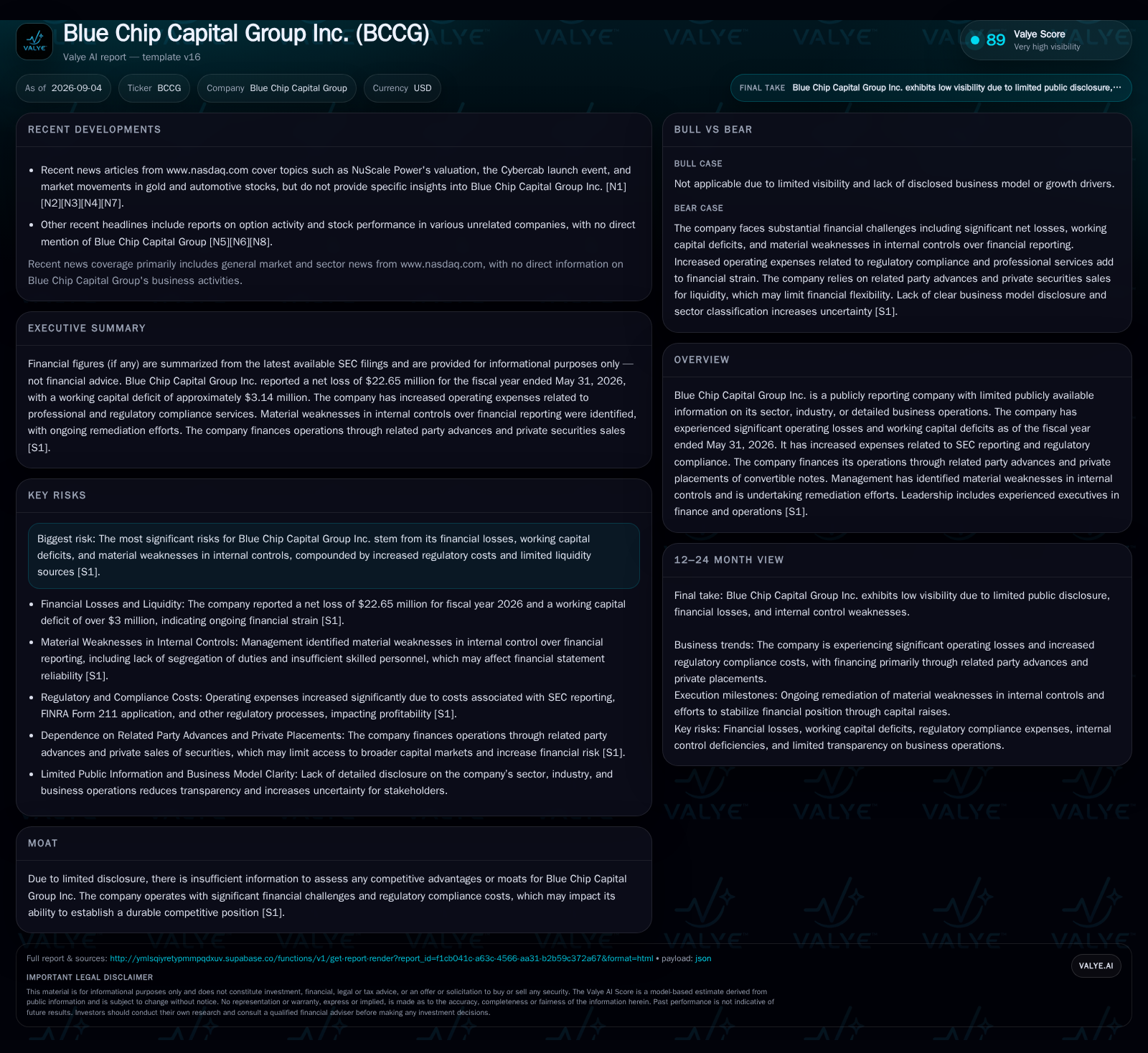
Blue Chip Capital Group Inc. reported a $22.65 million net loss and a $3.14 million working capital deficit for fiscal 2026, driven by rising regulatory and compliance expenses. The company finances through related party advances and private placements amid material internal control weaknesses. Lack of transparency on its business model and sector inhibits visibility into long-term value creation. The next 12-24 months hinge on remediation of financial controls, capital raising success, and evidence of operational progress or strategic clarity.
Blue Chip Capital Group Inc. is navigating a precarious financial and operational landscape as of its 2026 fiscal year-end. The company reported a substantial net loss of $22.65 million alongside a $3.14 million working capital deficit, reflecting acute liquidity challenges. These financial pressures are compounded by rising costs tied to SEC reporting obligations and regulatory compliance, which have driven operating expenses sharply higher. Meanwhile, management has acknowledged material weaknesses in internal controls, highlighting risks to financial statement accuracy. The absence of clear information about its industry focus or business activities further clouds prospects, making the company’s path to sustainable profitability and operational stability uncertain.
Financial Losses and Operational Hurdles Define Blue Chip Capital’s Present
Blue Chip Capital Group Inc. reported a net loss of $22.65 million for the fiscal year ended May 31, 2026, coupled with a working capital deficit of $3.14 million, which increased markedly from the previous year’s deficit of approximately $609,000 [S1]. These figures underscore significant ongoing financial strain and liquidity challenges. The company’s cash position remains limited, with only $1.4 million in cash and equivalents reported as of February 29, 2024, and current assets shrinking to $277,000 by November 30, 2025 [S1][S2].
Operating expenses surged to $21.74 million, primarily due to higher compensation and professional fees related to SEC reporting and regulatory processes [S1]. Management disclosed material weaknesses in internal controls over financial reporting, including insufficient segregation of duties and lack of skilled personnel, creating risks for accurate and timely financial disclosures [S1]. The company has been funding operations through related party advances and private sales of securities, including convertible notes issued under Regulation D, Rule 506(b) [S1], indicating constrained access to traditional capital markets.
Opaque Revenue Model and Expense-Driven Operating Dynamics
Blue Chip Capital Group’s business model and revenue-generating activities remain largely undisclosed, complicating any clear analysis of its economic drivers. The absence of identified sectors or industry classification in filings suggests the company may be in early-stage operations or a transitional phase, lacking stable revenue streams. Consequently, operating losses primarily related to compliance and administrative expenditures dominate the financial profile, rather than profitable core business activities [S1].
The company’s cost structure appears heavily weighted towards fixed expenses such as professional fees and compliance costs, which have escalated sharply in the past year. This elevates operating leverage on the downside, as limited or no revenue growth would not offset these fixed costs. Capital intensity and cash burn are high relative to current assets and liquidity, requiring ongoing external financing mainly through related party advances and private placements. Without clear volume or pricing metrics, the prospects for margin improvement depend critically on establishing sustainable revenue sources and controlling fixed expense growth.
Limited Visibility into Market Position Undermines Competitive Analysis
Due to the lack of disclosed sector, industry, or product/service descriptions, assessing Blue Chip Capital Group’s competitive positioning is challenging. There is insufficient evidence of any unique technology, distribution advantage, customer lock-in, or intellectual property that might constitute a moat or durable competitive edge [S1]. The company’s current financial and operational challenges further weaken any potential competitive standing, as resource constraints limit investment in growth drivers or innovation.
Potential competitors or peers remain unidentified given opacity in business activities, making benchmarking impossible. The reliance on related party funding rather than open capital markets may constrain the company’s ability to scale or respond to competitive threats. Without clearer articulation of its value proposition or customer base, Blue Chip Capital risks marginalization or obsolescence in any market it might serve.
Stabilizing Controls and Financing Enable Path to Operational Clarity
In a favorable outcome, Blue Chip Capital Group successfully remediates its internal control deficiencies, enabling reliable financial reporting that builds investor confidence. Concurrently, the company secures sufficient capital through private placements or related party advances to stabilize liquidity and fund essential operations. This financial stability allows management to clarify and disclose its business model, demonstrating early revenue traction or strategic partnerships that validate future growth potential [S1].
Confirmation of this scenario would include reported improvements in internal control audits, narrowing operating losses, and announcements of customer contracts or product launches. Conversely, failure to address control weaknesses or secure funding would falsify this outcome. Transparency on operating metrics and incremental revenue generation would be critical evidence to support a constructive reassessment of the company’s outlook.
Financial Strain and Business Opacity Persist
The most plausible middle-path scenario involves Blue Chip Capital continuing to operate under significant financial pressure, with recurring operating losses and working capital deficits. Regulatory and compliance costs remain elevated, limiting investment in revenue-generating activities. The company relies mainly on related party advances and private note sales to fund operations, maintaining a fragile liquidity position without broader capital market access [S1].
In this scenario, remediation of internal control issues progresses slowly, and transparency into the business model remains limited, leaving investors uncertain about long-term viability. Confirmation would be stable or slightly worsening losses, continued reliance on related party financing, and minimal disclosure of operational advances. A falsification test would be the emergence of sustained revenue growth or reduced regulatory expense burden, which appears unlikely absent strategic shifts.
Escalating Losses and Weak Controls Trigger Liquidity Crisis
The downside risk sees Blue Chip Capital’s financial position deteriorate further, with mounting losses and a worsening working capital deficit that exhausts available liquidity. Material weaknesses in internal controls remain unaddressed, undermining confidence in reported results and deterring external capital providers. Regulatory expenses continue to rise, exacerbating the cash burn without corresponding revenue streams [S1].
If related party advances and private placements dry up, the company could face insolvency or forced restructuring. Confirming evidence would include missed financial reporting deadlines, restatements, or inability to meet short-term obligations. Conversely, if new liquidity sources or effective expense controls materialize, this scenario would be falsified. However, given current trends, this outcome remains a significant risk.
Factors to Assess Stability and Strategic Progress
Key metrics to monitor include: (1) operating cash flow trends, which would reveal whether losses translate into real cash burn; (2) progress reports on remediation of internal control weaknesses, especially external audit outcomes; (3) disclosure of business model details or customer contracts that would clarify revenue sources; (4) changes in related party advances or private placement activity as a gauge of financing capacity; and (5) movements in operating expenses related to compliance, as reductions could signal cost control improvements.
(6) If disclosed, unit economics or early revenue metrics would help gauge functional business momentum; (7) management commentary on strategic initiatives or capital-raising plans; and (8) any shifts in regulatory environment impacting compliance costs. Together, these indicators would help determine whether Blue Chip Capital is stabilizing, evolving toward sustainable operations, or facing deepening financial distress.
Disclaimer: This is research-only, informational analysis and not investment advice. It may include AI-generated interpretation and general industry context. Always verify important details using primary sources.

Comments