
Duluth Holdings Enhances Profitability with Strategic Operational Focus Amid Retail Challenges
Recent quarterly results reflect Duluth Holdings' capacity to generate profits and maintain liquidity in a competitive apparel market, yet the company faces ongoing risks from consumer trends and supply chain dynamics that will shape its medium-term trajectory.
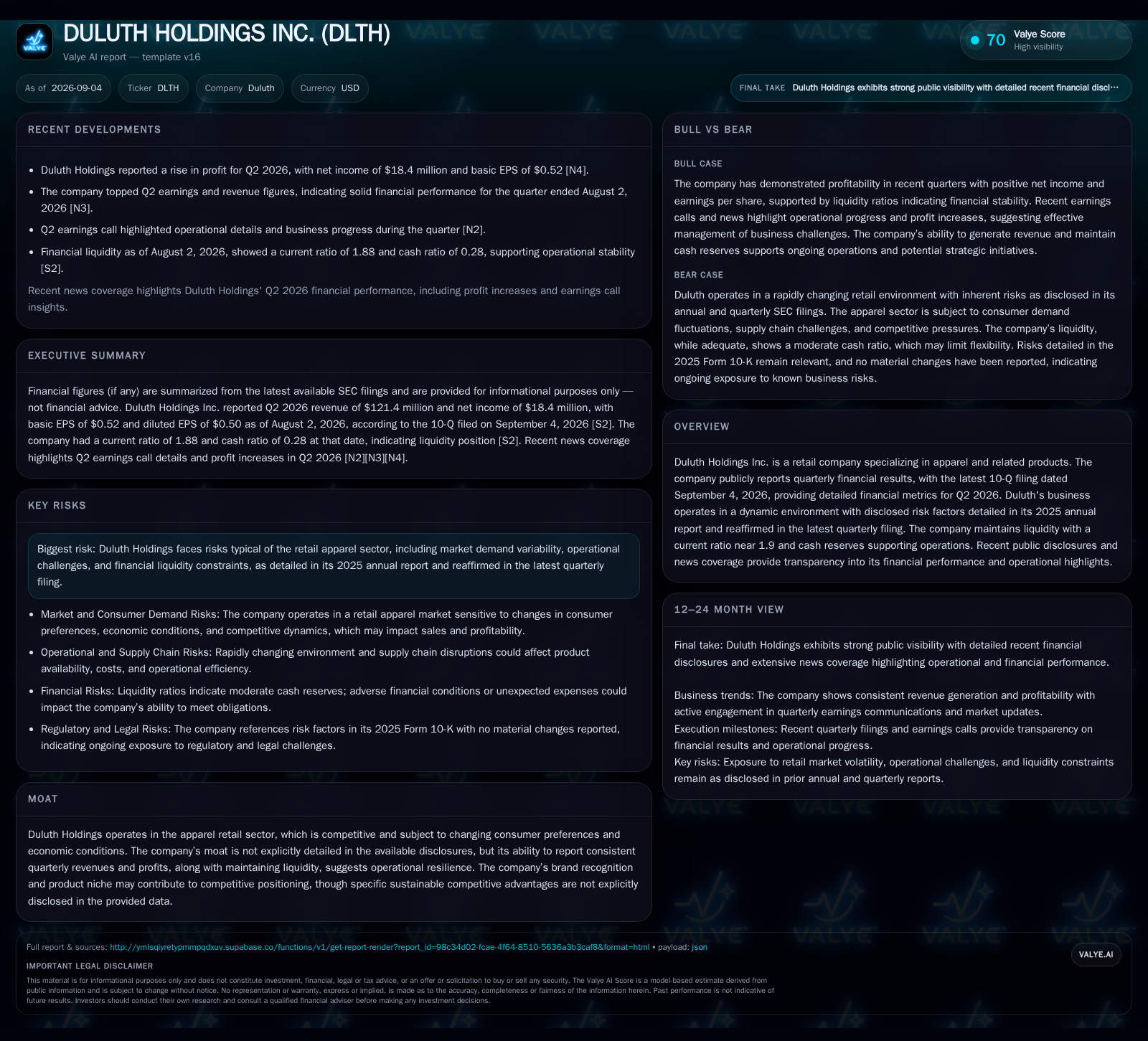
Duluth Holdings reported solid Q2 2026 financial results with revenue of $121.4 million and net income of $18.4 million, demonstrating operational resilience in the apparel retail sector. Its business economics rest on managing pricing, volume, and mix in a highly competitive environment, with moderate capital intensity and some operating leverage potential. Competitive positioning depends on brand niche and product differentiation but remains vulnerable to consumer and supply chain shifts. Scenarios range from expansion through improved market penetration and operational efficiency to contraction due to demand softness and cost pressures. Key watchpoints include sales growth dynamics, margin trends, liquidity measures, and inventory management.
Duluth Holdings Inc. reported encouraging second-quarter 2026 results with revenues of $121.4 million and net income of $18.4 million, reflecting continued operational discipline in a challenging apparel retail environment. The company’s liquidity remains stable with a current ratio near 1.9, supporting near-term operational needs. However, the apparel sector’s inherent exposure to shifting consumer preferences and supply chain disruptions presents ongoing risks. Duluth’s future performance will hinge on its ability to leverage brand strengths, optimize pricing and inventory strategies, and navigate competitive pressures to sustain profitability and growth.
Recent Financial Results Highlight Operational Resilience Amid Retail Dynamics
Duluth Holdings reported Q2 2026 revenue of $121.4 million and net income of $18.4 million, with basic earnings per share of $0.52, as disclosed in its September 4, 2026 10-Q filing [S2]. This represents a profit increase quarter-over-quarter, signaling operational effectiveness despite a volatile retail apparel market. Additionally, the company’s earnings surpassed analyst estimates, reflecting better-than-expected sales and cost management [N3][N4].
Liquidity metrics also reinforce the company’s operational stability, with a current ratio of 1.88 and a cash ratio of 0.28 at the end of Q2 2026 [S2]. These figures suggest Duluth maintains sufficient short-term assets to cover liabilities, though the relatively low cash ratio implies limited cash buffer relative to total current obligations. The company operates in a fast-changing environment with disclosed risks primarily related to market demand and supply chain variability, as reaffirmed in its latest SEC filings [S1][S2].
Revenue and Margin Dynamics Driven by Pricing, Volume, and Cost Management
Duluth’s revenue generation depends on selling apparel and related products through its retail channels, subject to fluctuations in consumer demand, seasonal trends, and fashion cycles. Pricing power is constrained by competitive pressures and consumer sensitivity, necessitating careful balance between price increases and volume retention. Product mix also influences revenue, as premium or differentiated items can command higher margins.
From a cost structure perspective, the company likely faces a mix of fixed costs (store leases, salaried labor, distribution infrastructure) and variable costs (inventory, shipping, commissions). Moderate capital intensity is implied by retail store operations and inventory investment, while operating leverage can emerge if fixed costs are spread over higher sales volume. However, margin expansion depends on cost control, efficient inventory turnover, and minimizing markdowns, which can erode profitability if demand softens or supply chain costs rise.
A deeper analysis of Duluth’s unit economics reveals critical sensitivities that investors should consider. For instance, the interplay between pricing adjustments and volume elasticity is pivotal; if price increases lead to disproportionate volume declines, overall revenue and profitability could suffer. Conversely, modest price hikes accompanied by stable or growing volume can enhance margins due to operating leverage. Additionally, inventory management plays a dual role: excessive stock risks markdowns and obsolescence, while insufficient inventory can cause stockouts and lost sales. Effective forecasting and replenishment systems are therefore essential to balance carrying costs against sales potential. Furthermore, cost management is not limited to direct expenses but extends to overhead allocation and supply chain efficiencies, which can amplify margin impacts when scaled.
Niche Brand Identity and Product Differentiation as Competitive Anchors
Duluth operates in a highly competitive apparel retail sector characterized by numerous national and specialty players. Its durable competitive advantage may stem from brand recognition within a specific apparel niche that resonates with a loyal customer base. This positioning can create some customer stickiness and reduce direct price wars if the brand fulfills unique needs or quality expectations.
However, the apparel market’s inherent volatility due to shifting consumer tastes, fashion trends, and economic cycles poses ongoing risks. Competitors range from large apparel conglomerates to emerging direct-to-consumer brands that leverage digital channels aggressively. Supply chain agility and product innovation are critical competitive factors. Duluth’s ability to sustain differentiation and operational efficiency will determine whether it can defend or grow market share amid these dynamics.
From a competitive economics perspective, Duluth’s niche brand positioning offers both advantages and vulnerabilities. While specialization can create customer loyalty and reduce direct price competition, it may also limit scale economies and bargaining power with suppliers compared to larger competitors. The company’s ability to innovate within its niche—whether through product design, materials, or customer experience—can strengthen its moat but requires ongoing investment and market insight. Moreover, the rise of digital-native competitors and shifts in consumer shopping behaviors challenge traditional retail models, making omnichannel capabilities and data-driven marketing increasingly important. Duluth’s strategic responses in these areas will influence its capacity to sustain differentiation and defend market share against both established and emerging rivals.
Expanding Market Share and Operational Leverage Through Brand Extension and Efficiency Gains
In a favorable scenario, Duluth could leverage its existing brand equity to penetrate new customer segments or expand product offerings, thus increasing sales volume and improving revenue mix. Operational improvements such as enhanced inventory management, supply chain optimization, and selective store expansion could reduce costs and increase fixed-cost absorption, driving margin expansion.
Confirmation of this scenario would include sustained top-line growth exceeding industry averages, improving gross and operating margins, and stable or improving liquidity ratios. Conversely, failure to achieve meaningful sales growth or persistent margin compression would falsify this optimistic path, indicating either competitive pressures or internal execution challenges.
Profitability Supported by Prudent Cost Control Despite Market Fluctuations
The most plausible near-term outcome is that Duluth maintains steady revenue and profit levels by managing costs tightly, optimizing inventory to avoid excess markdowns, and sustaining a core loyal customer base. This scenario reflects continuing sector volatility but limited structural shifts in consumer preferences or competitive intensity.
Evidence supporting this scenario includes consistent quarterly earnings within a defined range, stable or gradually improving liquidity metrics, and no material changes in risk disclosures. A falsification would be marked by significant revenue declines or margin erosion beyond seasonal or macro retail trends, indicating deeper market share losses or operational setbacks.
Operational leverage gains are contingent upon achieving sufficient sales growth to absorb fixed costs without proportionally increasing variable expenses. This dynamic implies that Duluth’s cost structure must be carefully managed to avoid inflexible commitments that could exacerbate losses during downturns. In addition, expanding product lines or entering adjacent market segments carries execution risk; misaligned offerings or overextension could dilute brand identity and strain operational resources. Conversely, successful brand extensions can unlock cross-selling opportunities and deepen customer relationships, enhancing lifetime value. Monitoring the incremental contribution margins of new initiatives and their impact on overall profitability will be crucial to validating this upside scenario.
Demand Softening and Margin Pressure from Supply Chain Disruptions Undermine Profitability
A downside outcome involves deterioration in consumer demand due to economic weakness or evolving fashion preferences that reduce sales volumes, forcing Duluth into aggressive discounting and margin erosion. Concurrent supply chain disruptions could increase costs or reduce product availability, compounding profitability pressures.
This scenario would be confirmed by declining revenues, widening gross margin deficits, deteriorating inventory turnover, and weakening liquidity ratios. A falsifying development would be the company’s ability to quickly adjust pricing and inventory or diversify product mix to stabilize earnings despite adverse external conditions.
In the base scenario, maintaining profitability through prudent cost control assumes stable consumer preferences and manageable competitive pressures. However, this equilibrium can be fragile if external shocks—such as sudden raw material cost increases or regulatory changes—occur. The company’s ability to swiftly adjust operating expenses, renegotiate supplier contracts, or optimize store footprints will influence resilience. Additionally, sustaining a loyal customer base requires continuous engagement and value delivery, particularly as consumer expectations evolve. Tracking customer retention rates, average transaction values, and feedback metrics can provide early signals of brand health. Failure to adapt to incremental shifts may result in gradual erosion of market position, even absent dramatic industry disruptions.
Sales Mix, Inventory Efficiency, and Liquidity Trends Inform Outlook
Key metrics to monitor include same-store sales growth and overall revenue trends to gauge demand strength and market acceptance. Gross margin percentage and markdown rates reveal pricing power and inventory management effectiveness, while operating margin trends indicate cost control success.
Liquidity indicators such as the current ratio and cash ratio will show the company’s capacity to meet short-term obligations and fund operational needs. Inventory turnover rates serve as a useful metric of supply chain efficiency and product demand alignment. Additionally, tracking any updates on risk factors or strategic initiatives in quarterly filings and earnings calls will provide insight into evolving business conditions.
Disclaimer: This is research-only, informational analysis and not investment advice. It may include AI-generated interpretation and general industry context. Always verify important details using primary sources.

Comments