
Royale Energy, Inc. (ROYL) — Navigating Liquidity and Uncertainty Amid Limited Disclosure
Royale Energy exhibits modest revenue generation but faces notable liquidity constraints and opaque operational visibility. This analysis explores the company’s business model dynamics, competitive positioning, and plausible scenarios for its future trajectory.
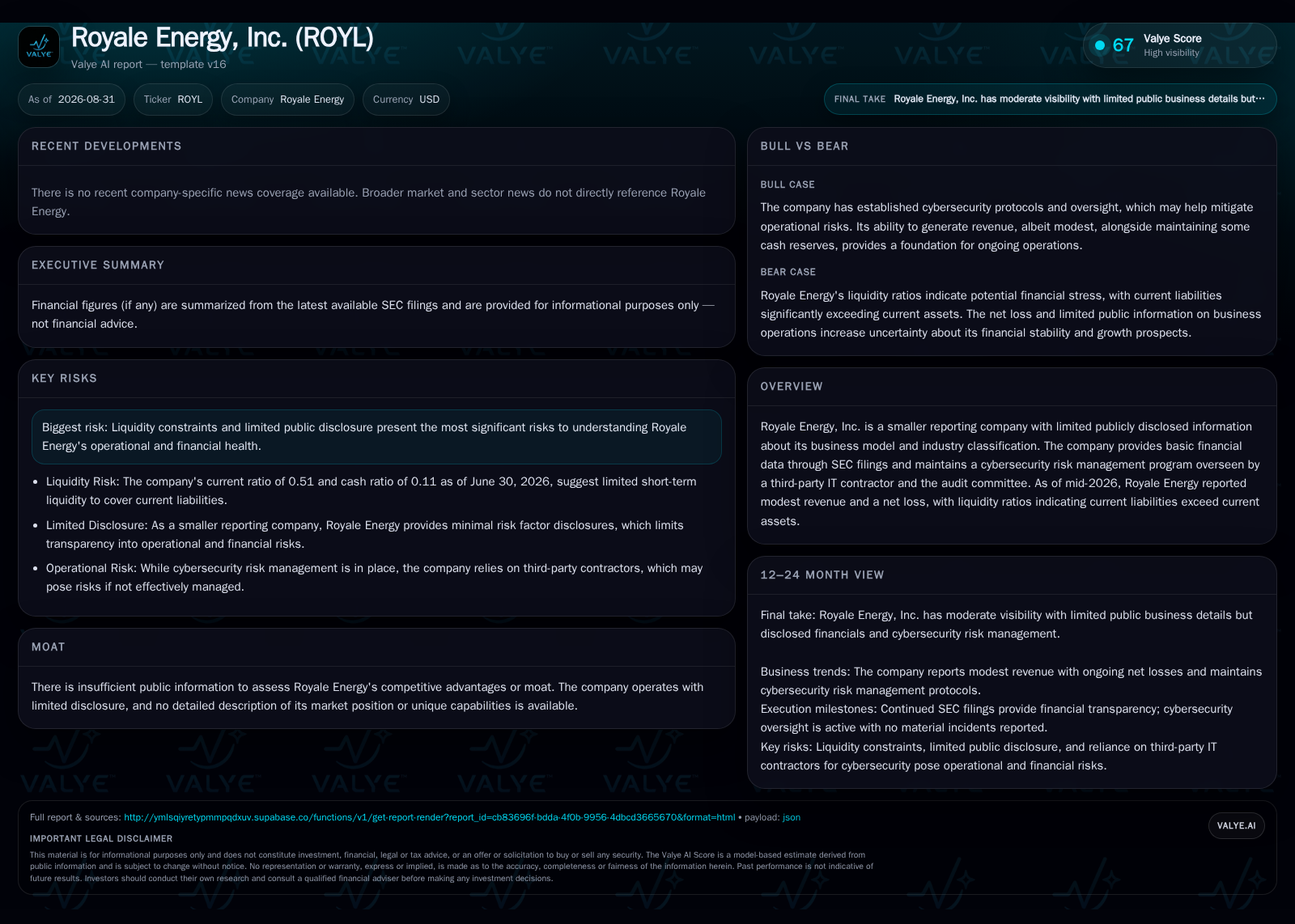
Royale Energy, a smaller reporting company with limited public disclosure, currently posts modest revenue alongside net losses and liquidity shortfalls. Its cybersecurity risk management framework reduces operational threat but reliance on third-party contractors remains a vulnerability. Absent clear competitive advantages or detailed business model insights, Royale's outlook hinges on resolving financial pressures and improving operational transparency. Key variables include cash flow improvement, enhanced financial reporting, and strategic execution that could either stabilize or further strain its viability.
Royale Energy, Inc. presents a challenging profile marked by modest revenue generation and persistent net losses amid tight liquidity conditions. Its status as a smaller reporting company with minimal risk disclosures limits insight into the underlying business model and competitive landscape. While cybersecurity oversight is actively managed externally and no material incidents have been reported, the company’s financial fragility and opaque operations raise questions about resilience and growth potential. This analysis dissects Royale’s economic structure, competitive environment, and plausible future outcomes to gauge where value may emerge or erode.
Latest Operating Snapshot
As of the second quarter of 2026, Royale Energy reported revenue of $680,141 while incurring a net loss of $813,118, resulting in negative basic and diluted earnings per share of approximately $0.01 [S2]. These figures highlight ongoing challenges in achieving profitability despite generating some top-line sales.
Liquidity metrics further underscore financial strain; the company's current ratio stood at 0.51 and cash ratio at 0.11 at June 30, 2026, meaning current liabilities more than double current assets and cash reserves cover barely a tenth of short-term obligations [S2]. Such ratios signal tight working capital conditions and potential pressure on operational continuity without capital infusion or improved cash generation.
Business Model and Unit Economics
Royale Energy operates with limited public information on its core business activities, revenue streams, or customer base, complicating detailed unit economics analysis. The modest revenue scale and ongoing losses suggest that fixed costs or capital expenditures may be high relative to sales, or that pricing and volume have yet to reach a sustainable threshold.
Given the current liquidity constraints, it is plausible that operating leverage is minimal or negative; fixed overheads could be compressing margins, while variable costs might be inflexible due to contractual or operational commitments. The company's reliance on third-party IT contractors for cybersecurity hints at outsourcing some operational functions, potentially limiting fixed cost buildup but also adding dependency risks.
Capital intensity and investment needs remain unclear, but low cash reserves relative to liabilities imply limited capacity for discretionary spending or growth funding. The path to positive operating leverage likely requires either material revenue growth, cost rationalization, or capital restructuring to reduce interest or repayment burdens.
Moat, Competition and Counterforces
No explicit competitive advantages or moats are discernible from available disclosures. Royale’s limited public profile and absence of detailed market or product information suggest it may lack differentiated offerings, scale economies, or proprietary technology that could impede competitor encroachment or create pricing power.
The company’s small scale and liquidity challenges could weaken its bargaining power with suppliers, customers, or partners, intensifying competitive pressures. The use of third-party cybersecurity services may also indicate a lack of internal capabilities that could differentiate operational reliability or security.
Competitive dynamics likely hinge on cost efficiency and operational execution rather than unique product features. Without clearer insights into industry positioning or peer comparisons, Royale is vulnerable to substitution or market share erosion unless it can carve out niche expertise or strategic partnerships.
Bull Case
In a favorable scenario, Royale successfully addresses liquidity constraints by securing capital or generating improved cash flow through scaling revenue and operational efficiency. Strengthened financial footing would enable investment in growth initiatives or cost infrastructure, enhancing margins and reducing losses.
Sustained cybersecurity risk management with no material incidents builds stakeholder confidence, potentially facilitating stronger customer or partner relationships. If the company can leverage this operational stability to expand contract wins or improve pricing, it could develop positive operating leverage and transition toward profitability.
Confirming evidence would include improved liquidity ratios, upward revenue trends, and narrower net losses in subsequent filings. Falsification would occur if cash burn accelerates, operating losses widen, or management signals inability to meet obligations.
Base Case
Royale continues operating with modest revenue growth offset by persistent losses and liquidity challenges. The company maintains cybersecurity oversight without incidents but fails to materially improve financial health or market position. Costs remain elevated relative to revenue, leaving operating leverage muted.
In this scenario, Royale’s scale and disclosure limitations persist, constraining investor visibility and valuation. The company may rely on incremental capital raises or cost controls to sustain operations without significant expansion or profitability gains.
Key confirming signals would be flat or slightly improving revenue alongside stable or slowly narrowing losses and ongoing compliance with cybersecurity protocols. Falsification would involve rapid deterioration of liquidity or operational disruptions.
Bear Case
Downside risks crystallize if Royale’s liquidity worsens, forcing distressed asset sales, debt restructuring, or operational cutbacks that impair revenue generation. Failure to manage cybersecurity risks or reliance on third-party contractors could lead to incidents undermining operational continuity or regulatory standing.
Lack of transparency and limited scale amplify investor uncertainty, potentially constraining access to new capital and accelerating financial decline. The cumulative effect could lead to insolvency or forced divestiture.
Evidence confirming this trajectory would include declining cash reserves, missed payments, increasing legal or regulatory issues, or reported cybersecurity breaches. Conversely, absence of such developments would argue against the worst-case scenario.
What Matters Next
Key metrics to watch include subsequent quarterly revenue and net income trends to assess operational improvement or further erosion. Liquidity ratios and cash flow statements will be critical to gauge short-term financial health and runway.
Disclosure enhancements or management commentary on business strategy, capital plans, and risk management would improve visibility. Monitoring any cybersecurity incidents or changes in third-party contractor arrangements is also important since these affect operational risk.
Additional useful indicators would be customer concentration data, contract terms or continued-adoption indicators (if disclosed), and capital expenditure levels. Finally, external conditions such as market demand in Royale’s sector and financing environment will influence strategic options.
Disclaimer: This is research-only, informational analysis and not investment advice. It may include AI-generated interpretation and general industry context. Always verify important details using primary sources.

Comments