
Greystone Logistics, Inc.: Navigating Customer Diversification Amid Competitive and Financial Strains in Plastic Pallet Manufacturing
Greystone Logistics manufactures recycled plastic pallets serving beverage, pharmaceutical, and other sectors amid shifting customer dynamics and sustainability-driven market growth. Balancing capacity expansion and technological investments against significant customer loss, competitive pressures, and liquidity challenges, the company’s near-term trajectory hinges on execution of diversification and operational leverage strategies.
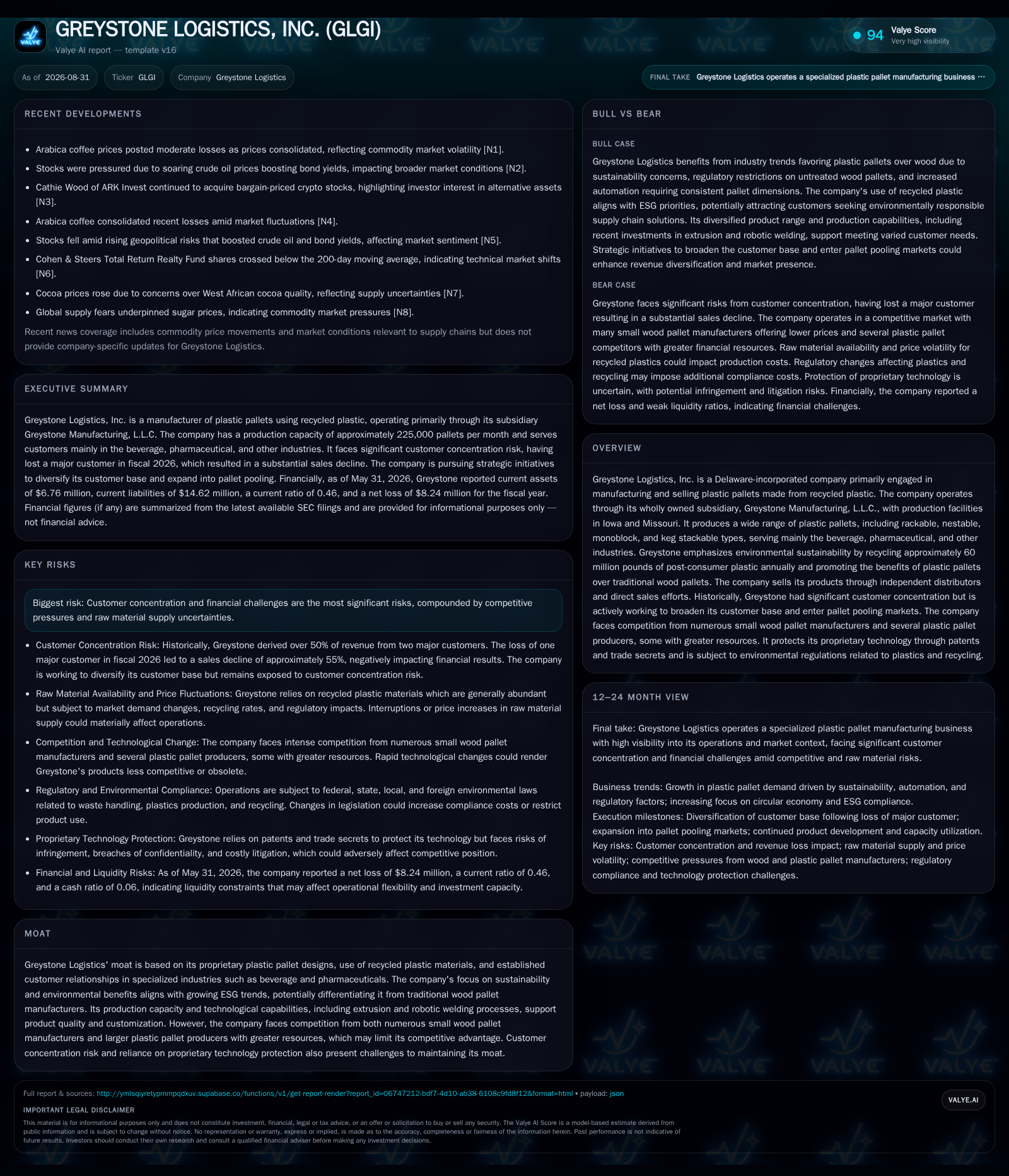
Greystone Logistics operates a specialized plastic pallet manufacturing business leveraging recycled materials aligned with sustainability trends. Despite a robust production platform and product breadth, the company faces critical hurdles from a major customer loss, resulting financial stress, and a fragmented competitive landscape dominated by wood and plastic pallet makers. Future success depends on expanding the customer base, monetizing pallet pooling, managing raw material risks, and protecting proprietary technology while navigating evolving regulatory and competitive environments.
Greystone Logistics, Inc. stands at a critical inflection point within the plastic pallet manufacturing industry. Leveraging a sizable production platform focused on recycled plastic pallets, the company taps into secular growth drivers such as sustainability, warehouse automation, and regulatory restrictions on wood pallets. However, the steep decline in revenue following the loss of a major customer in fiscal 2026 has exposed vulnerabilities in customer concentration and liquidity. The company’s ability to execute on diversification strategies and expand into pallet pooling will be decisive in stabilizing top-line growth and improving profitability amid intensifying competition and raw material cost pressures.
Latest Operating Snapshot
As of May 31, 2026, Greystone Logistics reported current assets of $6.76 million against current liabilities of $14.62 million, reflecting a current ratio of 0.46 and a cash ratio of 0.06, highlighting liquidity constraints [S1]. The fiscal year ended with a net loss of $8.24 million and a negative EPS of $0.30, indicating operational and financial challenges. The company’s production capacity stands at approximately 225,000 pallets per month across 14 injection molding machines in Bettendorf, IA, and Palmyra, MO, supplemented by newer extrusion and robotic welding capabilities at a Jasper, IN facility, enabling manufacture of specialized pallet sizes from recycled plastics [S1].
A significant operating event was the loss of a major customer in fiscal 2026, which resulted in a sales decrease of roughly $30 million or 55%, shifting the revenue mix so no single customer now exceeds 10% of total sales [S1]. The company is actively pursuing customer diversification and exploring pallet pooling business models to stabilize revenue streams and reduce concentration risk. Additionally, Greystone recycles about 60 million pounds of post-consumer plastic annually, underpinning its ESG differentiation and alignment with sustainability trends in supply chains [S1].
Business Model and Unit Economics
Greystone’s business model centers on manufacturing plastic pallets primarily from recycled high-density polyethylene (HDPE) sourced from various local and national suppliers. The core revenue driver is pallet sales to beverage, pharmaceutical, and other industrial customers, sold through a mix of independent distributors and direct sales. The company’s product breadth spans rackable, nestable, monoblock, and specialty pallets, enabling customization for client-specific operational needs. The manufacturing process involves capital-intensive fixed assets—14 injection molding machines plus extrusion and robotic welding capacity—with variable costs dominated by recycled plastic input prices and energy consumption [S1].
Operating leverage is a material factor: once fixed manufacturing capacity is absorbed, incremental volume growth can improve margins, provided recycled plastic costs remain stable. However, high fixed costs mean that volume declines significantly depress profitability, as evidenced by the recent loss of a major customer and resultant sales drop. The company also provides grinding and pelletizing services, generating fee revenue and facilitating vertical integration in recycled plastic processing. Pricing power hinges on delivering total cost of ownership benefits over wood pallets—through longer lifespan, consistency, and sustainability claims—although competitive pressures may limit pricing flexibility, especially from lower-cost wood pallet providers.
Moat, Competition and Counterforces
Greystone’s moat is anchored in its proprietary pallet designs, in-house recycled plastic processing capabilities, and established customer relationships in regulated sectors like pharmaceuticals and beverage, where pallet specifications and approval processes impose switching frictions. Its commitment to sustainability and significant recycled plastic usage aligns with ESG trends, creating potential differentiation versus traditional wood pallet manufacturers, which dominate the fragmented global pallet market [S1]. The company’s range of pallet types and recent investments in extrusion and robotic welding enhance product customization and quality consistency, supporting competitive positioning.
Nonetheless, the company faces intense competitive counterforces. The wood pallet segment includes numerous small, price-focused manufacturers competing primarily on cost, while plastic pallet competitors with greater scale and resources threaten market share and innovation pace. Customer concentration and revenue dependency on few large buyers amplify risk. Protection of proprietary technology via patents and trade secrets is a moat component but carries inherent risks of infringement and litigation, potentially eroding competitive advantage. Furthermore, raw material supply disruptions or price volatility could reduce cost competitiveness compared to wood alternatives or larger plastic producers with integrated supply chains.
Bull Case
In a favorable scenario, Greystone capitalizes on accelerating substitution of wood pallets with plastic to meet growing ESG and regulatory demands, as well as the rise of automation requiring uniform pallet dimensions and durability. The company’s extensive use of recycled plastic positions it well with customers prioritizing sustainability and circular economy principles. Continued execution on diversifying the customer base reduces concentration risk and stabilizes revenue. Success in pallet pooling initiatives could create recurring revenue streams and deepen customer relationships, leveraging operational leverage in production capacity to improve margins.
Confirming evidence would include sustained or growing order volumes from diversified customers, stable or improving raw material costs, and positive margin trends from higher capacity utilization. Further patent approvals or technological improvements enhancing product differentiation would bolster the moat. Falsification would occur if new customer wins remain limited, pallet pooling fails to scale, or raw material prices spike materially without offsetting pricing power, leading to continued losses and liquidity deterioration.
Base Case
Under the base case, Greystone manages to partially recover from the major customer loss by modestly expanding its customer portfolio and stabilizing revenues, albeit without substantial growth. The company maintains its current production capacity utilization levels, balancing fixed costs with incremental volume to avoid further margin erosion. Pallet pooling initiatives progress slowly, constrained by sales cycles and operational complexities. Raw material prices remain volatile but manageable, with the company passing some costs through pricing adjustments. Competitive pressures persist but do not materially erode market share.
Financial performance remains challenged but gradually improves, with losses narrowing as operational efficiencies and cost controls take effect. The proprietary technology portfolio prevents immediate competitive threats but does not lead to substantial new product breakthroughs. ESG alignment continues to resonate with customers but does not translate into significant pricing premiums. This scenario is contingent on steady macroeconomic conditions and no major regulatory shifts adverse to plastic pallet usage or recycled plastics supply.
Bear Case
In the downside scenario, Greystone’s customer diversification efforts falter, failing to replace lost volume from its major customer, resulting in continued revenue declines and underutilized production capacity. Intense competition from lower-cost wood pallet suppliers and plastic manufacturers with deeper pockets erodes pricing power and market share. Raw material costs rise sharply due to recycling supply constraints or regulatory changes, compressing margins further. Proprietary technology is challenged by litigation or infringement, weakening the company’s competitive position.
Liquidity pressures intensify, limiting the company’s ability to invest in capacity enhancements or innovation, thereby initiating a negative feedback loop of competitive disadvantage and financial strain. Regulatory developments imposing stricter controls or higher compliance costs on plastics production and recycling exacerbate operational difficulties. Confirming evidence includes sustained losses, customer attrition, adverse patent disputes, and deteriorating working capital metrics. Falsification would require unexpected large customer wins, stable input costs, or regulatory relief.
What Matters Next
Key performance indicators to monitor include: (1) Customer revenue diversification progress, specifically the percentage of revenue from top customers and new customer acquisition rates; (2) Production capacity utilization rates reflecting volume recovery and operational efficiency; (3) Raw material input cost trends and recycling supply stability, critical for margin management; (4) Progress and financial impact of pallet pooling initiatives, a potential driver of recurring revenue; (5) Operating margin trajectory and net profitability as indicators of financial health; (6) Liquidity metrics such as current ratio and cash on hand to assess potential financial flexibility; (7) Patent portfolio developments and litigation outcomes impacting technology moat; and (8) Regulatory changes affecting plastics manufacturing, recycling, and environmental compliance costs.
Regular disclosure or insight into these metrics will help gauge the company’s execution against its strategic initiatives and resilience to competitive and market risks. Improvements in customer diversification and pallet pooling monetization would support a more optimistic outlook, whereas worsening liquidity or raw material disruptions would raise concerns.
Disclaimer: This is research-only, informational analysis and not investment advice. It may include AI-generated interpretation and general industry context. Always verify important details using primary sources.

Comments