
Super Micro Computer Inc (SMCI) Deep-Dive: Navigating AI-Driven Demand Amid Operational and Regulatory Challenges
Super Micro leverages its specialized server hardware expertise to capture AI data center growth, supported by reported liquidity position and rising earnings expectations. Yet customer concentration, supply chain dependencies, and stringent export controls impose material risks that could shape its near-term trajectory.
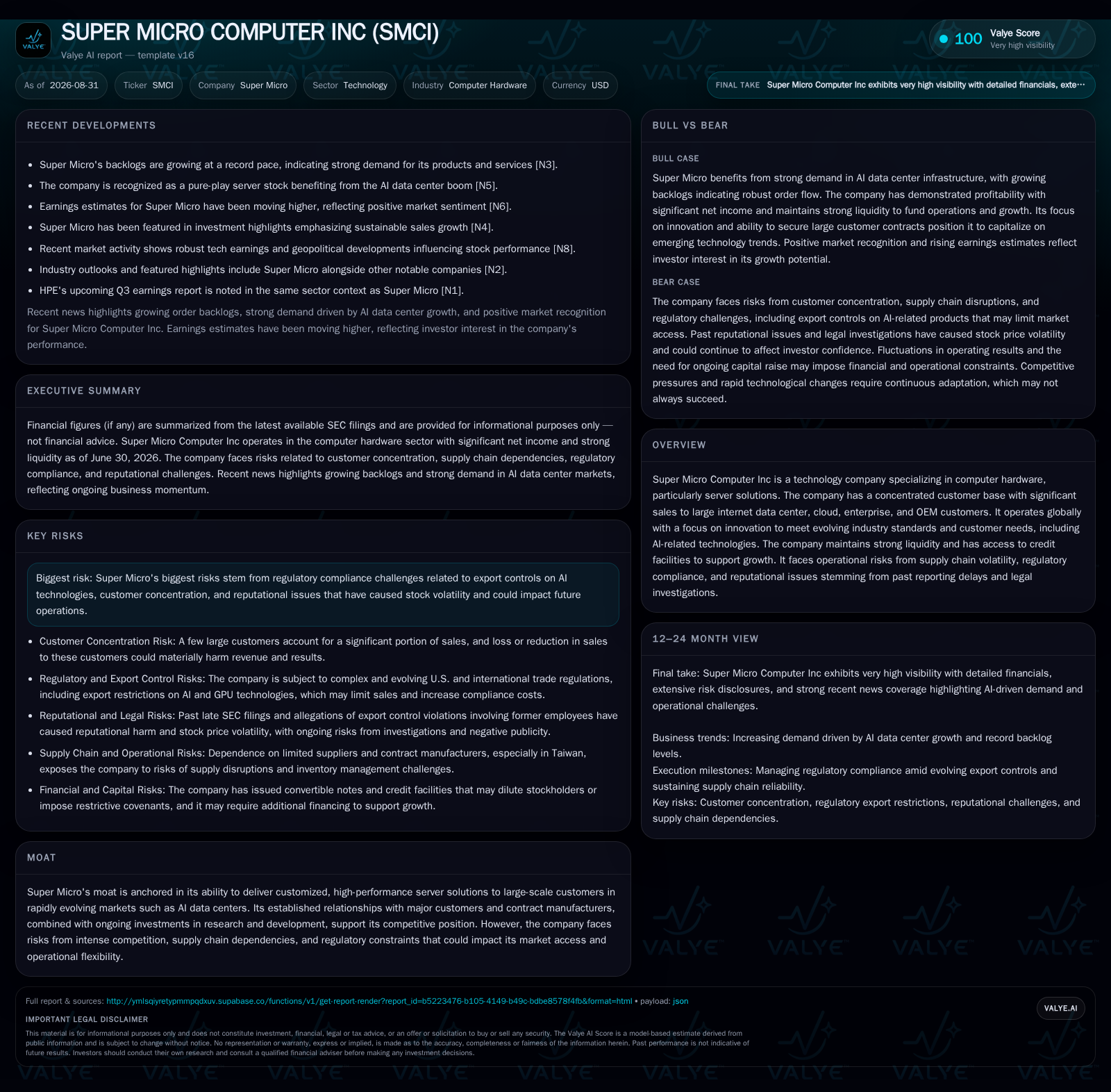
Super Micro Computer Inc is capitalizing on robust AI data center demand, evidenced by record backlog growth and positive market recognition. The company’s business model hinges on delivering customized, high-performance server solutions to large customers, supported by reported liquidity position and operational scale. However, significant customer concentration, supply chain vulnerabilities centered in Taiwan, and evolving U.S. export controls on AI technologies present ongoing risks. Its moat depends on technological innovation and deep customer relationships, but regulatory and competitive pressures could constrain growth. Key metrics to monitor include backlog trends, customer diversification, regulatory compliance progress, and supply chain resilience.
Super Micro Computer Inc (SMCI) stands at a pivotal juncture in the computer hardware sector, propelled by surging demand for AI data center infrastructure and recognized as a pure-play beneficiary of this secular trend. The company reported robust net income of $2.23 billion for fiscal 2026 and maintains reported liquidity position with over $7.5 billion in cash and equivalents, underpinning its capacity to fund growth amid market uncertainties. However, ongoing operational risks from supply chain concentration in Taiwan, customer dependency, and complex U.S. export controls on AI technologies temper its outlook. This analysis dissects Super Micro’s business model economics, competitive positioning, and regulatory landscape to gauge its strategic runway and risk profile going forward.
Latest Operating Snapshot
Super Micro’s backlog is expanding at a record pace, reflecting accelerating demand for its server solutions driven primarily by AI data center growth [N3]. This backlog growth serves as a leading indicator of near-term revenue momentum and suggests the company is securing large, complex orders from hyperscale cloud and enterprise customers.
The company reported a substantial net income of $2.23 billion in fiscal 2026, with basic EPS of $3.65, supported by strong operational execution and favorable product mix [S1]. Its liquidity position remains robust, holding $7.52 billion in cash and equivalents alongside $23 million in short-term investments, resulting in a healthy current ratio of 3.87 and a cash ratio above 1.0. These financial metrics provide a buffer against market volatility and enable continued investment in R&D and capacity expansion.
However, Super Micro’s revenue exhibits significant customer concentration, with at least one customer representing over 10% of net sales in 2026 [S1]. This concentration heightens exposure to contract renewals and pricing pressures from large customers. Additionally, the company faces operational risks tied to its supply chain, heavily reliant on Taiwanese contract manufacturers, which could be disrupted by geopolitical tensions or logistical bottlenecks.
Regulatory compliance remains a salient risk factor. The company operates under complex U.S. and international export control regimes, especially regarding AI-related hardware exports to China and Eastern Europe. While Super Micro has taken steps to comply, evolving restrictions could limit addressable markets and increase compliance costs [S1].
Business Model and Unit Economics
Super Micro’s revenue derives primarily from the design, manufacture, and sale of custom server hardware solutions tailored to large-scale data center operators, cloud providers, and OEMs. Pricing tends to be volume- and configuration-dependent, influenced by product mix and customer specifications. High-performance AI-optimized servers command premium pricing due to specialized components and engineering complexity.
The company’s cost structure includes significant variable costs for components sourced through a limited supplier base, particularly in Taiwan. Fixed costs encompass R&D expenditures to maintain technological edge and manufacturing overhead. Operating leverage could emerge if growing AI demand drives higher volumes while fixed R&D and SG&A costs remain relatively stable, improving margin profiles.
Capital intensity is moderate to high, given the need for investments in R&D, supply chain infrastructure, and inventory to meet fluctuating customer demand. However, Super Micro’s strong cash reserves and credit facilities provide flexibility to fund these capital needs without immediate dilution or external financing.
Unit economics hinge on efficiently balancing supply chain agility against component cost volatility and maintaining customer relationships to secure repeat orders. Volume growth in AI data center deployments can improve scale economics, but the company’s reliance on a few large customers increases risk if demand contracts or competitive pressures intensify.
Moat, Competition and Counterforces
Super Micro’s moat is rooted in its ability to deliver highly customized, high-performance server solutions aligned with rapidly evolving AI workloads and data center architectures. Its longstanding relationships with major hyperscalers and enterprise customers facilitate trusted collaboration and recurring order flow. The company’s investment in R&D supports technological differentiation, enabling it to address niche performance and integration needs.
However, the competitive landscape is intense, featuring global OEMs, established server vendors, and emerging cloud infrastructure specialists. Scale advantages enjoyed by larger competitors may pressure pricing and limit Super Micro’s market share gains. Additionally, rapid technological shifts in AI hardware and software stack evolution require continuous innovation and capital investment.
Supply chain concentration, especially reliance on Taiwanese contract manufacturers, constitutes a counterforce to durability. Geopolitical risks or disruptions could impair production continuity and delivery timelines, eroding customer trust. Furthermore, regulatory constraints related to export controls impose additional barriers to market expansion, particularly in China, which remains a significant end market for hardware vendors.
Reputational risks stemming from previous late SEC filings and export control allegations contribute to investor wariness, potentially affecting customer and partner confidence. Maintaining compliance and transparent governance is vital to sustaining competitive positioning.
Bull Case
In a bullish scenario, Super Micro capitalizes on the accelerating secular growth in AI data center infrastructure demand, achieving sustained record backlog increases that convert efficiently into revenue. Its ability to offer differentiated, high-performance server solutions tailored to AI workloads, combined with strong customer relationships, enables it to capture market share from incumbents.
Strong operating leverage develops as volume growth outpaces fixed R&D and SG&A costs, leading to expanding margins and robust free cash flow generation. The company’s ample liquidity and credit capacity support strategic investments in supply chain diversification and technology innovation, further strengthening its moat. Positive regulatory developments or effective compliance management mitigate export control restrictions, enabling broader access to international markets, including China.
Confirming evidence would include consistent quarter-over-quarter backlog growth, improving gross and operating margins, expanding customer diversification beyond a few large contracts, and successful navigation of trade regulations without material sales disruptions. Falsification would arise if order growth stalls, margins compress due to pricing pressures or supply disruptions, or regulatory changes severely restrict market access.
Base Case
Under the base case, Super Micro continues to benefit from solid AI-driven demand, with backlog growth remaining strong but at a moderated pace reflecting competitive pressures and macroeconomic variability. Revenue and earnings grow steadily but with some volatility due to customer concentration and supply chain constraints.
Operating leverage improves gradually as the company scales, but margin expansion is partially offset by rising compliance and logistics costs linked to navigating complex export controls. Supply chain risks persist but are managed through incremental diversification efforts. Customer reliance remains a concern, but contract renewals and modest new logos support revenue stability.
In this scenario, the company maintains reported liquidity position to fund ongoing R&D and working capital needs without needing dilutive financing. Regulatory compliance efforts prevent major disruptions, though market access to some geographies remains restricted. Confirming signals would be stable to growing backlog figures, steady margin trends, and transparent regulatory disclosures. Evidence counter to this would include material order cancellations, widening losses, or significant regulatory penalties.
Bear Case
The bear case materializes if Super Micro faces a sharp contraction in key customer orders due to demand slowdowns or contract losses, exacerbated by intensified pricing competition. Disruptions in its Taiwan-centric supply chain could significantly delay deliveries, damage customer relationships, and inflate costs, undermining profitability.
Regulatory headwinds worsen with stricter U.S. export controls on AI-related hardware, effectively barring sales to critical international markets, particularly China and Eastern Europe. Compliance costs soar, and legal or reputational issues resurface from past export control violations, further eroding investor and customer confidence.
Under this scenario, operating results fluctuate substantially, liquidity tightens due to increased working capital needs or capital expenditures, and the company may need to raise capital under unfavorable terms, diluting equity holders. Confirming evidence would be declining backlog, widening losses, regulatory sanctions, or publicized supply chain failures. Falsification would require strong order inflows, stable regulatory environment, and effective supply chain risk mitigation.
What Matters Next
Key metrics to monitor include: 1) Backlog growth rates and quality to assess demand sustainability and order conversion; 2) Customer concentration trends, specifically revenue diversification beyond top clients to reduce dependency risk; 3) Gross and operating margin progression as a proxy for pricing power and operating leverage; 4) Supply chain health indicators such as lead times, inventory levels, and supplier diversification efforts; 5) Regulatory compliance developments including export license approvals, restrictions, or investigations outcomes; 6) Capital expenditure and R&D spending trends reflecting investment in innovation and capacity; 7) Cash flow and liquidity position to evaluate potential financial flexibility; 8) Market share shifts relative to competitors in AI server hardware segments.
Additional qualitative milestones include management commentary on geopolitical risk mitigation, progress on reputational issues, and new product introductions aligned with AI workloads. Given the dynamic regulatory and competitive landscape, continuous updates on trade policies and industry standards will be critical to understanding the company’s evolving risk/reward profile.
Disclaimer: This is research-only, informational analysis and not investment advice. It may include AI-generated interpretation and general industry context. Always verify important details using primary sources.

Comments