
Palo Alto Networks: Platformization, AI Security, and the Economics of Cyber Consolidation
Palo Alto Networks’ push into integrated AI-powered platforms and observability aims to reshape enterprise cybersecurity economics, but operational complexity, customer concentration, and the evolving risk landscape present material challenges to sustainable growth.
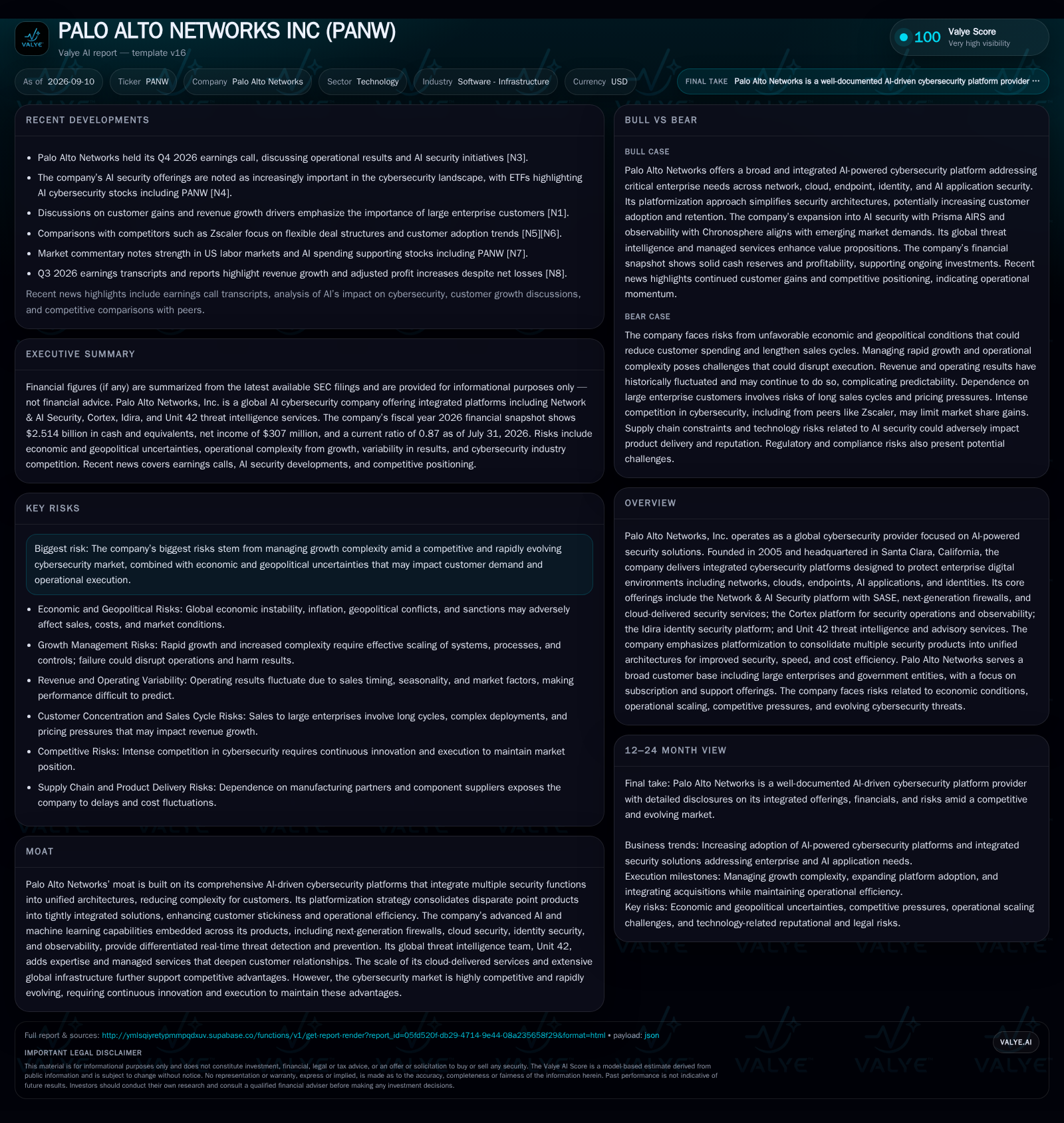
Palo Alto Networks continues to expand its AI-driven cybersecurity and observability offerings, leveraging a broad product suite and recent acquisitions to address the complex needs of large enterprises. While the company reported net income of $307 million for the fiscal year ending July 31, 2026, and maintains a substantial cash position, its current ratio of 0.87 highlights near-term liquidity pressures. The company’s strategy relies on platform consolidation, but faces risks from long enterprise sales cycles, intense competition, and the operational demands of growth and integration. Key to the investment thesis are the adoption of AI security solutions, execution on platform expansion, and the ability to manage complexity without margin erosion. [S1] [N3] [N6]
Palo Alto Networks, a leading global provider of AI-driven cybersecurity solutions, is at a strategic crossroads as it seeks to consolidate its position in an increasingly crowded and technologically dynamic market. The company’s platformization approach—integrating network, cloud, endpoint, identity, and AI application security—aims to simplify customer environments and enhance retention. Financially, Palo Alto Networks reported solid profitability for the fiscal year ending July 31, 2026, but with a current ratio below 1 and a mounting operational footprint post-acquisition, the company faces near-term liquidity and execution risks. The ultimate test lies in whether its AI-powered platforms can deliver both security outcomes and scalable economics amid surging demand and intensifying competition. [S1] [N3] [N6]
Latest Developments: Liquidity, Profitability, and Platform Expansion
Palo Alto Networks ended its fiscal year on July 31, 2026 with $307 million in net income and $2.514 billion in cash and equivalents, reflecting ongoing profitability and a robust cash reserve. However, a current ratio of 0.87 and a cash ratio of 0.34 indicate that near-term liabilities exceed current assets, pointing to a tighter liquidity position than many peers in the software infrastructure segment. This financial posture is particularly relevant given the company’s recent headcount and customer base growth, much of it attributable to the CyberArk acquisition, which adds operational complexity and integration risk. [S1]
Recent earnings calls and news coverage emphasize the company’s continued focus on AI-driven cybersecurity, with operational momentum reportedly visible in customer wins and competitive positioning against players like Zscaler. However, the company’s sales and revenue growth are heavily reliant on expanding its platform and subscription offerings to large enterprise customers—a segment known for slow, complex sales cycles and high expectations for product integration and service. [N3] [N6]
How Platformization Could Transform Cybersecurity Economics
Palo Alto Networks’ economic model depends on consolidating multiple point solutions—network security, endpoint protection, identity, AI application security, and observability—into unified platforms such as Prisma AIRS, Cortex, and Idira. This platformization strategy is designed to drive higher customer lifetime value through broader product adoption, stickier relationships, and the potential for bundled pricing. The company’s revenue mix is likely weighted towards subscriptions and support, which, if structured as multi-year contracts, could enhance revenue visibility and margin stability—though the actual contract mechanics are not detailed in the current disclosures.
The primary lever for operating leverage is expanding wallet share within existing customers, particularly large enterprises and government entities. However, scaling this approach requires significant ongoing investments in R&D, sales, and customer support, as well as seamless integration of acquired technologies. Fixed costs related to cloud infrastructure, threat intelligence, and AI model development are high, but variable costs per incremental customer may decline if platform adoption accelerates. The challenge is to balance these investments against the risk of margin compression from pricing pressure or the need to meet demanding enterprise requirements.
Capital needs remain a consideration given the company’s sub-1.0 current ratio. While the absolute cash balance provides a buffer, substantial near-term obligations could constrain flexibility for further acquisitions or aggressive R&D expansion unless operating cash flow remains strong or external financing is accessed. [S1]
Competitive Landscape: Integrated Platforms Versus Point Solutions
The cybersecurity market is characterized by rapid innovation and intense competition from both established players and emerging specialists. Palo Alto Networks’ principal competitors include other integrated platform providers as well as best-of-breed point solution vendors in areas like cloud security, SASE (Secure Access Service Edge), and identity management. Companies such as Zscaler, CrowdStrike, and Fortinet represent relevant peer groups, each with their own approach to platform breadth, cloud-native architecture, and AI integration.
Palo Alto Networks’ competitive advantage may lie in its breadth of integrated offerings and its ability to address security needs across network, endpoint, identity, and AI workloads. The platformization model could increase switching costs for customers who standardize on Palo Alto’s architecture, though this advantage is contingent on seamless integration and demonstrable security outcomes. Counterforces include the risk of customer preference for specialized solutions, the operational friction of integrating acquired technologies, and the ability of competitors to innovate rapidly or undercut on price.
The emergence of AI-specific security needs and the proliferation of agentic applications create new vectors for differentiation, but also invite competition from both horizontal (broad security vendors) and vertical (AI security specialists) entrants. Sustained leadership will require not just breadth, but demonstrable efficacy in real-world threat prevention and response.
What Success Looks Like: Efficient Platform Adoption and Margin Expansion
In a favorable scenario, Palo Alto Networks successfully executes on its platformization strategy, driving rapid adoption of integrated security solutions across its large enterprise and government customer base. Cross-selling of AI-powered modules—such as Prisma AIRS for AI lifecycle security and Chronosphere for observability—could increase average revenue per customer and reduce churn, while bundled offerings may improve gross margins by lowering per-product selling and support costs.
Confirmation of this scenario would come from disclosed metrics such as accelerating growth in multi-product platform adoption, expansion of recurring subscription revenue, and visible operating margin improvement. Additional evidence would include successful integration of acquired assets (e.g., CyberArk), increasing customer renewal rates, and continued net income growth despite elevated R&D and integration expenses. If Palo Alto Networks can demonstrate that its AI and automation capabilities materially improve customer security posture and operational efficiency, it could command premium pricing and defend its market share against both legacy and new entrants.
Falsification would be evident if customer adoption stalls, integration issues delay new product rollouts, or gross margin declines despite revenue growth—suggesting that platform complexity or competitive pressures are eroding the economic benefits of consolidation.
Steady-State Growth Amid Complexity and Competition
The most plausible scenario is one where Palo Alto Networks continues to grow its top line at a moderate pace by expanding its footprint within existing large enterprise accounts and incrementally winning new business, but faces ongoing operating complexity and margin pressures. Platform adoption advances, but is tempered by long sales cycles, integration challenges, and the need to keep pace with rapid technological change.
In this scenario, the company maintains profitability but sees only gradual improvement in operating leverage as the costs of scaling, integrating acquisitions, and supporting complex deployments offset some efficiency gains. Evidence supporting this path would include stable or modestly expanding operating margins, ongoing growth in subscription and support revenue, and continued expansion of the customer base without a substantial increase in net income or free cash flow. Conversely, a marked deterioration in margins, rising customer churn, or persistent liquidity tightness would signal that the company is struggling to translate platform breadth into sustainable economics.
When Complexity Outpaces Execution: Margin Squeeze and Growth Disruption
The adverse scenario unfolds if Palo Alto Networks’ operational complexity—driven by rapid growth, acquisitions, and platform integration—outstrips its ability to execute efficiently. Prolonged integration issues, customer dissatisfaction with product interoperability, or a failure to keep up with evolving cyber threats (particularly in AI security) could result in stalled revenue growth, increased churn, and margin compression.
This scenario would likely be confirmed by a combination of missed revenue targets, declining operating margins, and negative operating cash flow. Additional warning signs would include a rising need for external financing due to liquidity constraints, loss of major enterprise customers to competitors, and publicized security incidents that damage the company’s reputation. If competitors with more agile architectures or specialized solutions win share, Palo Alto Networks could be forced into price competition, further eroding profitability.
Falsification of this scenario would require evidence of successful integration, positive customer feedback, and sustained or improving profitability even as the company scales.
Milestones That Will Shape Palo Alto Networks’ Platform Ambition
Growth in multi-product platform adoption rates—if disclosed—would clarify whether customers are consolidating around Palo Alto’s integrated offerings versus mixing point solutions.
Subscription and support revenue as a share of total revenue would help test the shift toward recurring, high-visibility business.
Gross and operating margin trends: Sustained improvement would support the thesis of platform-driven operating leverage; compression would suggest integration or pricing pressures.
Net customer retention and churn rates (if disclosed) would illuminate the stickiness of the platform approach and competitive dynamics.
Integration progress on recent acquisitions, particularly CyberArk, including cost synergies, cross-selling success, and product interoperability milestones.
Operating cash flow generation versus near-term liabilities: A widening gap would raise questions about potential financial flexibility and funding needs.
Disclosure of AI security module adoption, such as Prisma AIRS and Chronosphere, would indicate traction in emerging security domains.
Any notable security incidents or customer losses, especially among large enterprises, would test the platform’s real-world efficacy and reputational resilience.
Disclaimer: This is research-only, informational analysis and not investment advice. It may include AI-generated interpretation and general industry context. Always verify important details using primary sources.

Comments