
Torrid Holdings: Liquidity Strains and the Challenge of Profitable Niche Retail
Torrid Holdings, a specialist in plus-size apparel retailing, faces mounting liquidity pressures and operational volatility. While its niche positioning offers some differentiation, recent quarterly results highlight the difficulty of maintaining profitability and stability in a sector buffeted by shifting consumer trends, intense competition, and rising financial constraints.
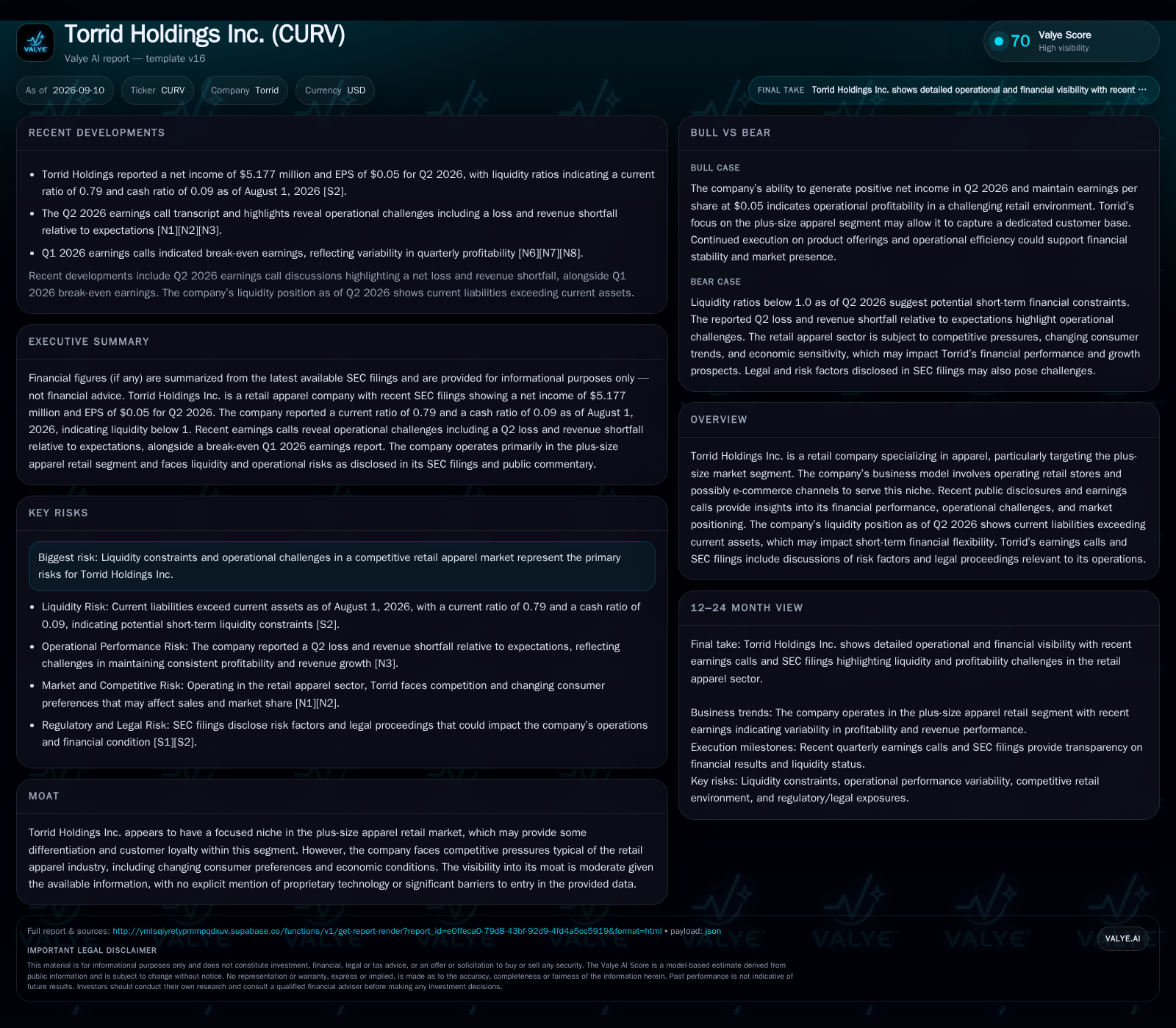
Torrid Holdings reported net income of $5.177 million and EPS of $0.05 for Q2 2026, but the company’s current ratio of 0.79 and cash ratio of 0.09 point to significant liquidity constraints. Recent earnings calls reveal variable profitability, including a Q2 revenue shortfall and previous break-even performance. Torrid’s focus on the plus-size apparel niche provides some differentiation, but the company faces operational, competitive, and financial risks that could shape its future trajectory. [S2] [N1] [N2] [N3] [N6] [N7] [N8]
Torrid Holdings, a retailer specializing in plus-size apparel, finds itself at a crossroads as liquidity tightens and operational results fluctuate. While the company reported a Q2 2026 net income of $5.177 million, its current and cash ratios—at 0.79 and 0.09, respectively—signal a precarious financial position that could constrain flexibility. The broader context of unpredictable earnings, a competitive retail environment, and changing consumer preferences adds complexity to Torrid’s outlook. The key question is whether its niche focus can drive durable differentiation and profitability, or if mounting financial and operational pressures will force strategic retrenchment or restructuring.
Recent Results Spotlight Liquidity and Profitability Volatility
Torrid Holdings reported a net income of $5.177 million for the quarter ending August 1, 2026, with basic and diluted EPS of $0.05. However, this operational profitability is overshadowed by a current ratio of 0.79 and a cash ratio of 0.09, both well below conventional safety thresholds in retail. These figures indicate that current liabilities exceed current assets, and that the company’s cash reserves are minimal relative to its obligations. Recent earnings calls further highlight variability, with a Q2 revenue shortfall and a break-even Q1, underscoring the unpredictability of Torrid’s operating results and the strain on its liquidity. [S2] [N1] [N2] [N3] [N6] [N7] [N8]
How Torrid’s Retail Model Drives Cash Flow—And Where It Breaks Down
Torrid’s core business model is built on selling plus-size apparel through a combination of physical retail stores and, likely, e-commerce channels. Revenue is a function of pricing, volume, and product mix, with gross margins influenced by inventory management, markdowns, and sourcing costs. Fixed costs—such as leases, store labor, and corporate overhead—can create leverage in periods of strong sales, but expose the company to losses during downturns. Variable costs, including cost of goods sold and sales commissions, scale with revenue.
Liquidity is a mounting concern: with current assets of $186.537 million and current liabilities of $234.861 million as of August 1, 2026, Torrid’s ability to cover short-term obligations without external funding is constrained. This could limit inventory purchases, marketing investments, or store refreshes—initiatives that are often critical for driving traffic and sales in retail. If Torrid is forced to discount heavily to move inventory or cannot invest in customer experience, profit margins may erode further. The risk is a negative feedback loop: liquidity pressures drive operational cuts, which in turn threaten sales and profitability.
The interplay between fixed and variable costs in Torrid’s model creates a delicate balance that amplifies financial risk during demand fluctuations. High fixed costs, such as long-term lease commitments and salaried personnel, limit the company’s ability to rapidly adjust expenses in response to revenue declines. This rigidity can exacerbate liquidity pressures when sales soften unexpectedly. Conversely, variable costs tied directly to sales volumes provide some flexibility, but only to the extent that revenue sustains them. The timing mismatch between cash inflows from sales and outflows for fixed obligations can strain working capital, especially if inventory turnover slows or receivables extend. Understanding this dynamic is critical for assessing how operational volatility translates into financial stress.
Differentiation in Plus-Size Apparel: Moat or Mirage?
Torrid’s strategic focus on the plus-size segment offers a degree of differentiation in an otherwise crowded apparel landscape. This niche can foster brand loyalty, repeat purchases, and targeted merchandising that mass-market competitors may overlook. However, barriers to entry are modest: established retailers and new digital-native brands can and do compete in extended sizing, often leveraging broader assortments or superior supply chains.
Competitive threats include fast-fashion chains, direct-to-consumer upstarts, and legacy department stores expanding their plus-size offerings. E-commerce platforms intensify price transparency and reduce switching costs, making it harder to sustain premium pricing or loyalty absent a compelling proposition. In this context, Torrid’s moat appears limited—its advantage is likely more a function of brand recognition and merchandising agility than structural barriers.
The competitive landscape in plus-size apparel is evolving, with the entry of digitally native brands leveraging data analytics and agile supply chains to tailor offerings rapidly. These competitors often operate with lower overhead and can experiment with limited runs or personalized products, challenging traditional retailers like Torrid. The relative ease of product differentiation in apparel means that brand loyalty can be fleeting unless supported by consistent quality, fit, and community engagement. Moreover, consumer expectations for inclusivity and diversity in marketing add complexity to brand positioning. Torrid’s ability to maintain relevance depends not only on product assortment but also on cultivating an authentic connection with its target demographic amidst intensifying competition.
If Niche Loyalty and Operational Discipline Converge
A favorable outcome for Torrid hinges on two reinforcing factors: sustained customer loyalty in the plus-size category and disciplined operational execution. If Torrid can leverage its brand to drive repeat purchases, optimize inventory, and control costs, it could stabilize profitability and gradually rebuild liquidity. Signs of this scenario would include sequential improvement in gross margin, positive same-store sales growth, and a rising current ratio—suggesting that operational cash flow is outpacing short-term liabilities.
Further confirmation would come from evidence of market share gains in the plus-size segment, expansion of private-label or exclusive products, and measured growth in e-commerce penetration. If the company successfully renegotiates debt or secures external financing on favorable terms, the risk of a liquidity crunch could abate, supporting investment in customer experience and digital capabilities.
Volatile Performance Amidst Competitive and Financial Headwinds
The most plausible near-term path is one of continued volatility: Torrid ekes out intermittent quarters of profitability but remains hamstrung by liquidity constraints and competitive pressures. Revenue may stabilize or grow modestly if consumer demand for plus-size apparel holds, but margin compression is likely as the company balances promotional activity with inventory management. Cash flow may remain tight, forcing ongoing scrutiny of capital allocation and possibly necessitating asset sales or incremental financing.
Evidence supporting this scenario would include choppy quarter-to-quarter earnings, limited improvement in liquidity ratios, and persistent commentary about cost control and operational discipline on earnings calls. The absence of clear market share gains or transformative product launches would reinforce the view that Torrid is treading water rather than breaking out.
Liquidity Squeeze Triggers Strategic Retrenchment or Restructuring
The adverse scenario is defined by a further deterioration in liquidity, with the company unable to meet near-term obligations without asset sales, debt restructuring, or an equity raise. In this case, Torrid may be forced to shutter underperforming stores, slash marketing, or undertake a formal restructuring process. The brand’s differentiation in plus-size apparel may not be sufficient to offset the operational and financial headwinds.
Signs of this outcome would include declining sales, negative operating cash flow, missed debt payments, vendor disputes, or adverse legal outcomes as described in recent SEC filings. If the company’s current ratio falls further, or if major credit lines are reduced or withdrawn, the risk of a liquidity event increases. A shrinking store base or management turnover would provide further evidence of distress.
Milestones and Metrics That Will Clarify Torrid’s Viability
Quarterly trends in current ratio and cash ratio: sustained improvement would signal successful liquidity management, while further decline would increase risk. [S2]
Gross margin performance and inventory turn: margin expansion and faster inventory turnover could indicate effective merchandising and cost control.
Same-store sales growth: positive comps would suggest brand resonance and customer loyalty.
E-commerce penetration and digital sales growth: rising share of digital revenue may support margin resilience and broaden reach.
Evidence of successful refinancing, debt renegotiation, or new credit facilities: such developments would relieve short-term liquidity pressure.
Store count and real estate strategy: closures or consolidation would signal retrenchment, while selective opening or remodeling could indicate confidence.
Management commentary on legal and regulatory risks: adverse legal developments or new risk disclosures would heighten caution. [S1] [S2]
If disclosed, customer retention and repeat purchase rates: improving retention would support the case for a defensible niche.
Disclaimer: This is research-only, informational analysis and not investment advice. It may include AI-generated interpretation and general industry context. Always verify important details using primary sources.

Comments